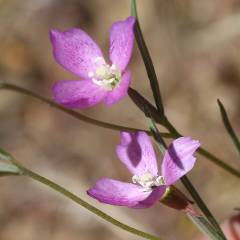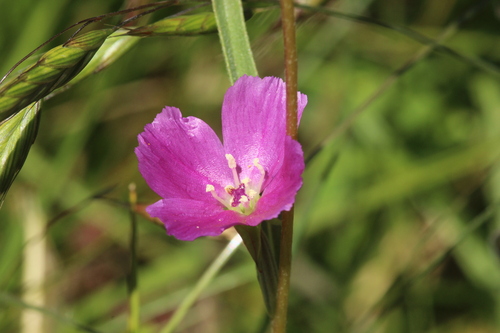
Clarkia, Genus, purpurea, Species,
- Genus & species
winecup clarkia
Western North America (California Floristic Province)
SunFull Sun
Overview
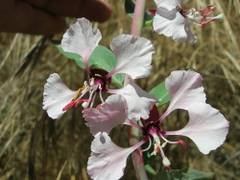
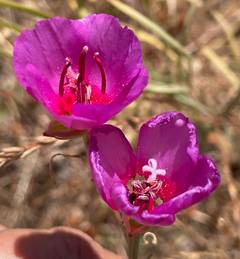
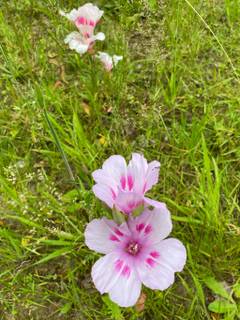
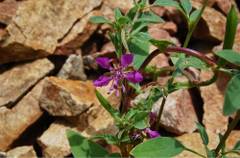
Clarkia purpurea is an annual wildflower in the evening primrose family, growing 8-24 inches (20-60 cm) tall on slender, often branched stems. Leaves are linear to lance-shaped, 1-2.5 inches (2.5-6 cm) long, arranged alternately and sometimes tinged red. The flowers have four fan-shaped petals, each 0.3-0.8 inch (8-20 mm) long, ranging from pink and lavender to deep purple and wine-red, frequently marked with a darker central blotch. Blooms open along the upper stem from late spring into summer. The cup- to bowl-shaped flowers give rise to the common name winecup clarkia. Seed develops in elongated four-chambered capsules that split to release numerous small seeds, allowing the plant to self-sow in open ground. It grows in dry, open habitats including grassland, oak woodland edges, and disturbed slopes, completing its life cycle within a single season. After seed set the plant dies back, leaving no structure for the rest of the year. Flowers attract native bees and other small pollinators. Plants tolerate poor, rocky soils but need full sun and sharp drainage; in rich or overwatered conditions stems grow lax and flowering is reduced.
Native Range
Native to western North America, from Washington and Oregon south through California into Baja California, Mexico.Suggested Uses
Used in wildflower meadows, native plant gardens, and dry sunny borders. Suited to naturalized plantings and seed mixes for open ground. Self-sows to form drifts where soil is left undisturbed.How to Identify
Appearance
Size & Dimensions
Height8" - 2'
Width/Spread4" - 1'
Bloom Information
Detailed Descriptions
Flower Description
pink to wine-purple, often with a darker central spotFoliage Description
green, sometimes red-tingedGrowing Conditions
Sun Requirements
Requires 6-8 hours of direct sunlight daily
• Full Sun: 6+ hours of direct sunlight
• Partial Shade: 3-6 hours of direct sunlight
• Full Shade: Less than 3 hours of direct sunlight
Water & Climate
Water Needs
Drought Tolerance
Drought tolerant when established
Care & Maintenance
Care Guide
Grows as a cool-season annual from seed sown in fall or early spring. Full sun and free-draining soil produce compact, well-flowered plants. Water is needed only to establish seedlings, and established plants tolerate dry conditions while declining in soggy soil. No fertilizer is required, and rich soil tends to produce lax, leggy growth. Plants complete their cycle and die by mid to late summer. Allowing seed capsules to mature supports self-sowing for the following season.Pruning
No pruning is required for this annual. Spent stems can be removed once seed has dropped if self-sowing is not wanted. Dried stems left in place allow seed to disperse naturally.Toxicity
Non-toxicPlanting Guide
Planting Methods & Timing
Planting Method
direct sow
Direct Sow Timing
fall or early spring
Days to Maturity
60–90 days
Plant Spacing
6 inches
Companion Planting
Good Companions