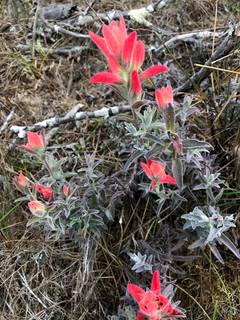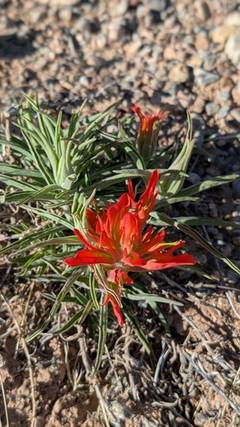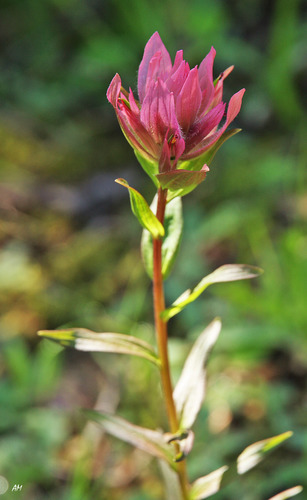
Castilleja, Genus, miniata, Species,
- Genus & species
common paintbrush
Western North America from Alaska to New Mexico
Overview
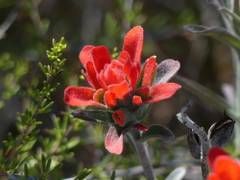
Castilleja miniata is a hemiparasitic herbaceous perennial reaching 12-30 inches (30-75 cm) tall and 8-12 inches (20-30 cm) wide, drawing water and nutrients from neighboring host plants through root-to-root haustorial connections. Stems are upright, often unbranched or with few branches near the top, with alternate lance-shaped leaves 1-3 inches (2.5-7.5 cm) long and 0.2-0.4 inch (5-10 mm) wide. The colored portion of the inflorescence consists of bright red to scarlet (occasionally orange, yellow, or pink) leafy bracts 0.6-1.5 inches (1.5-4 cm) long surrounding small greenish-yellow tubular corollas. Bloom occurs from May through September depending on elevation and moisture. Plants behave as short-lived perennials, often persisting 3-5 years in cultivation; longevity depends on host plant compatibility. Establishment from seed requires sowing alongside host species (commonly bunchgrasses or Eriogonum species) since seedlings cannot mature without root contact. Failure to establish in standard nursery culture is the principal challenge in cultivation.
Native Range
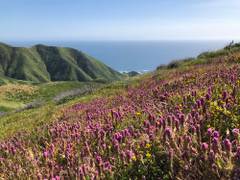
Native to western North America from Alaska through the Yukon and British Columbia south through Washington, Oregon, California, and the Rocky Mountain states to New Mexico and Arizona. Grows in moist meadows, montane and subalpine slopes, streambanks, and forest openings at elevations from 100 to 11,000 feet (30-3,400 m). Most populations occur on rich, seasonally moist soils with grass or forb cover.Suggested Uses
Used in native meadow plantings, dry slope restorations, and rock gardens combined with grass or Eriogonum hosts, spaced 12-18 inches (30-45 cm) apart. Plantings establish reliably only when seeded directly with native hosts; container-grown specimens transplanted into bare soil rarely persist beyond the first season. Common host plants include Festuca idahoensis, Bromus carinatus, and Eriogonum umbellatum.How to Identify
Appearance
Size & Dimensions
Height1' - 2'6"
Width/Spread8" - 1'
Bloom Information
Blooms May through September across the range. Low-elevation populations begin in May; subalpine populations bloom July through August. Individual inflorescences hold color for 4-6 weeks; total bloom on a clump extends 8-12 weeks. Hummingbirds visit flowers throughout the bloom period.
Detailed Descriptions
Flower Description
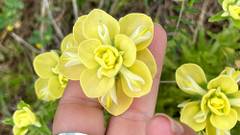
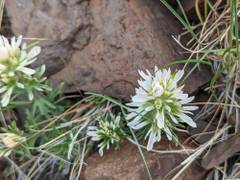
bright red to scarlet (occasionally orange, yellow, or pink)Foliage Description
greenGrowing Conditions
Sun Requirements
Requires 5-9 hours of direct sunlight daily
• Full Sun: 6+ hours of direct sunlight
• Partial Shade: 3-6 hours of direct sunlight
• Full Shade: Less than 3 hours of direct sunlight
Care & Maintenance
Care Guide
Seeds are sown in fall directly with native bunchgrass or Eriogonum hosts; nursery transplants establish poorly without host roots already in the planting site. Water during the first growing season alongside host plants; established plantings receive water on the host's schedule. Foliage browns and collapses after first hard frost; new shoots emerge in spring from the persistent crown. Few pest or disease problems occur. Soil chemistry should match the host's preferences (well-drained loam to sandy soil, pH 5.5-7.5). Powdery mildew can appear in humid summers but rarely affects long-term performance.Pruning
Spent flower stems are removed at the base after seed dispersal in autumn, or left in place for self-seeding within the host stand. Foliage dies back to the crown each winter and does not require cutting. Mid-season pruning damages the slow-growing crown and is not done.Pruning Schedule
Prune: October–November
fall