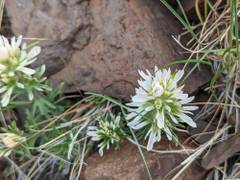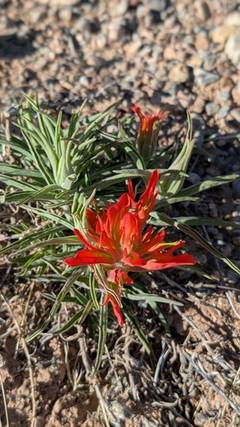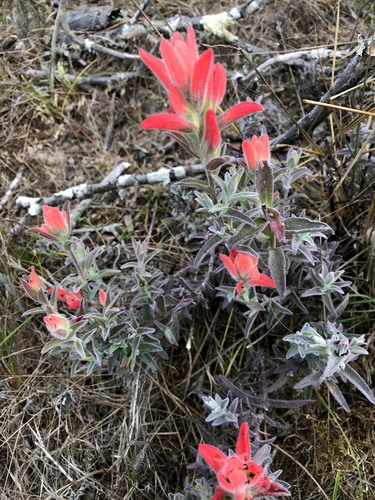
Castilleja, Genus, affinis, Species,
- Genus & species
coast paintbrush
California Floristic Province (coastal California and northern Baja California)
Overview
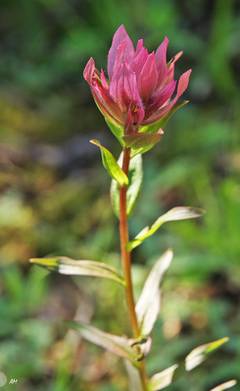
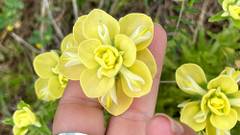
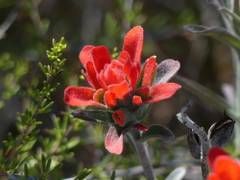
Castilleja affinis is a hemiparasitic perennial in the broomrape family, reaching 12-32 inches (30-80 cm) tall with an upright, sometimes sprawling habit. The true flowers are slender greenish tubes 0.6-1 inch (15-25 mm) long, largely hidden among the colored parts of the plant, which are the bracts and upper leaves tipped in red to orange-red. Stems often branch at the base and are covered in spreading hairs. Leaves are linear to lance-shaped, 0.8-2.8 inches (2-7 cm) long, the lower ones entire and the upper ones often divided into narrow lobes. Like other paintbrushes, it forms haustorial connections to the roots of neighboring plants and draws part of its water and nutrients from these hosts, which makes it hard to cultivate without compatible companions. It occurs on coastal bluffs, in chaparral, and in oak woodland from sea level to about 5,000 feet (1,500 m). Flowering plants are visited by hummingbirds, which act as the primary pollinators of the tubular flowers. The species is variable across its range, with several intergrading subspecies recognized along the California coast. Its dependence on host roots and specific soils limits its use to restoration plantings and native gardens where suitable hosts are already established.
Native Range
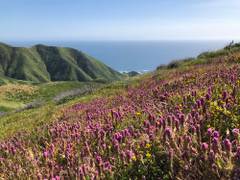
Native to the coastal regions of California, extending into northern Baja California, Mexico. It grows in coastal scrub, chaparral, and open woodland communities below about 5,000 feet (1,500 m).Suggested Uses
Used in California native plant gardens, coastal restoration projects, and pollinator plantings where compatible host plants are already growing. It suits naturalistic and meadow-style settings rather than formal beds because of its parasitic habit.How to Identify
Appearance
Size & Dimensions
Height1' - 2'8"
Width/Spread8" - 1'4"
Bloom Information
Flowers from March to June, with peak color in April and May along the California coast. The colored bracts persist for several weeks, longer than the short-lived tubular flowers they surround. Bloom timing shifts later at higher elevations and in cooler coastal sites.
Detailed Descriptions
Flower Description
greenish flowers with red to orange-red bractsFoliage Description
green, sometimes purple-tingedGrowing Conditions
Sun Requirements
Requires 6-10 hours of direct sunlight daily
• Full Sun: 6+ hours of direct sunlight
• Partial Shade: 3-6 hours of direct sunlight
• Full Shade: Less than 3 hours of direct sunlight