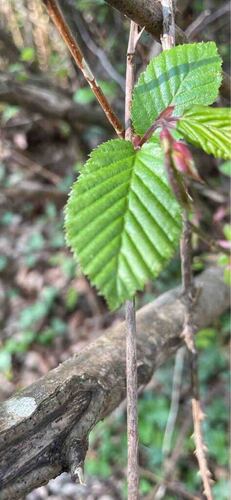
Carpinus, Genus, betulus, Species,
- Genus & species
European hornbeam
Europe and western Asia (England to the Caucasus and Iran)
Overview
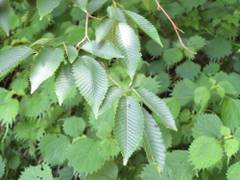
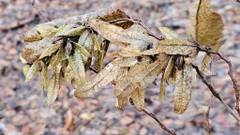
Carpinus betulus is a medium to large deciduous tree reaching 40–60 feet (12–18 m) tall with a spread of 30–40 feet (9–12 m). The crown is pyramidal when young and broadens to a rounded or ovoid canopy at maturity. The trunk is fluted — with irregular ridges and hollows along its length rather than the uniform round cross-section carried by most trees — and the bark is smooth, gray, and muscle-like in appearance, holding this character into old age without peeling. Leaves are ovate, 2–5 inches (5–13 cm) long, with prominent parallel veins and doubly serrate margins. Spring color is bright green, darkening to medium green in summer and turning yellow to orange-yellow in fall. The foliage is marcescent; dry, papery, tan-brown leaves persist through much of winter, most densely on lower branches and on hedged plants. This winter leaf retention turns the species into year-round screening when clipped as a hedge. Pendulous male catkins and small female catkins open in April–May. Fruit are small nutlets subtended by three-lobed leafy bracts in hanging clusters. Growth rate is moderate at 10–15 inches (25–38 cm) per year. The tree tolerates heavy pruning and has been used for formal hedges and pleaching in European gardens for centuries. The dense, hard wood has historically been used for tool handles, butcher blocks, and charcoal.
Native Range
Carpinus betulus is native across Europe and into western Asia, from England and Scandinavia south to the Mediterranean mountains and east to the Caucasus and Iran. It occurs in mixed broadleaf forests, often as an understory or coppice tree, on clay and loam soils from lowland to montane elevations.Suggested Uses
Used as a shade tree, street tree, and formal hedge. The tolerance of heavy pruning together with marcescent winter foliage has made the species a standard European hedging tree for centuries. Formal hedges supply year-round screening. Pleached allées and stilted hedges are traditional applications. The species functions as a street tree where 30–40 foot (9–12 m) width fits; 'Frans Fontaine' suits narrower sites at 12–18 feet (3.6–5.5 m) wide. The fluted trunk adds winter interest. Not grown in containers at tree size. Hedge spacing: 18–24 inches (45–60 cm); shade tree spacing: 25–35 feet (7.5–10.5 m).How to Identify
Appearance
Size & Dimensions
Height40' - 60'
Width/Spread30' - 40'
Bloom Information
Pendulous male catkins 1–3 inches (2.5–8 cm) long and small greenish female catkins open in April–May with or just before the emerging leaves. The catkins are wind-pollinated and carry no significant ornamental value. Hanging clusters of three-lobed leafy fruit bracts develop in late summer and persist into fall.
Detailed Descriptions
Flower Description
Greenish (inconspicuous catkins)Foliage Description
Bright green (spring), medium green (summer), yellow to orange-yellow (fall), tan-brown marcescent (winter)Growing Conditions
Sun Requirements
Requires 4-10 hours of direct sunlight daily
• Full Sun: 6+ hours of direct sunlight
• Partial Shade: 3-6 hours of direct sunlight
• Full Shade: Less than 3 hours of direct sunlight
Care & Maintenance
Care Guide
Plant in average, well-drained soil in full sun to partial shade. Tolerates a wide range of soil types including heavy clay, alkaline soils, and compacted urban conditions. Drought tolerance once established is higher than that of Fagus sylvatica. The species tolerates heavy pruning and responds well to hedging, pleaching, and formal shaping. No serious pest or disease problems in most regions; Japanese beetle, scale insects, and two-lined chestnut borer can occur. The deep fibrous root system competes less aggressively with nearby plantings than maple or beech roots, which allows underplanting.Pruning
For shade trees, prune in late winter to early spring before leaf emergence. Remove dead, crossing, or structurally weak branches. The species tolerates heavy pruning and can be maintained as a formal hedge at any height from 4 feet (1.2 m) upward. Hedges are clipped 2–3 times per season from June through August. Marcescent foliage is densest on hedged plants. Pleached forms are trained along a framework and clipped back annually on the side growth.Pruning Schedule
Prune: February–March
winterearly spring