Carpinus, Genus, cordata, Species,
- Genus & species
heartleaf hornbeam
Japan (Hokkaido, Honshu, Shikoku, Kyushu), Korea, northeastern China, Russian Far East; moist mixed broadleaf forests at 1,500–5,000 feet / 450–1,500 m
Overview
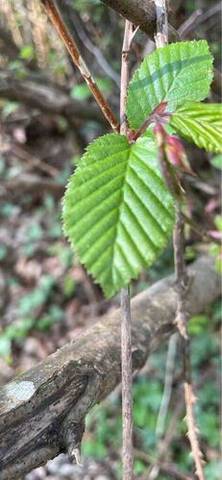
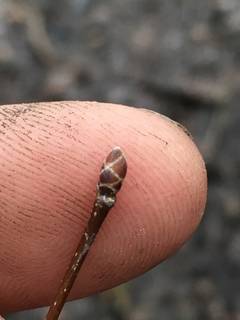
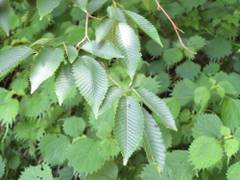
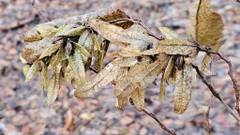
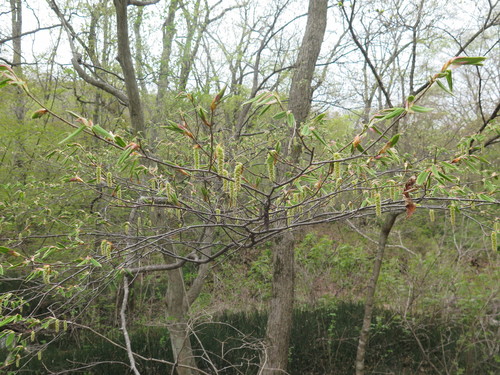
Carpinus cordata is a small to medium deciduous tree in the birch family (Betulaceae) reaching 25–40 feet (7.5–12 m) tall with a spread of 20–30 feet (6–9 m). The crown is broadly rounded to spreading with a short trunk and low branching. The species carries heart-shaped (cordate) leaves 3–6 inches (8–15 cm) long and 2–4 inches (5–10 cm) wide with deeply impressed, corrugated parallel veins that give the leaf surface a quilted texture visible at close range; the 3–6 inch leaf size is roughly twice the 1.5–3 inch (4–8 cm) leaf size of C. betulus and C. caroliniana, the two hornbeams more commonly encountered in North American and European cultivation. Leaf margins are doubly serrate. Spring growth is medium green, darkening to deep green through summer, and autumn color is yellow to russet-brown (less saturated than the orange-red autumn color of C. caroliniana). Bark is gray-brown with shallow vertical fissures that deepen with age, developing more bark character than mature C. betulus. Pendulous fruit clusters 3–5 inches (8–13 cm) long carry large overlapping bladder-like bracts resembling hops and are larger than the fruit clusters of other cultivated hornbeams. Growth rate is slow to moderate at 8–12 inches (20–30 cm) per year. The species tolerates deep shade, reflecting its origins as a midstory tree in mixed broadleaf forests. Nursery availability is limited in North America; specialist arboretum plant sales are a primary source.
Native Range
Carpinus cordata is native to Japan (Hokkaido, Honshu, Shikoku, and Kyushu), Korea, northeastern China, and the Russian Far East, where it occurs in moist mixed broadleaf forests at montane elevations of 1,500–5,000 feet (450–1,500 m). The species is an understory to midstory tree in its native forest communities.Suggested Uses
Grown as a specimen tree in woodland gardens, in arboretum collections, and at the edge of shaded border plantings at 15–25 foot (4.5–7.5 m) spacing. The large quilted-textured leaves carry bold foliage interest among finer-textured woodland companions such as Acer palmatum, Hamamelis, and ferns. Shaded moist sites that would produce poor results with most ornamental trees suit the species well. Hop-like fruit clusters extend seasonal interest into fall. Container culture is not suitable at mature size. Dry exposed sites and containers produce poor results.How to Identify
Appearance
Size & Dimensions
Height25' - 40'
Width/Spread20' - 30'
Bloom Information
Pendulous male catkins and small upright female catkins open in April–May with the emerging leaves. Pollination is by wind. Large hop-like pendant fruit clusters 3–5 inches (8–13 cm) long with overlapping bladder-like bracts develop through summer and persist into fall, carrying more visual interest than the smaller fruit clusters of C. betulus or C. caroliniana. Flowers themselves are not an ornamental feature; foliage and fruit clusters are the primary display.
Detailed Descriptions
Flower Description
Greenish, inconspicuous pendant male catkins and small upright female catkinsFoliage Description
Medium to deep green heart-shaped 3-6 inches with deeply corrugated parallel veins; yellow to russet-brown autumn colorGrowing Conditions
Sun Requirements
Requires 2-8 hours of direct sunlight daily
• Full Sun: 6+ hours of direct sunlight
• Partial Shade: 3-6 hours of direct sunlight
• Full Shade: Less than 3 hours of direct sunlight
Care & Maintenance
Care Guide
Grows in partial shade to full sun in moist well-drained humus-rich soil at pH 5.0–7.0. Hardy to zone 4. Deep shade is tolerated well, reflecting the species' forest-understory origins. Consistent soil moisture is required; the large leaves scorch on the margins under hot drying winds and drought stress. Sheltered sites and humus-rich woodland soils produce the strongest growth. Mature character takes 15–20 years to develop given the slow growth rate. The tree is difficult to source in the North American nursery trade; specialist arboretum plant sales and rare-plant nurseries are the main suppliers. No serious pest or disease problems are reported.Pruning
Prune in late winter to early spring (February–March) before bud break. Train to a single trunk for a conventional tree form or allow multi-stemmed development for a larger-textured shrub form. Remove crossing, dead, or damaged branches. The naturally spreading canopy requires minimal shaping. The species tolerates formative pruning but is not suitable for formal clipped hedging given the large leaf size.Pruning Schedule
Prune: February–March
winterearly spring