Cardamine, Genus, bulbosa, Species,
- Genus & species
bulbous cress
Overview
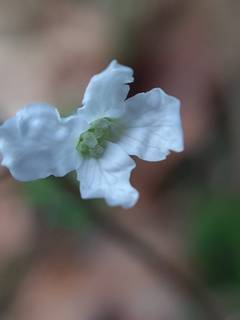
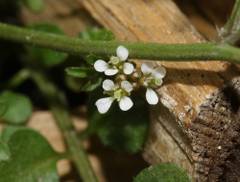
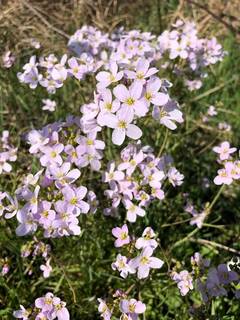
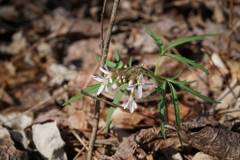
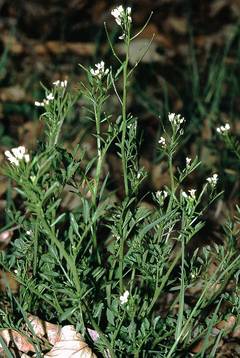
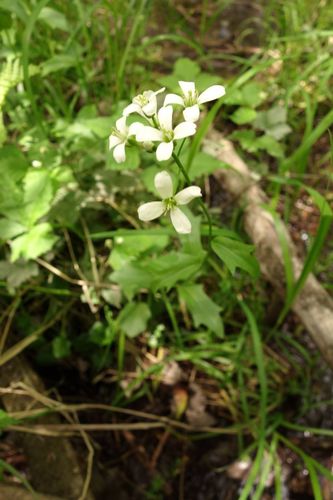
Cardamine bulbosa is a herbaceous perennial in the mustard family (Brassicaceae), growing from a small rounded tuber to 6–20 inches (15–50 cm) tall. It forms a rosette of long-stalked, rounded to heart-shaped basal leaves, while the upright flowering stem carries smaller, oblong, shallowly toothed leaves. In spring the stem ends in a compact raceme of white flowers, each with four petals and measuring about 0.4–0.6 inch (10–15 mm) across. Slender erect seedpods 0.8–1.2 inches (20–30 mm) long follow, splitting to release small seeds. The plant grows in consistently moist to wet ground — wet woodlands, spring seeps, streambanks, wet meadows, and calcareous fens — across eastern North America. Foliage emerges early and flowers before the tree canopy closes, then the plant often goes dormant by midsummer as soils dry, leaving a gap in the planting later in the season. The tuber, leaves, and stems have a peppery, cress-like flavor and have been eaten raw. It spreads slowly by seed and by offsets from the tuber, forming loose colonies in suitable wet habitat.
Native Range
Cardamine bulbosa is native to eastern North America, ranging from southern Quebec and Ontario south to Florida and Texas and west to the Great Plains. It is most frequent in moist, base-rich soils of the eastern deciduous forest region.Suggested Uses
Cardamine bulbosa is used in woodland gardens, rain gardens, and the moist margins of ponds and streams as a spring-flowering native. It supplies early nectar and pollen and serves as a larval host for the falcate orangetip butterfly. It naturalizes into loose colonies where soils remain reliably moist.How to Identify
Appearance
Size & Dimensions
Height6" - 1'8"
Width/Spread6" - 1'
Bloom Information
Flowers open from April through June, earliest in southern populations and in warm springs. Bloom on a colony lasts about 4–5 weeks, with white racemes carried just above the basal leaves. Pollination is by early-season bees and flies, after which the upright pods mature and the plant begins to die back.
Detailed Descriptions
Foliage Description
greenGrowing Conditions
Sun Requirements
Requires 2-6 hours of direct sunlight daily
• Full Sun: 6+ hours of direct sunlight
• Partial Shade: 3-6 hours of direct sunlight
• Full Shade: Less than 3 hours of direct sunlight