Camassia, Genus, leichtlinii, Species,
- Genus & species
great camas
Western North America from British Columbia to California
Overview
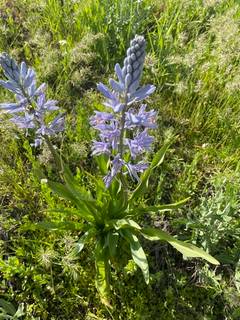
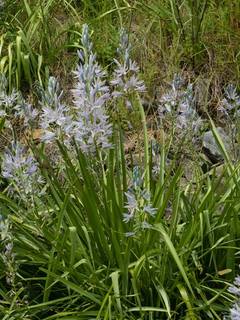
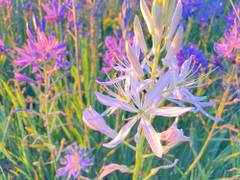
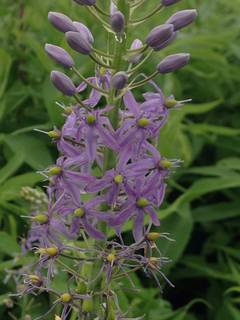
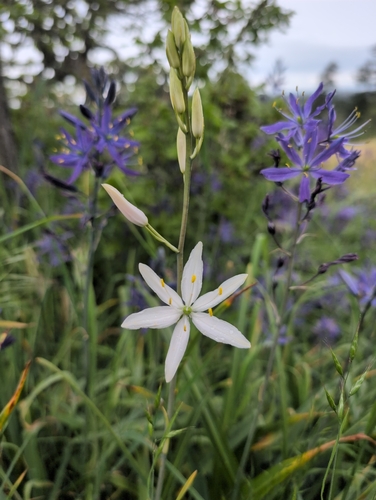
Camassia leichtlinii is a bulbous perennial reaching 24-48 inches (60-120 cm) tall in flower and 6-12 inches (15-30 cm) wide. Bulbs ovoid, 1-2 inches (2.5-5 cm) wide, with thin papery white outer scales. Basal leaves emerge in early spring, linear, 12-24 inches (30-60 cm) long and 0.4-0.8 inch (1-2 cm) wide, glabrous and dark green; foliage dies back to ground level by mid-summer. Flowering raceme leafless, with 12-50 star-shaped flowers opening sequentially from the base upward. Each flower 1.5-3 inches (4-7.5 cm) across with six blue, violet, or cream tepals; lower tepals slightly larger and held forward in C. leichtlinii ssp. leichtlinii, all six tepals symmetric in ssp. suksdorfii. Bloom April through June across the range. Capsules ovoid, 0.5-1 inch (1.3-2.5 cm), splitting in July to release flat black seeds. Plants spend July through September fully dormant underground. Lifespan 20-50 years on suitable sites; multiplies slowly by bulb offsets, producing 1-3 daughter bulbs per parent every 3-5 years.
Native Range
Native to western North America from southern British Columbia south through the Pacific Northwest, Coast Ranges, and Sierra Nevada to central California, east to Idaho and western Montana. Found in seasonally wet meadows, prairies, oak savanna, and open woodland clearings at sea level to 6,500 feet (2,000 m) elevation. Most populations occur in heavy soils with winter-spring saturation and summer drying.Suggested Uses
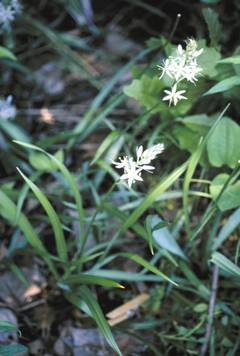
Planted in moist meadow, oak savanna, and prairie restoration plantings at 4-6 inch (10-15 cm) bulb spacing in zones 4-9. Used in native bulb lawns and pollinator gardens with seasonal soil moisture. Suitable for naturalizing in turf if mowing is delayed until foliage has yellowed in late June. Bulbs are reportedly edible when slow-cooked but raw bulbs of C. leichtlinii contain saponins and are difficult to distinguish from Toxicoscordion venenosum (death camas) when not in flower.How to Identify
Appearance
Size & Dimensions
Height2' - 4'
Width/Spread6" - 1'
Bloom Information
April through June across most of the range, with peak bloom in May at lower elevations and into July above 4,000 feet (1,200 m). Individual flowers last 4-6 days; total raceme bloom extends 2-3 weeks per plant. Bloom is reduced after dry winters and shifts later by 2-3 weeks following late-melting snowpack.
Detailed Descriptions
Flower Description
Blue, violet, or creamFoliage Description
Dark greenGrowing Conditions
Sun Requirements
Requires 4-10 hours of direct sunlight daily
• Full Sun: 6+ hours of direct sunlight
• Partial Shade: 3-6 hours of direct sunlight
• Full Shade: Less than 3 hours of direct sunlight
Care & Maintenance
Care Guide
Plants establish from dormant bulbs planted 4-6 inches (10-15 cm) deep in fall before winter rains. Mature plants require consistent moisture during the foliage growth period (March-May) and complete summer dryness during dormancy (July-September). Tolerates heavy clay and seasonally saturated soils. Few pest pressures occur on natural sites; gophers consume bulbs in lawn-irrigated settings. Self-seeds modestly in gravelly soil; seedlings reach flowering size in 4-6 years. Lifespan 20-50 years on suitable sites; populations expand slowly through bulb offsets.Pruning
Foliage is left to yellow naturally in June or July; cutting green leaves reduces bulb vigor for the following year. Spent flower scapes can be cut back to ground level after seed dispersal in late July or left to release seed in naturalistic meadow plantings.Pruning Schedule
Prune: July
summer
Container Growing
Suitable for container growing
Minimum container size: 2 gallons