Camassia, Genus, spp., Multiple species,
- Genus
- Multiple species
camas
North America, chiefly the western states and provinces
Overview
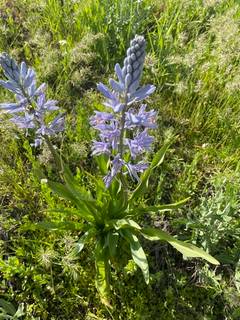
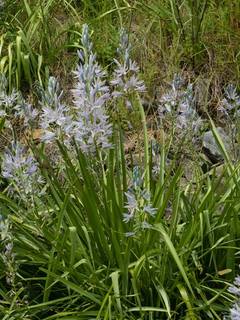
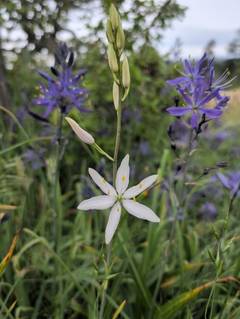
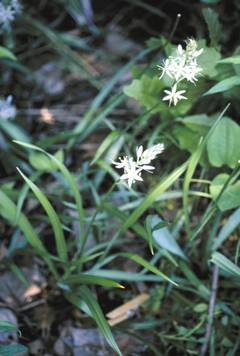
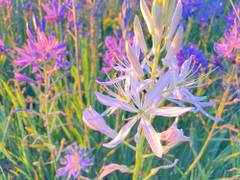
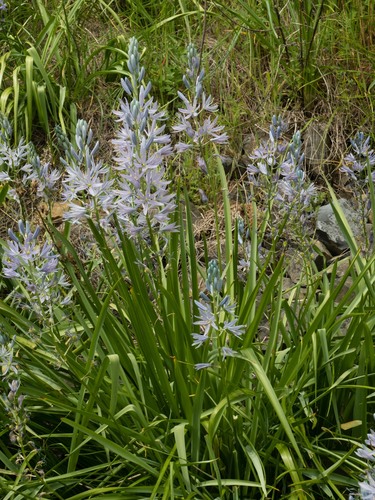
Camassia is a genus of about six species of bulbous perennials in the asparagus family (Asparagaceae), called camas or quamash and native to North America. Most species grow in the moist meadows, prairies, and streamsides of western North America, with one, C. scilloides, in the east. Each bulb sends up a clump of long, narrow, grass-like basal leaves in early spring, followed by an upright flowering stem 1 to 4 ft (30 to 120 cm) tall. The stem carries a tall raceme of star-shaped flowers, each with six narrow tepals in blue, violet, or, in some forms, white to cream, opening from the bottom up over two to three weeks in late spring. After bloom the foliage yellows and the plant goes dormant for the dry summer. The bulbs of C. quamash and C. leichtlinii were a staple food of Indigenous peoples of the Pacific Northwest, pit-roasted to turn their inulin into sweet sugars. The toxic death camas (Toxicoscordion species) grows in the same meadows and resembles camas out of bloom. Plants need moisture in spring but tolerate summer drought once dormant, and they naturalize into drifts where conditions suit.
Native Range
The genus is native to North America. Five species are western, ranging from British Columbia to California and east to the Rockies, while C. scilloides grows in the central and southeastern United States.Suggested Uses
Used in meadow and prairie plantings, moist borders, rain gardens, and naturalized drifts in grass. Camas pairs with late tulips and other spring bulbs and follows them into early summer. The species suit pollinator and native-plant gardens across much of North America.How to Identify
Appearance
Size & Dimensions
Height1' - 4'
Width/Spread6" - 1'
Bloom Information
Flowering comes in mid to late spring, roughly April to June depending on elevation and latitude. The lowest flowers on each spike open first, giving two to three weeks of bloom per plant. Seed pods then form as the foliage fades to dormancy.
Detailed Descriptions
Flower Description
blue, violet, white, and creamFoliage Description
greenGrowing Conditions
Sun Requirements
Requires 4-8 hours of direct sunlight daily
• Full Sun: 6+ hours of direct sunlight
• Partial Shade: 3-6 hours of direct sunlight
• Full Shade: Less than 3 hours of direct sunlight
Care & Maintenance
Care Guide
Plants grow in full sun to light shade in fertile soil that stays moist through spring, including heavy clay and seasonally wet ground. Once the foliage dies down they tolerate dry summers, matching their natural cycle. Bulbs are planted 4 to 6 in (10 to 15 cm) deep in autumn and left undisturbed to form clumps. They seed about freely and can also be divided as the leaves die back. No heavy feeding is needed beyond a little compost. Bulb-eating rodents are the main pest, and bulbs may rot in soil that stays wet all summer.Pruning
No pruning is needed beyond letting the foliage die back fully to feed the bulb. Spent flower stems can be cut after bloom to limit seeding, or left to self-sow. Crowded clumps are lifted and divided in late summer dormancy.Container Growing
Suitable for container growing
Minimum container size: 2 gallons