Camassia, Genus, cusickii, Species,
- Genus & species
Cusick's camas
Northeastern Oregon (Wallowa Mountains and surrounding valleys in Union, Wallowa, and Baker counties; moist meadows, stream margins, seasonally wet grasslands at 2,500–5,500 feet / 760–1,680 m)
Overview
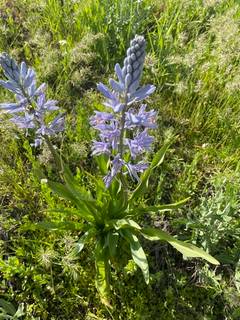
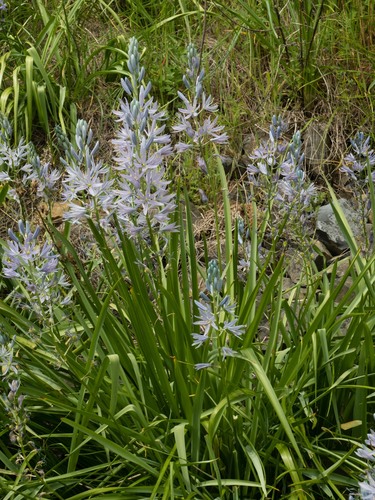
Camassia cusickii is a bulbous perennial in the asparagus family (Asparagaceae, subfamily Scilloideae) reaching 24–36 inches (60–90 cm) tall in flower with a basal foliage clump 12–18 inches (30–45 cm) wide. The plant grows from a large fleshy bulb 2–4 inches (5–10 cm) in diameter, which is larger than the 1–2 inch (2.5–5 cm) bulbs of C. quamash and roughly matches the bulb size of C. leichtlinii. A rosette of broad strap-shaped gray-green to blue-green basal leaves 12–20 inches (30–50 cm) long and 1–2 inches (2.5–5 cm) wide emerges in early spring; the 1–2 inch leaf width is greater than the 0.5–1 inch (1.3–2.5 cm) width of C. leichtlinii leaves and substantially greater than the narrow C. quamash foliage. Stout erect flower scapes rise in late April–May to 24–36 inches (60–90 cm), carrying dense racemes 8–16 inches (20–40 cm) long of 30–100 star-shaped pale steel-blue to lavender-blue flowers, each 1–1.5 inches (2.5–4 cm) across with 6 narrow tepals. Flowers open sequentially from the bottom of the raceme upward over 2–3 weeks. After flowering, the foliage yellows and goes dormant by midsummer, leaving a gap in the planting. Bulb offsets develop slowly, forming small colonies over 5–10 years. Hardy to zone 3. The dormancy gap creates bare ground from July onward unless interplanted with later-emerging perennials.
Native Range
Camassia cusickii is native to a restricted range in northeastern Oregon, primarily the Wallowa Mountains and surrounding valleys (Union, Wallowa, and Baker counties). It grows in moist meadows, along stream margins, and in seasonally wet grasslands at elevations of 2,500–5,500 feet (760–1,680 m). The species was named after William Conklin Cusick (1842–1922), a pioneer botanist of Oregon who documented the flora of the Wallowa Mountains region.Suggested Uses
Grown in naturalized meadow plantings, rain gardens, and the moist edges of mixed borders at 6–8 inch (15–20 cm) spacing with bulbs set 4–6 inches (10–15 cm) deep. Dense pale blue racemes carry in mass plantings among ornamental grasses and spring-blooming perennials, and the species suits wet-meadow restorations and wildlife gardens. Later-emerging companions such as Aster, Echinacea, and ornamental grasses cover the midsummer dormancy gap left by yellowing Camassia foliage. Cut stems hold well in arrangements. Container culture is not suitable given the large bulb size and summer dormancy.How to Identify
Appearance
Size & Dimensions
Height2' - 3'
Width/Spread1' - 1'6"
Bloom Information
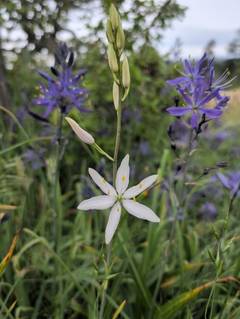
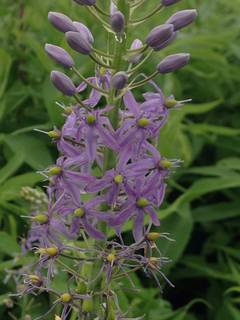
Dense racemes 8–16 inches (20–40 cm) long rise on stout scapes in late April–May. Each raceme carries 30–100 star-shaped pale steel-blue to lavender-blue flowers 1–1.5 inches (2.5–4 cm) across. Flowers open sequentially from the bottom of the raceme upward over 2–3 weeks. Capsules develop after flowering and hold small black seeds. Foliage yellows and enters dormancy by midsummer. Native bees and bumblebees pollinate the flowers.
Detailed Descriptions
Flower Description
Pale steel-blue to lavender-blue, star-shaped 1-1.5 inches with 6 tepals in dense racemes of 30-100 floretsFoliage Description
Gray-green to blue-green, broad strap-shaped 12-20 inches long and 1-2 inches wideGrowing Conditions
Sun Requirements
Requires 5-10 hours of direct sunlight daily
• Full Sun: 6+ hours of direct sunlight
• Partial Shade: 3-6 hours of direct sunlight
• Full Shade: Less than 3 hours of direct sunlight
Care & Maintenance
Care Guide
Plant bulbs 4–6 inches (10–15 cm) deep in fall in moist humus-rich soil in full sun to partial shade. Hardy to zone 3. The species grows naturally in seasonally wet meadows that hold moisture in spring and dry somewhat in summer, so spring soil moisture is required for strong flowering while summer irrigation is unnecessary once foliage yellows. No fertilization is required on reasonably fertile garden soil. The midsummer dormancy gap is covered by interplanting with later-emerging perennials or ornamental grasses. Bulbs are long-lived and do not require lifting or dividing unless colonies become congested after many years. Slugs may damage emerging spring foliage. No serious disease problems are reported.Pruning
Remove spent flower scapes after bloom if seed set is not wanted; leaving the scapes allows a small proportion of seedlings to establish in naturalistic meadow plantings, though seedlings are slow to reach flowering size (4–5 years). Foliage is allowed to yellow and wither naturally to replenish the bulb; green leaves are not cut because they are still feeding the bulb. Dried foliage is removed after it has fully withered, usually by late June or early July.Pruning Schedule
Prune: June
summer