Image 1 of 9
© No machine-readable author provided. Koba-chan assumed (based on copyright claims)., some rights reserved (CC-BY) · Wikimedia Commons
1 / 9
Callicarpa, Genus, japonica, Species,
- Genus & species
Japanese beautyberry
Overview
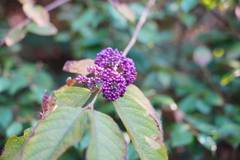
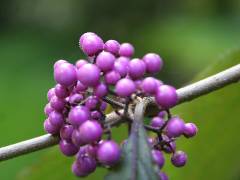
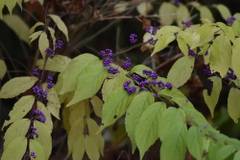
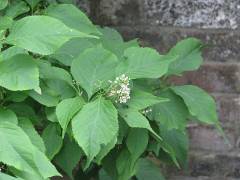
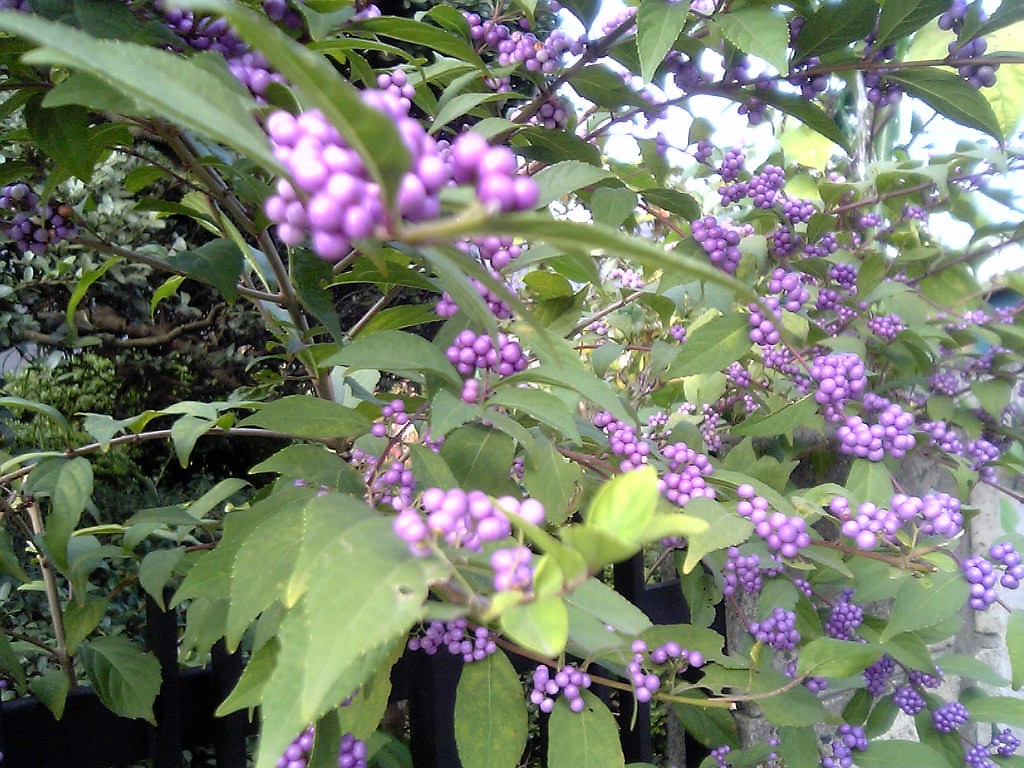
Callicarpa japonica is a deciduous shrub reaching 4-6 feet (1.2-1.8 m) tall and wide, with slender arching stems rising from a clumping base. Leaves are opposite, elliptic to obovate, 2-5 inches (5-12 cm) long, finely toothed, drawn out to a long tip, and nearly hairless on both surfaces; they turn pale yellow in October before dropping. Flowers are 0.15 inch (3-4 mm) across, pale pink to white, held in axillary clusters 1-1.5 inches (2.5-4 cm) wide in June and July. Fruit is a violet-purple drupe 0.15-0.2 inch (3-5 mm) across, carried in tight clusters at the leaf axils along the length of each stem, colouring in September and holding after the leaves fall until birds strip it between November and February. The form Leucocarpa carries white fruit. Flowers and fruit form on the current season's growth, so stems cut back to 6-12 inches (15-30 cm) in late winter still fruit that autumn. Fruit set falls away on isolated plants, and two or more plants within 15 feet (4.5 m) carry heavier clusters. Stems are killed back to the crown near -20F (-29C) and regrow to full height in one season.
Native Range
Callicarpa japonica is native to Japan, Korea, eastern China, and Taiwan, where it grows on woodland margins, in scrub, and along stream banks in hill country below 3,300 feet (1,000 m). It was introduced to Western gardens in the 1840s and is grown across temperate Europe and North America. Plants have naturalized locally in parts of the southeastern United States without spreading widely.Suggested Uses
Planted in groups of three or more at 4-5 foot (1.2-1.5 m) spacing in shrub borders and on woodland edges across USDA zones 5-8, where the autumn fruit sits above lower plantings. Cut stems in fruit hold their berries for 10-14 days indoors. Berries feed mockingbirds, robins, and finches from November into late winter, once frost has softened them.How to Identify
Appearance
Size & Dimensions
Height4' - 6'
Width/Spread4' - 6'
Bloom Information
Flowering runs 3-4 weeks in June and July, on shoots made earlier the same season. Each cluster holds 20-40 flowers 0.15 inch (3-4 mm) across, opening over about 10 days. Bees and small butterflies work the flowers, and the resulting fruit colours from September. Plants set little fruit when grown singly, while groups of three or more within 15 feet (4.5 m) carry heavier clusters.
Detailed Descriptions
Flower Description
Pale pink to whiteFoliage Description
Mid green turning pale yellow in autumnGrowing Conditions
Sun Requirements
Requires 4-10 hours of direct sunlight daily
• Full Sun: 6+ hours of direct sunlight
• Partial Shade: 3-6 hours of direct sunlight
• Full Shade: Less than 3 hours of direct sunlight
Care & Maintenance
Care Guide
Fruit set is heaviest at 6 or more hours of direct sun, while plants in shade below 4 hours grow leggy and carry scattered berries. Soils from sand to clay at pH 5.5-7.5 are tolerated, with free drainage counting for more than fertility. Water at 1 inch (25 mm) per week through the first two seasons; established plants hold through 3-4 weeks of dry weather, though leaves droop by mid-afternoon above 90F (32C). Fertilizer is generally unnecessary, and nitrogen raises leaf size while lowering fruit numbers. Few pests trouble the species, and root rot follows on ground that stays saturated through winter. Stems die back to the crown near -20F (-29C) and regrow to full height in a single season.Pruning
Cutting all stems to 6-12 inches (15-30 cm) in late winter, before growth resumes, renews the plant each year, and flowers and fruit follow on the new shoots the same season. Plants left uncut reach 6 feet (1.8 m) as a thicket of older stems carrying smaller fruit clusters. Taking a third of the oldest stems out at the base each year is an alternative that holds more height through winter. Cuts made after growth starts in April remove the flowering wood for that year.Pruning Schedule
Prune: February–March
early spring
Container Growing
Suitable for container growing
Minimum container size: 10 gallons