Callicarpa, Genus, americana, Species,
- Genus & species
American beautyberry
Southeastern United States and Caribbean
Overview
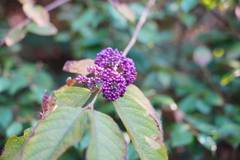
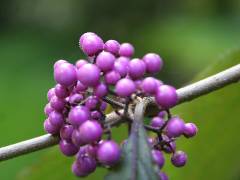
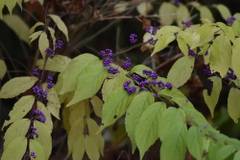
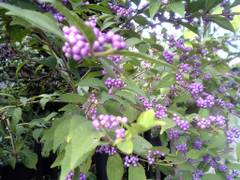
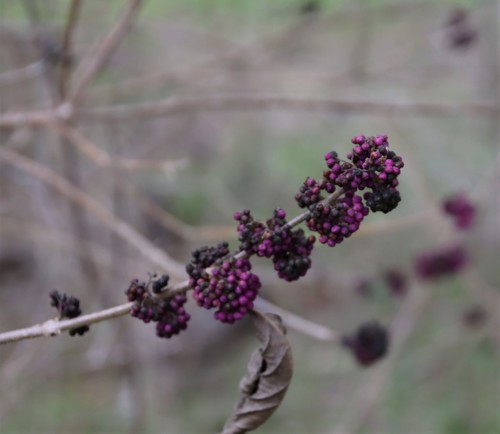
Callicarpa americana is a deciduous shrub reaching 3-8 feet (90-240 cm) tall and 4-6 feet (1.2-1.8 m) wide, with a loose, open, arching habit. Stems are slender and woody at the base, becoming somewhat lax with age. Leaves are opposite, ovate to elliptic, 3-6 inches (7.5-15 cm) long, with serrated margins and a soft, slightly fuzzy texture; foliage is yellow-green in summer and turns pale yellow before dropping in autumn. Small lavender to pink flowers in tight axillary cymes appear along the stems from June through August. Bright magenta-purple berries 0.16-0.24 inch (4-6 mm) across form in tight, ringed clusters around the stems beginning in August and persist into November or until consumed by birds. White-fruited forms (var. lactea) and pink-fruited forms occur in cultivation. Foliage extracts contain callicarpenal and have documented mosquito-repellent activity in laboratory studies. Plants tolerate seasonal flooding but show stem dieback below 0°F (-18°C) and may die back to the ground in zone 6. Stems become open and sparse without periodic renewal pruning.
Native Range
Callicarpa americana is native to the southeastern United States from Maryland and Virginia south to Florida, west to Texas and Oklahoma, and is also found in Bermuda, Cuba, and the Bahamas. Occurs as an understory shrub in moist deciduous forests, swamp margins, hardwood hammocks, and along forest edges in sandy or loamy soils, typically below 1,500 feet (450 m) elevation.Suggested Uses
Used in shrub borders, woodland edge plantings, and naturalistic landscapes, spaced 4-6 feet (1.2-1.8 m) apart. Berries are eaten by mockingbirds, finches, robins, and other songbirds from October through December. Container culture in pots of at least 10 gallons (38 L) is feasible in zones 6-9 with consistent moisture.How to Identify
Appearance
Size & Dimensions
Height3' - 8'
Width/Spread4' - 6'
Bloom Information
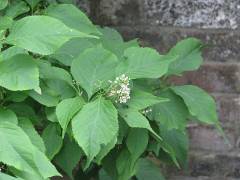
Small lavender to pink flowers in tight axillary clusters open from June through August in zones 6-9. Individual flowers are 0.1-0.16 inch (3-4 mm) across, with bloom progressing along new growth. Peak bloom lasts 4-6 weeks, followed by berry development that becomes visible in late August. In zone 10, flowering may begin in late May and finish by mid-July.
Detailed Descriptions
Flower Description
Lavender to pinkFoliage Description
Yellow-green in summer, pale yellow in fallGrowing Conditions
Sun Requirements
Requires 4-8 hours of direct sunlight daily
• Full Sun: 6+ hours of direct sunlight
• Partial Shade: 3-6 hours of direct sunlight
• Full Shade: Less than 3 hours of direct sunlight
Care & Maintenance
Care Guide
Water weekly during the first growing season; established plants tolerate 3-4 weeks of drought in zones 6-9 but produce smaller berry yields under prolonged drought. The species tolerates seasonal flooding for 1-2 weeks. Sites with consistent organic mulch 2-3 inches (5-7.5 cm) deep maintain soil moisture and reduce water stress. Few significant pests or diseases occur in cultivation; powdery mildew may develop in deep shade. Plants typically live 15-25 years before stems become open and woody, at which point hard renewal pruning regenerates the form.Pruning
Cut stems back to 12 inches (30 cm) above ground in late winter or very early spring; flowers and berries form on new wood, so this hard pruning does not reduce fruiting. Without annual pruning, plants develop an open, leggy habit by 4-5 years. Light shaping during the growing season can be done after summer flowering.Pruning Schedule
Prune: February–March
winterearly spring
Container Growing
Suitable for container growing
Minimum container size: 10 gallons