Callicarpa, Genus, spp., Multiple species,
- Genus
- Multiple species
beautyberries
Asia, the Americas, Australia, and the Pacific
Overview
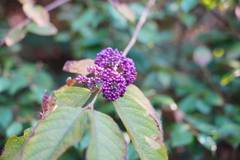
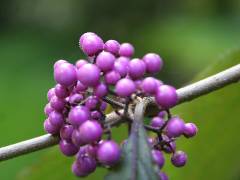
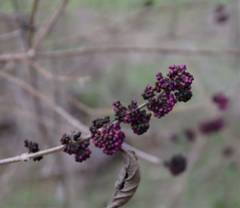
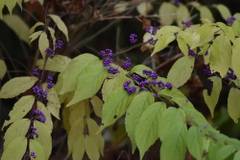
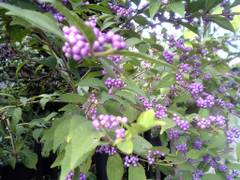
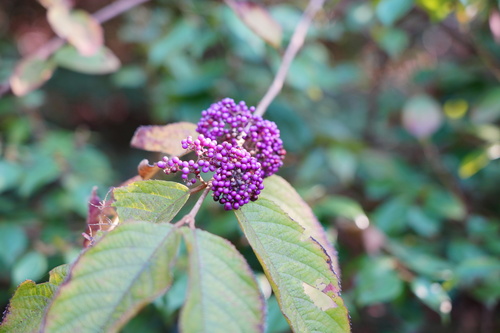
Callicarpa is a genus of about 140 species of shrubs and small trees in the family Lamiaceae, found in eastern and southern Asia, the Americas, Australia, and the Pacific islands. Most cultivated species are deciduous shrubs reaching 3-8 feet (0.9-2.4 m) tall and wide, with arching or upright branches carrying paired oval to lance-shaped leaves 2-6 inches (5-15 cm) long. Small flowers in tight clusters open along the stems in summer in shades of pink, lilac, or white, each cluster held where a leaf meets the stem. The flowers are followed in autumn by dense clusters of rounded berries 0.1-0.2 inch (3-5 mm) across, most often bright violet to magenta-purple, though some species and cultivars bear white fruit. The berries persist on bare stems after the leaves drop and are eaten by birds through autumn and winter. Foliage of several species turns pale yellow before falling. C. americana is native to the southeastern United States, while C. bodinieri and C. dichotoma come from China and Japan. Most species flower and fruit on new growth, so a hard pruning in late winter does not sacrifice the autumn fruit display, though it reduces the overall size of the framework.
Native Range
Callicarpa is native across warm-temperate and tropical regions of Asia, the Americas, Australia, and the Pacific. C. americana grows wild in the southeastern United States and the Caribbean, while several widely grown ornamental species originate in China, Japan, and Korea.Suggested Uses
Grown in shrub borders, wildlife gardens, and mixed plantings for the autumn berry clusters and as a food source for birds. Plants can be grouped to intensify the fruit display, since cross-pollination improves berry set in some species. The arching forms also suit woodland edges and informal hedges.How to Identify
Appearance
Size & Dimensions
Height3' - 8'
Width/Spread3' - 8'
Bloom Information
Flowering occurs in summer, roughly June to August, with small pink, lilac, or white flowers clustered in the leaf axils. The flower display is modest, as the individual blooms are small and partly hidden by foliage. The berries that follow are the main season of interest, coloring from late summer and persisting into winter.
Detailed Descriptions
Flower Description
pink to lilac, sometimes whiteFoliage Description
greenGrowing Conditions
Sun Requirements
Requires 6-10 hours of direct sunlight daily
• Full Sun: 6+ hours of direct sunlight
• Partial Shade: 3-6 hours of direct sunlight
• Full Shade: Less than 3 hours of direct sunlight
Water & Climate
Water Needs
Drought Tolerance
Drought tolerant when established
Care & Maintenance
Care Guide
Most species grow in full sun to part shade in moist, well-drained soil and tolerate a range of soil types once established. Flowering and fruiting are heaviest in full sun. The hardiest species, such as C. dichotoma and C. bodinieri, are generally hardy in USDA zones 5-8, while C. americana suits zones 6-10. In colder areas the stems may die back in winter and regrow from the base in spring. Water regularly through the first growing season to establish the roots, after which most species tolerate short dry spells. Fruiting drops off when plants are grown in deep shade.Pruning
Prune in late winter or early spring, since the flowers and fruit form on the current season's growth. Cut stems back by one-third to one-half, or close to the base in cold climates where the wood dies back, to keep a compact framework. Remove weak or crossing branches at the same time.Container Growing
Suitable for container growing
Minimum container size: 5 gallons