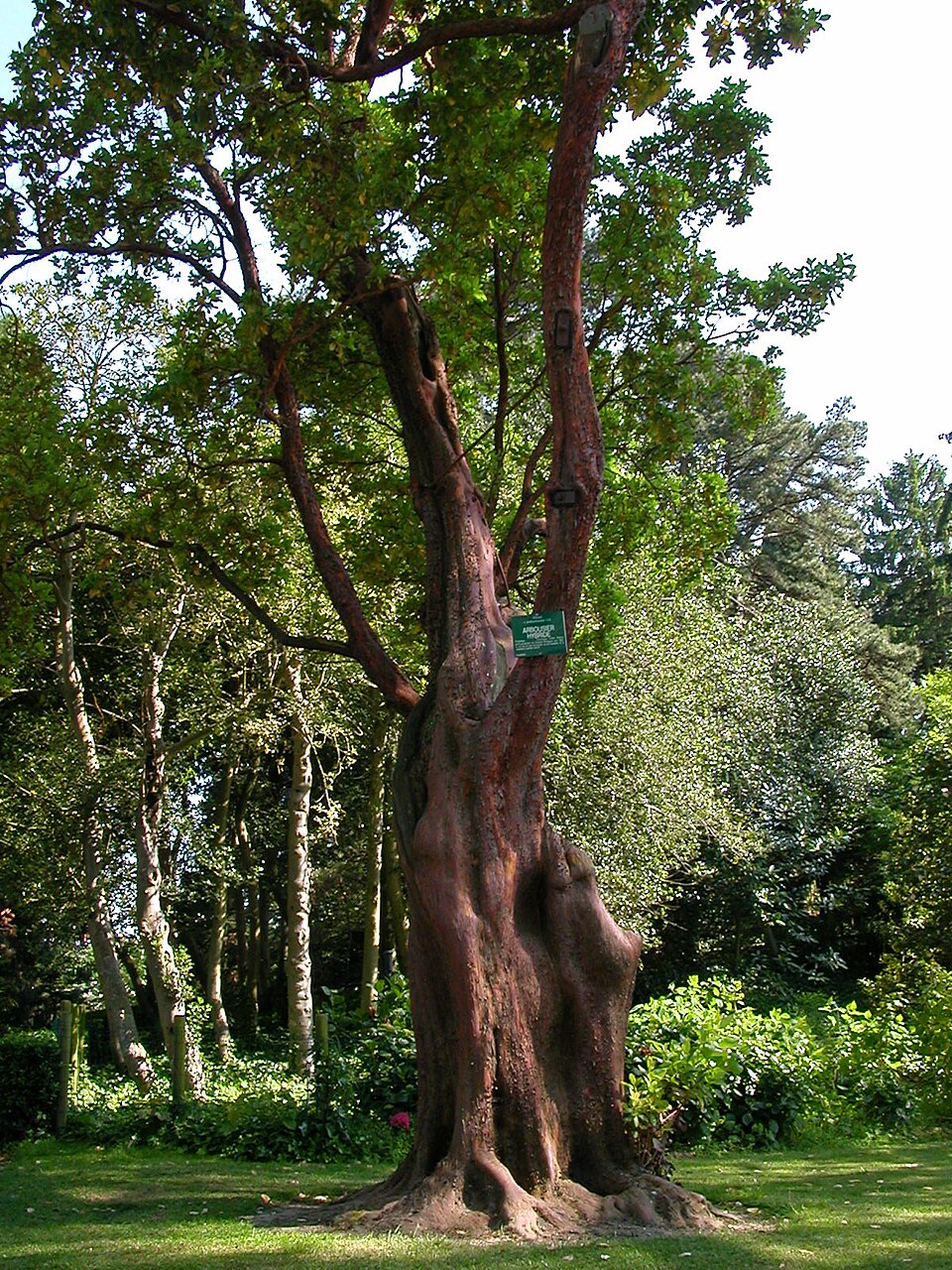
© Pymouss44, some rights reserved (CC-BY-SA) · Wikimedia Commons
Arbutus × andrachnoides
hybrid strawberry-tree
Overview
Arbutus x andrachnoides is an evergreen tree or large shrub of natural hybrid origin between the strawberry tree A. unedo and the Greek strawberry tree A. andrachne. It grows 15–30 feet (4.5–9 m) tall with a rounded, often multi-stemmed crown and reddish-brown bark that peels in thin flakes to reveal smooth cinnamon-colored new bark. The leathery, glossy dark green leaves are 2–4 inches (5–10 cm) long with finely toothed margins. Clusters of small white, urn-shaped flowers hang in drooping panicles, appearing mainly in late autumn to early spring depending on the season. Unlike A. unedo, the hybrid sets little or no fruit, so the warty red berries typical of that parent are rare. It grows in full sun to part shade on free-draining, slightly acid to neutral soils and tolerates heat, wind, and some drought once established. It is hardier than A. andrachne but slower to establish, and young plants are damaged by hard frost, limiting it to about USDA zone 8. Root disturbance and waterlogged soil are poorly tolerated.
Native Range
Arbutus x andrachnoides occurs naturally in the eastern Mediterranean, especially Greece and the Aegean, wherever A. unedo and A. andrachne grow together. It is also widely planted in mild-temperate gardens.Suggested Uses
Used as a specimen or small shade tree in Mediterranean-climate and mild coastal gardens, grown for its bark and evergreen canopy, spaced 12–20 feet (3.6–6 m) apart. Suited to dry slopes, courtyards, and water-conserving plantings. Its frost sensitivity and slow establishment limit use in colder inland gardens.How to Identify
Appearance
Size & Dimensions
Height15' - 30'
Width/Spread15' - 25'
Reaches mature size in approximately 15 years
Bloom Information
Small white urn-shaped flowers hang in panicles mainly from late autumn into early spring, with timing shifting between October and March by region and season. Flowering on this hybrid is irregular from year to year. Because fruit set is sparse, the simultaneous flower-and-fruit display of A. unedo rarely occurs.
Detailed Descriptions
Foliage Description
glossy dark greenGrowing Conditions
Sun Requirements
Requires 6-10 hours of direct sunlight daily
• Full Sun: 6+ hours of direct sunlight
• Partial Shade: 3-6 hours of direct sunlight
• Full Shade: Less than 3 hours of direct sunlight
Care & Maintenance
Care Guide
Growth is strongest in full sun to part shade on free-draining, slightly acid to neutral soil, including poor and rocky ground. Water during the first two or three years establishes the roots, after which the tree tolerates heat, wind, and moderate drought. Waterlogged or heavy clay soils cause root rot, and the plant resents transplanting once established. No routine feeding is needed on average soils. Hardiness reaches about USDA zone 8, with young plants needing shelter from hard frost. The peeling bark needs no maintenance and is left intact.Pruning
Little pruning is needed beyond removing dead, damaged, or crossing branches in late spring after flowering. Light shaping of young plants encourages a single trunk or a balanced multi-stemmed form. Hard cutting into old wood is generally limited, as the hybrid is slow to regrow from mature stems.Pruning Schedule
J
F
M
A
M
J
J
A
S
O
N
D
late spring