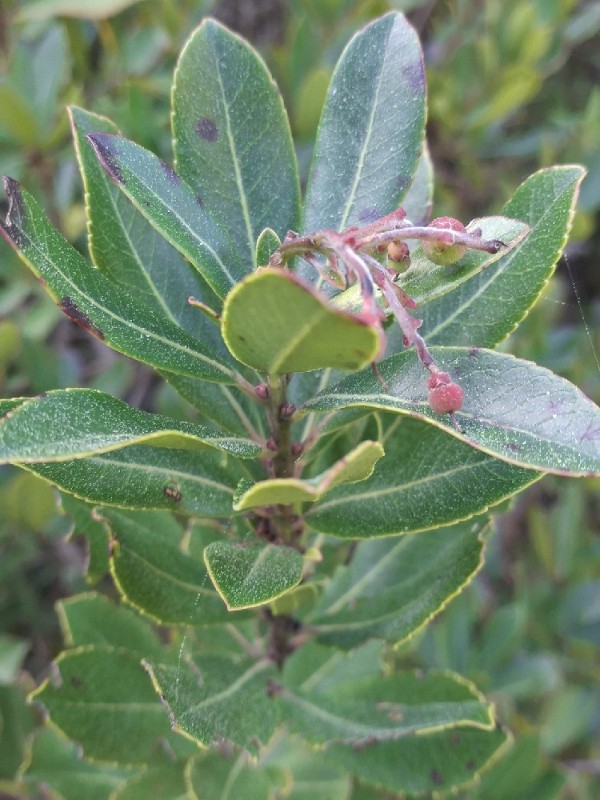
Arbutus, Genus, spp., Multiple species,
- Genus
- Multiple species
madrones
Mediterranean and western Europe; western North America to Central America
Overview
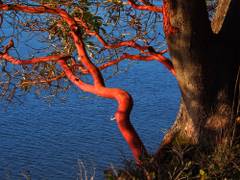
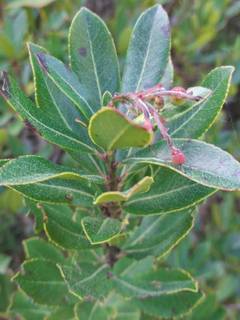
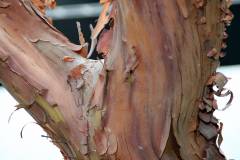
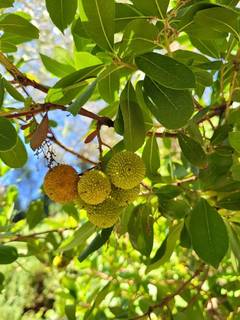
Arbutus is a genus of about 12 evergreen trees and shrubs in the family Ericaceae, found in two main centres: the Mediterranean and western Europe, and western North America south into Mexico and Central America. Plants range from multi-stemmed shrubs to trees 15–80 ft (4.5–25 m) tall across the genus, with several species, notably A. menziesii, shedding their thin outer bark each year to reveal smooth, reddish to cinnamon-coloured trunks beneath. The leathery, oval leaves are 2–6 in (5–15 cm) long, glossy dark green above and paler below, with finely toothed or smooth margins. Drooping clusters of small, urn-shaped white to pink flowers open in autumn or spring depending on species. These ripen into round, warty, red to orange fruit 0.5–0.8 in (1.5–2 cm) across that resemble small strawberries; the fruit is edible but bland in most species. Arbutus grows in full sun to light shade on well-drained, often rocky or acidic soils in USDA zones 7–10, and many species are drought-tolerant once established. The trees can be slow to establish, are intolerant of root disturbance, and some, such as A. menziesii, are prone to leaf and twig fungal diseases in cultivation.
Native Range
Arbutus occurs in two widely separated regions. A. unedo and A. andrachne grow around the Mediterranean and along the Atlantic fringe of western Europe, while A. menziesii, A. arizonica, and A. xalapensis range from British Columbia through the western United States into Mexico and Central America. The trees grow in chaparral, oak woodland, rocky slopes, and coastal forest.Suggested Uses
Arbutus is grown as a specimen and small shade tree, a screen, or a multi-stemmed feature where the peeling bark is shown off, and A. unedo is also used for informal hedging and containers. The drought-tolerant species suit Mediterranean, coastal, and water-wise gardens. The flowers support bees and the fruit feeds birds and other wildlife.How to Identify
Appearance
Size & Dimensions
Height15' - 80'
Width/Spread15' - 40'
Bloom Information
Flowering varies by species: the Mediterranean A. unedo blooms in autumn, often carrying flowers and the previous year's ripening fruit at once, while A. menziesii and other American species flower in spring. The urn-shaped flowers hang in branched clusters for several weeks and draw bees. Fruit ripens roughly a year later in autumn-flowering species and within the same season in others.
Detailed Descriptions
Flower Description
white to pinkFoliage Description
dark greenGrowing Conditions
Sun Requirements
Requires 6-12 hours of direct sunlight daily
• Full Sun: 6+ hours of direct sunlight
• Partial Shade: 3-6 hours of direct sunlight
• Full Shade: Less than 3 hours of direct sunlight
Water & Climate
Water Needs
Drought Tolerance
Drought tolerant when established
Care & Maintenance
Care Guide
Arbutus grows in full sun to light shade on well-drained, often gritty or acidic soil, and most species tolerate drought, heat, and poor ground once established. Sharp drainage is needed, as the roots are prone to rot in heavy or waterlogged soil. Young plants establish slowly and are intolerant of having their roots disturbed, so they are set out small and left in place. A. unedo adapts to a wide range of garden conditions, while A. menziesii is exacting and often declines under irrigation and summer water. Hardiness spans USDA zones 7–10 across the genus. Propagation is by seed or by semi-ripe cuttings, which root slowly.Pruning
Little pruning is needed beyond removing dead, damaged, or crossing branches in late winter. The multi-stemmed species can be thinned to show the bark, while shrubby forms tolerate light shaping. Heavy cutting into old wood is avoided, as regrowth is slow and uneven.Pruning Schedule
Prune: February
winter
Container Growing
Suitable for container growing
Minimum container size: 10 gallons