Overview
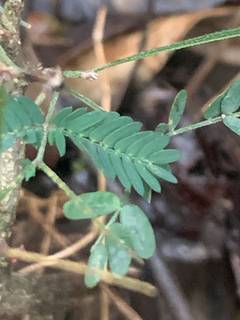
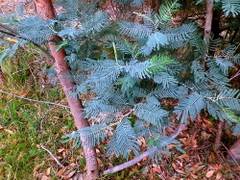
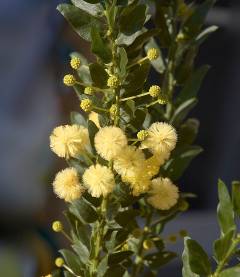
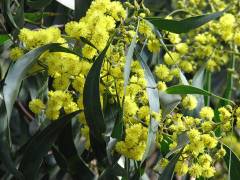
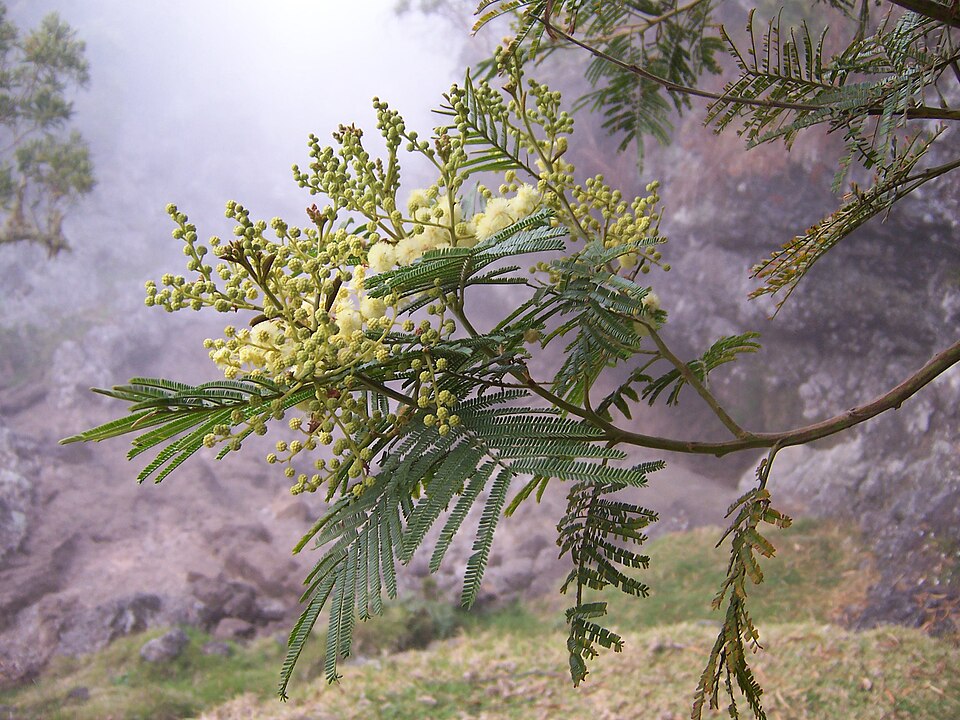
Acacia mearnsii is a fast-growing evergreen tree reaching 6-15 m (20-50 ft) tall, with a spreading crown and dark fissured bark. Unlike many wattles, it keeps true bipinnate leaves throughout life rather than developing flattened phyllodes; the dark green feathery fronds are 8-12 cm (3-4.7 in) long with many small leaflets and a raised gland at each pair of pinnae. In late spring and summer it bears abundant rounded heads of pale yellow to cream flowers, each head 5-6 mm (0.2 in) wide, massed in branched sprays and lightly fragrant. Flat dark brown pods 5-10 cm (2-4 in) long follow, constricted between the seeds. It grows naturally in open forest and on disturbed ground in southeastern Australia and is cultivated worldwide for the tannin in its bark. The same vigour makes it a serious environmental weed outside its native range; A. mearnsii is listed among invasive species in South Africa, parts of Europe, and other regions, where it forms dense thickets. It is short-lived, often declining after 15-20 years.
Native Range
Native to southeastern Australia, including New South Wales, Victoria, Tasmania, and South Australia, in open forest, woodland, and along watercourses and disturbed margins. It has been planted and has naturalised widely in Africa, Asia, South America, and Europe.Suggested Uses
Grown in forestry and farm plantings for tannin, fuel wood, and shelter, and used for quick shade and nitrogen-fixing on poor soils. Outside its native range its weed risk restricts where it is planted.How to Identify
Appearance
Size & Dimensions
Height20' - 50'
Width/Spread13' - 26'
Bloom Information
Pale cream to yellow globular flower heads appear in late spring and summer, roughly October to January, in large branched sprays. They are lightly fragrant and rich in pollen. Flowering is heavy in most years and followed by abundant seed pods.
Detailed Descriptions
Flower Description
Pale yellow to creamFoliage Description
Dark greenGrowing Conditions
Sun Requirements
Requires 6-12 hours of direct sunlight daily
• Full Sun: 6+ hours of direct sunlight
• Partial Shade: 3-6 hours of direct sunlight
• Full Shade: Less than 3 hours of direct sunlight