Acacia, Genus, falcata, Species,
- Genus & species
sickle wattle
Overview
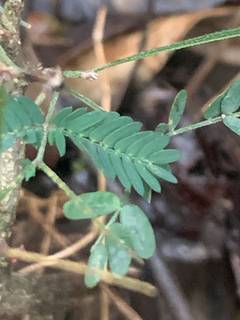
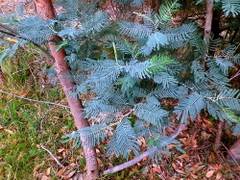
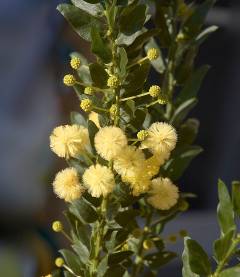
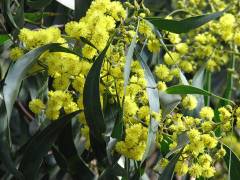
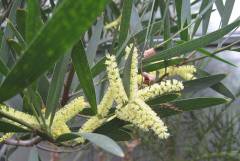
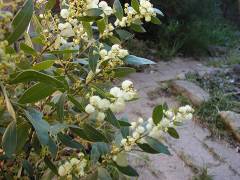
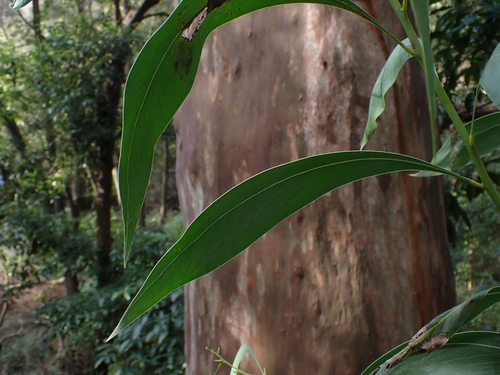
Acacia falcata is an evergreen shrub or small tree reaching 6-16 feet (2-5 m) tall and 6-13 feet (2-4 m) wide, with an open, upright to slightly spreading crown. Like most Australian wattles, it bears flattened leaf-like phyllodes rather than true leaves; these are sickle-shaped, 2.5-6 inches (6-15 cm) long and 0.4-1.2 inches (1-3 cm) wide, grey-green to blue-green, with a single prominent vein and a small gland on the upper margin. Pale cream to light yellow flowers are packed into globular heads about 0.2 inch (5 mm) across, grouped in branched clusters from the phyllode axils. Flowering occurs in autumn and winter, followed by flat, curved seed pods 2-4 inches (5-10 cm) long that ripen from green to brown. As a legume it fixes atmospheric nitrogen through root nodules. Growth is fast in the first few years, and plants are typically short-lived, declining after 10-15 years. It tolerates poor and clay soils but is sensitive to prolonged waterlogging.
Native Range
Native to eastern Australia, occurring in Queensland and New South Wales. Grows in open eucalypt forest and woodland on clay and shale-derived soils, from near the coast to the lower tablelands below about 2,600 feet (800 m).Suggested Uses
Used in revegetation, windbreak, and habitat plantings on clay soils, and as a fast-growing screen spaced 6-10 feet (1.8-3 m) apart. Suited to native and low-water gardens where a short-lived nitrogen-fixing shrub is wanted. Autumn and winter flowering is a pollen source for bees when other forage is limited.How to Identify
Appearance
Size & Dimensions
Height6' - 16'
Width/Spread6' - 13'
Colors
Bloom Information
Detailed Descriptions
Flower Description
pale cream to light yellowFoliage Description
grey-greenGrowing Conditions
Sun Requirements
Requires 5-10 hours of direct sunlight daily
• Full Sun: 6+ hours of direct sunlight
• Partial Shade: 3-6 hours of direct sunlight
• Full Shade: Less than 3 hours of direct sunlight
Care & Maintenance
Care Guide
Grows in full sun to part shade on a wide range of soils, including heavy clay, where drainage is not permanently waterlogged. Water during establishment; once established it tolerates extended dry periods. As a nitrogen-fixing legume it grows on low-fertility soils without added fertilizer. Borers and gall-forming insects can affect stressed plants. It regenerates from seed after fire or disturbance and may self-sow in cultivation. Plants are short-lived, declining after 10-15 years, and are periodically replaced.Pruning
Tip-prune from an early age to encourage a denser, branched habit. Light pruning after flowering maintains shape, while hard pruning into bare wood often fails to reshoot. Remove dead or borer-damaged wood as it appears.Pruning Schedule
Prune: July–August
winter