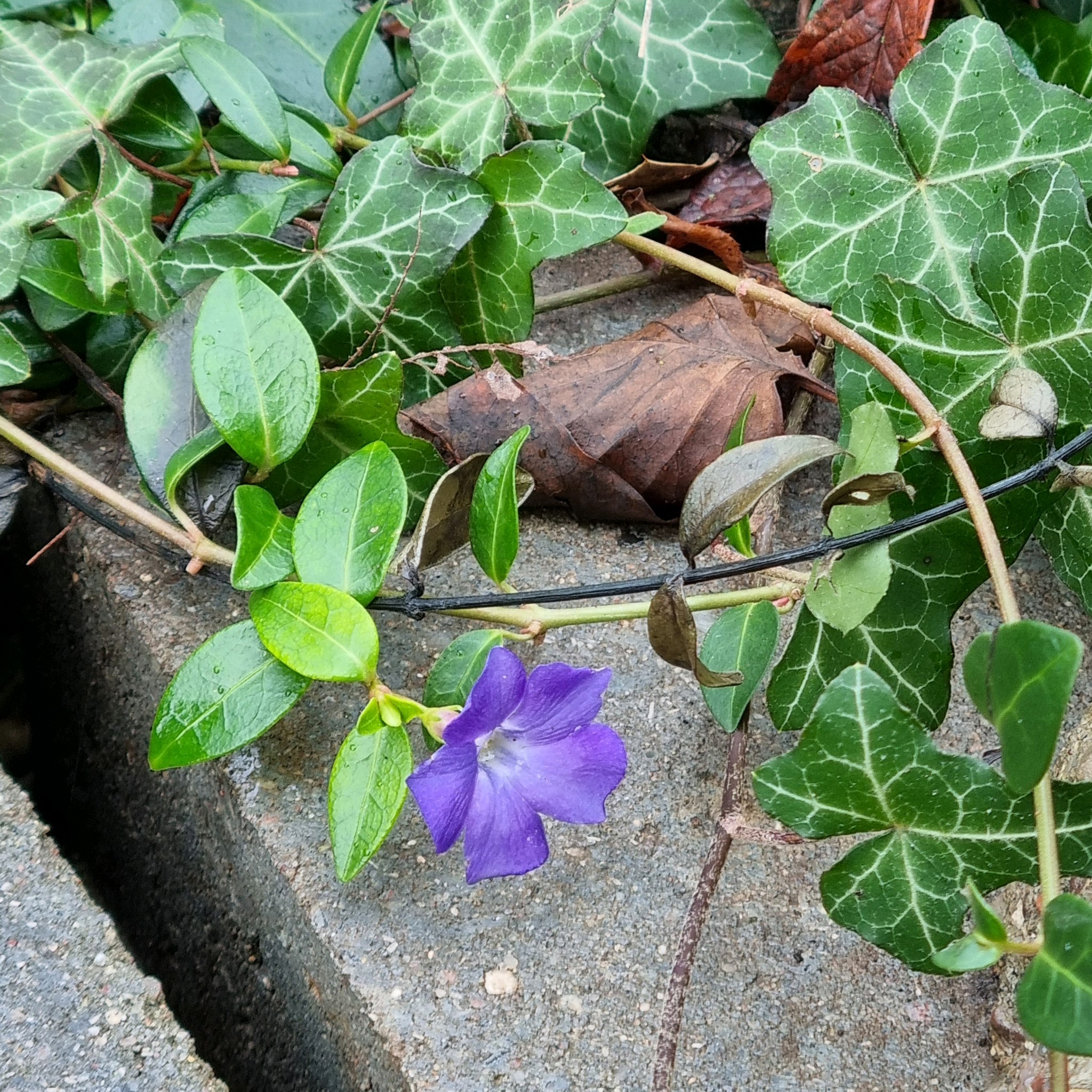
Vinca, Genus, spp., Multiple species,
- Genus
- Multiple species
periwinkles
Europe, northwest Africa, and southwest Asia
Overview
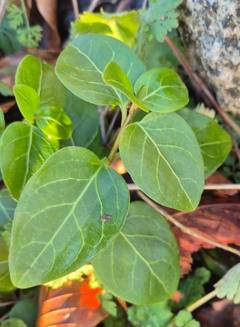
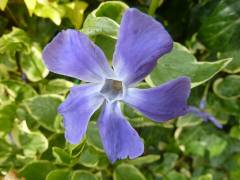
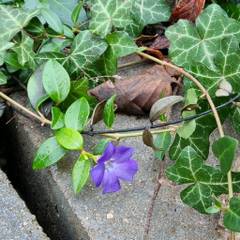
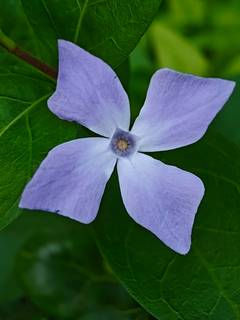
Vinca is a genus of about six species of trailing evergreen subshrubs and perennials in the family Apocynaceae, native to Europe, northwest Africa, and southwest Asia. Stems trail along the ground, rooting at the nodes to form dense mats 10-45 cm (4-18 in) tall that spread indefinitely. The opposite leaves are glossy, leathery, and elliptic to ovate, 1-9 cm (0.4-3.5 in) long, dark green and evergreen in mild climates. Solitary flowers arise from the leaf axils, each with five asymmetric lobes forming a pinwheel 2-5 cm (0.8-2 in) across in shades of blue-violet, lavender, and occasionally white or pale purple. Vinca minor is the smaller species with leaves to 4 cm (1.6 in), while V. major is coarser with broader leaves and larger flowers. All parts contain indole alkaloids including vincamine, and ingestion can cause digestive upset and low blood pressure in people and animals. The trailing stems root quickly, and both common species are listed as invasive in parts of North America, where they displace native ground flora in woodlands.
Native Range
Vinca is native to continental Europe, the Mediterranean basin, northwest Africa, and southwest Asia. V. minor and V. major have naturalized widely beyond this range and are considered invasive in temperate North America and parts of Australia.Suggested Uses
Vinca is grown as an evergreen groundcover on banks, beneath trees, and in shaded borders where its mat stabilizes soil. It is used for erosion control on slopes. Because both common species escape cultivation, its sale and planting are restricted in some regions.How to Identify
Appearance
Size & Dimensions
Height4" - 1'6"
Width/Spread2' - 4'
Bloom Information
Flowering peaks in spring, March to May, with scattered repeat bloom through summer and into autumn in mild regions. The flowers are borne singly and last several days each. V. minor tends to flower over a longer season than V. major, which concentrates its bloom in spring.
Detailed Descriptions
Flower Description
Blue-violet, lavender, whiteFoliage Description
Dark green, glossyGrowing Conditions
Sun Requirements
Requires 2-6 hours of direct sunlight daily
• Full Sun: 6+ hours of direct sunlight
• Partial Shade: 3-6 hours of direct sunlight
• Full Shade: Less than 3 hours of direct sunlight
Water & Climate
Water Needs
Drought Tolerance
Drought tolerant when established
Care & Maintenance
Care Guide
Periwinkles grow in part shade to full shade and tolerate full sun where soil stays moist. They adapt to most soils, including poor and dry ground once established, and spread fastest in moist, humus-rich conditions. Plants need little care beyond confinement, as the rooting stems extend well past their intended area. Growth slows in deep drought but rarely stops. In cold-winter zones the foliage may bronze or die back, regrowing from the crown in spring. The dense mat suppresses most weeds but also smothers smaller companion plantings.Pruning
Periwinkles are sheared in early spring to remove winter-damaged growth and to thicken the mat. Stems that root beyond the planting edge are cut and lifted to limit spread. Mowing on a high setting renews large plantings.Pruning Schedule
Prune: March–April
early spring
Container Growing
Suitable for container growing
Minimum container size: 1 gallons