Tragopogon, Genus, porrifolius, Species,
- Genus & species
purple salsify
Mediterranean, Europe, and western Asia
Overview
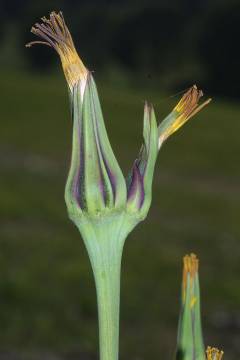
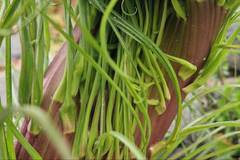
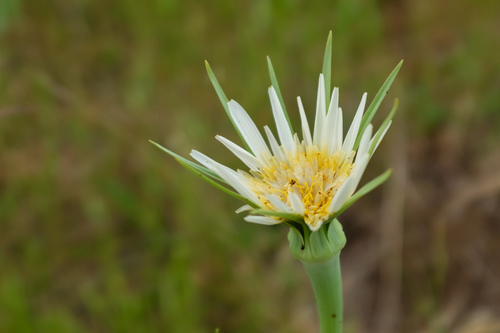
Tragopogon porrifolius is a biennial in the daisy family, grown both as a vegetable and as a wildflower, with a long fleshy taproot once popular as the oyster plant. In the first year it forms a tuft of long, narrow, grass-like leaves that clasp the stem and exude milky latex when broken. In the second year it sends up a smooth, branched stem 20-48 inches (50-120 cm) tall. From May to July it carries solitary flowerheads 1.5-2 inches (4-5 cm) across, made entirely of dull violet-purple ray florets, set behind a ring of slender green bracts that project well beyond the petals. The heads open in the morning and close by midday. Each head ripens into a large, spherical seed clock of plumed achenes, broader than a dandelion's. The plant grows on roadsides, rough grassland, and waste ground on dry, sunny soils, and the taproot is lifted in its first autumn or winter for the kitchen. Flowering in the second year ends the plant's life. Rich, wet, or shaded ground gives a poorer root and softer growth.
Native Range
Native to the Mediterranean region and adjacent parts of Europe and western Asia, and widely naturalised in temperate areas including North America. In Britain it is naturalised on roadsides and rough ground, mainly in the south.Suggested Uses
Grown as a root vegetable for its oyster-flavoured taproot and in ornamental and wildlife plantings for its flowers and seed heads. The violet flowers and large seed clocks suit naturalistic and cottage borders. It supports bees during its early-summer flowering.How to Identify
Appearance
Size & Dimensions
Height1'8" - 4'
Width/Spread8" - 1'
Bloom Information
Flowerheads open from May to July, one to a stem branch, unfurling in the morning sun and closing around midday. The violet-purple flowers draw bees and hoverflies during their short daily opening. Each pollinated head forms a wide, plumed seed clock that disperses on the wind.
Detailed Descriptions
Foliage Description
grey-greenGrowing Conditions
Sun Requirements
Requires 6-10 hours of direct sunlight daily
• Full Sun: 6+ hours of direct sunlight
• Partial Shade: 3-6 hours of direct sunlight
• Full Shade: Less than 3 hours of direct sunlight
Care & Maintenance
Care Guide
Tragopogon porrifolius grows in full sun on deep, free-draining, loose loam or sandy soil of neutral pH. A deep, stone-free soil produces the long, straight taproot used as a vegetable, while heavy or stony ground gives forked roots. It is grown from seed sown in spring where it is to crop, since the taproot resents transplanting. Roots are lifted from autumn of the first year through winter, before the plant runs to flower. Even moisture keeps the roots tender, while drought makes them woody. Left to flower in the second year, the plant sets seed and dies.Pruning
No pruning is required. Flower stems are removed if seeding is not wanted, or left to form ornamental seed clocks. As a biennial the whole plant is cleared once it dies after flowering.Container Growing
Suitable for container growing
Minimum container size: 5 gallons
Toxicity
Non-toxicPlanting Guide
Planting Methods & Timing
Planting Method
direct sow
Direct Sow Timing
Spring
Days to Maturity
120–150 days
Plant Spacing
4 inches