Overview
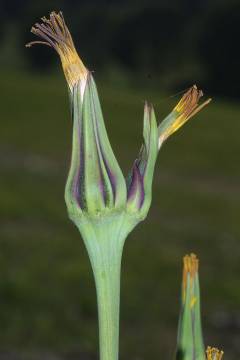
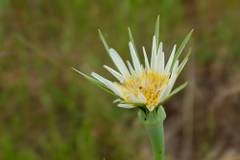
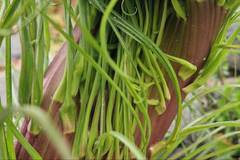
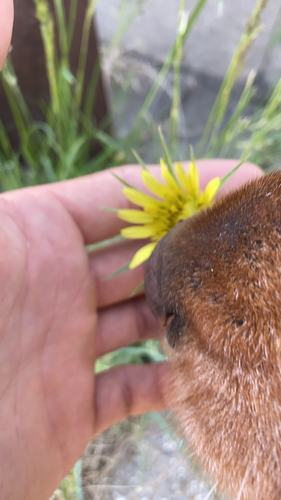
Tragopogon dubius is a biennial or short-lived perennial in the aster family, forming a basal tuft the first year and a branched flowering stem 1 to 3 feet (30-90 cm) tall the next. The leaves are long, narrow, and grass-like, 4-12 inches (10-30 cm) long, clasping the stem and tapering to a narrow point, with a bluish-green cast and milky sap when broken. Solitary flower heads 1.5-2.5 inches (4-6 cm) across open at the stem tips in late spring and summer, made of pale lemon-yellow ray florets backed by slender green bracts that project well beyond the rays. The heads open in morning sun and close by midday. Each head matures into a large, round, tan seed head 2.5-4 inches (6-10 cm) across, like an oversized dandelion clock, with each seed carried on a feathery parachute. The plant has a deep taproot, sets abundant wind-borne seed, and naturalizes on roadsides, fields, and disturbed ground. It is short-lived and dies after flowering, persisting at a site only through self-sown seedlings.
Native Range
Native to central and southern Europe and western Asia, from the Mediterranean to the Caucasus. It has naturalized across much of North America, where it grows on roadsides, rangeland, and disturbed open ground.Suggested Uses
Grown occasionally in wildflower meadows and informal plantings for its morning flowers and ornamental seed heads, spaced 10-16 inches (25-40 cm) apart. Its self-seeding and deep taproot suit naturalized rather than formal settings. The flowers draw bees and other pollinators in late spring.How to Identify
Appearance
Size & Dimensions
Height1' - 3'
Width/Spread8" - 1'4"
Bloom Information
Detailed Descriptions
Foliage Description
Bluish-greenGrowing Conditions
Sun Requirements
Requires 6-12 hours of direct sunlight daily
• Full Sun: 6+ hours of direct sunlight
• Partial Shade: 3-6 hours of direct sunlight
• Full Shade: Less than 3 hours of direct sunlight
Water & Climate
Water Needs
Drought Tolerance
Drought tolerant when established
Care & Maintenance
Care Guide
Grows in full sun on dry to average, freely draining soil of low to moderate fertility. It tolerates poor, gravelly, and disturbed ground and a wide pH range, needing no feeding or irrigation once the taproot is set. The deep root lets it withstand drought but makes established plants hard to transplant. Plants flower in their second year and die afterward, so a stand persists only by self-seeding. Rich or wet soil shortens its life and encourages rot. Removing seed heads before they open limits unwanted spread.Pruning
No formal pruning is needed. Cutting off the developing seed heads before they ripen limits self-sowing. Spent plants can be pulled after flowering, though the deep taproot may break and resprout.Toxicity
Non-toxicPlanting Guide
Planting Methods & Timing
Planting Method
direct sow