Toxicoscordion, Genus, fremontii, Species,
- Genus & species
Fremont's death camas
California Floristic Province, western North America
Overview
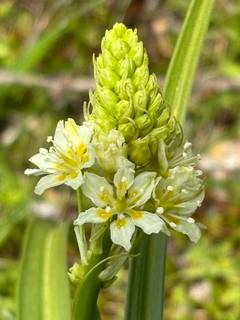
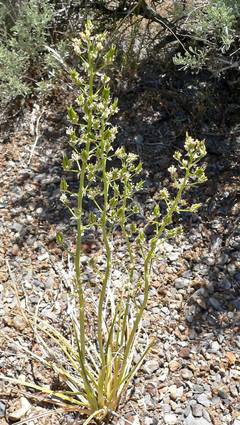
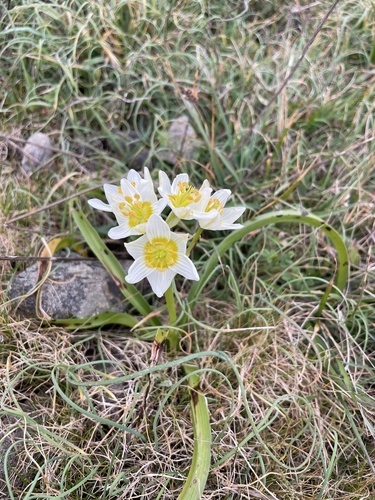
Toxicoscordion fremontii is a bulb-forming perennial 8-28 inches (20-70 cm) tall, growing from a deep, onion-like bulb sheathed in dark scales. Several grass-like basal leaves 8-16 inches (20-40 cm) long and keeled rise in late winter and fold lengthwise, often withering by the time the plant fruits. In spring the flowering stem carries an open raceme or branched cluster of star-shaped flowers, each 0.5-0.75 inch (1.3-2 cm) across, with six cream to pale yellow tepals marked at the base by a greenish-yellow gland. The flowers give way to three-lobed capsules holding many seeds. The whole plant is poisonous, holding zygacine and related alkaloids in the bulb, leaves, flowers, and seeds; it has killed grazing livestock and people who mistook the bulb for wild onion, and it lacks the onion smell that would warn them off. It grows on grassy slopes, coastal bluffs, chaparral openings, and oak woodlands, mostly in California and adjacent states, blooming early before summer drought. One trade-off is the severe toxicity, which makes it a hazard where livestock graze or where bulbs might be dug for food.
Native Range
Native to the western United States, mainly California and adjacent Oregon, Nevada, and Baja California, Mexico. It grows on grassy slopes, coastal bluffs, chaparral, and open oak woodland from sea level into the foothills.Suggested Uses
Used in native plant gardens, restoration plantings, and dry meadow seedings in its home range, set apart from areas grazed by livestock. It supports native bees in early spring, including specialist bees that gather its pollen.How to Identify
Appearance
Size & Dimensions
Height8" - 2'4"
Width/Spread6" - 1'
Bloom Information
Star-shaped cream to pale yellow flowers open from March to May, early in the season before the soil dries. The raceme blooms from the bottom upward over two to three weeks. Three-lobed seed capsules follow as the leaves wither.
Detailed Descriptions
Flower Description
Cream to pale yellowFoliage Description
Gray-greenGrowing Conditions
Sun Requirements
Requires 4-10 hours of direct sunlight daily
• Full Sun: 6+ hours of direct sunlight
• Partial Shade: 3-6 hours of direct sunlight
• Full Shade: Less than 3 hours of direct sunlight
Care & Maintenance
Care Guide
Grows in full sun to light shade in well-drained sandy, loamy, or rocky soils at pH 6.0-7.5, on sites that are moist in winter and spring and dry through summer. The bulb goes dormant in summer drought and resprouts with fall and winter rains, so summer water in cultivation rots it. Hardy in zones 6-9, it withstands the dry-summer, wet-winter pattern of its range. It is grown from seed or bulb offsets and is slow to reach flowering size. Every part is poisonous, with the toxins concentrated in the bulb and seeds.Pruning
Pruning is not applicable to this bulb. Spent flower stalks can be cut after the capsules drop or left to self-sow. The foliage is allowed to wither naturally as the bulb enters summer dormancy.Container Growing
Suitable for container growing
Minimum container size: 2 gallons