Tillandsia, Genus, recurvata, Species,
- Genus & species
ballmoss
warmer Americas (southern US to Argentina)
Overview
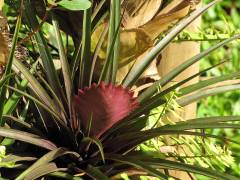
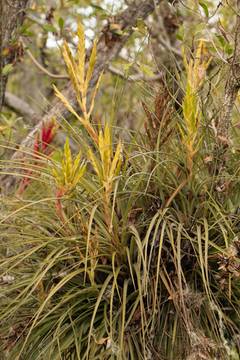
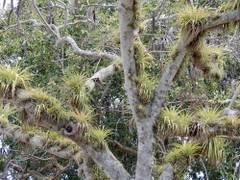
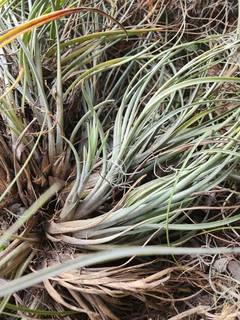
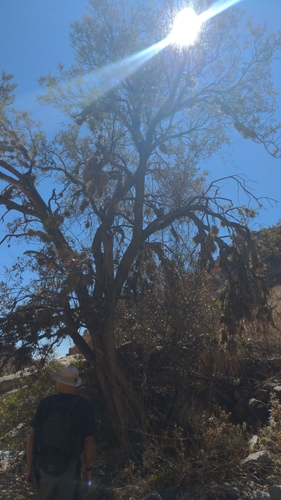
Tillandsia recurvata is a small epiphytic bromeliad that grows on tree branches, cacti, rocks, and power lines rather than in soil, forming rounded grey-green clumps 2-10 inches (5-25 cm) across. The narrow, curling leaves are covered in silvery scales that absorb water and nutrients from rain, dew, and airborne dust, so the plant takes nothing from its host and is not a parasite. Many individual rosettes mass together into ball-shaped tangles. Thin wiry stalks 2-6 inches (5-15 cm) long carry one to a few small pale blue to violet tubular flowers in spring and summer. The flowers give way to slender capsules that split to release seeds with feathery parachutes that catch on bark and wires. The plant anchors by wiry roots that grip rather than feed. It grows in warm, humid regions with good air circulation and tolerates heat and drought between rains. Heavy growth can build up on stressed or bare branches. It spreads by seed and by fragments carried on the wind.
Native Range
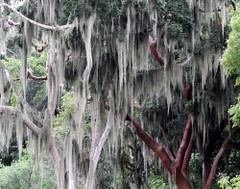
Tillandsia recurvata is native to the warmer Americas, from the southern United States, Arizona to Florida and Georgia, through Mexico, Central America, and the Caribbean to Argentina and Chile. It grows as an epiphyte on trees, shrubs, cacti, rocks, and man-made structures in humid, frost-free regions.Suggested Uses
Grown as a low-care ornamental air plant on mounts, driftwood, and garden trees in mild climates and indoors in bright rooms. It is used in terrariums and mounted displays. The clumps also shelter small insects and spiders.How to Identify
Appearance
Size & Dimensions
Height2" - 10"
Width/Spread2" - 10"
Colors
Bloom Information
Detailed Descriptions
Flower Description
pale blue to violetFoliage Description
grey-greenGrowing Conditions
Sun Requirements
Requires 4-8 hours of direct sunlight daily
• Full Sun: 6+ hours of direct sunlight
• Partial Shade: 3-6 hours of direct sunlight
• Full Shade: Less than 3 hours of direct sunlight
Care & Maintenance
Care Guide
This epiphyte grows attached to branches, bark, wire, or rock in bright, airy, humid conditions, and takes no water or nutrients from its support. It absorbs moisture from rain, dew, and humidity through leaf scales and tolerates drought between wettings. Bright indirect light and free air movement suit it, while still, soggy conditions cause rot. It needs no soil and no fertilizer beyond the dust and rain it catches. In gardens it is simply wedged or tied onto a branch until it anchors. Heavy buildup on weakened trees can shade small branches.Pruning
No pruning is needed. Clumps can be pulled off branches by hand where buildup is heavy. Removed clumps can be reattached elsewhere, as the plant continues to grow once wedged in place.Container Growing
Suitable for container growing