Tillandsia, Genus, fasciculata, Species,
- Genus & species
cardinal airplant
Florida, Mexico, Central America, Caribbean, and northern South America
Overview
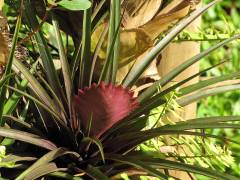
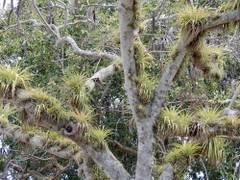
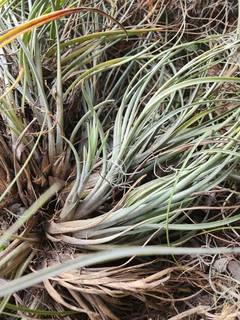
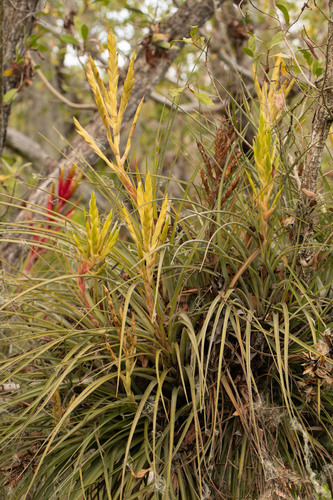
Tillandsia fasciculata is an evergreen epiphytic bromeliad that grows perched on tree branches and trunks rather than in soil, forming a dense rosette of stiff, narrow, gray-green leaves 8-20 inches (20-50 cm) long that taper to narrow points. The leaves are coated in tiny silvery scales that absorb moisture and nutrients from the air and rain. At bloom it sends up a stout, branched flower spike to 12-28 inches (30-70 cm) tall with flattened, overlapping bracts in red, orange, or green from which slender violet to purple tubular flowers emerge in succession. Native to Florida, Mexico, Central America, the Caribbean, and northern South America, it grows in hammocks, swamps, and forests, anchored to bark by wiry roots that hold it in place but take up little water. T. fasciculata needs bright, filtered light, warmth, and humidity, and it cannot survive hard frost or prolonged dryness. In Florida it has declined sharply where the introduced Mexican bromeliad weevil bores into the plants, and several populations are now protected. Each rosette flowers once and then slowly dies, leaving offsets that continue the clump.
Native Range
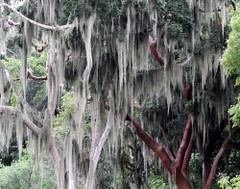
Native to Florida, Mexico, Central America, the Caribbean, and northern South America. It grows as an epiphyte in hammocks, swamps, and humid forests, attached to the bark of trees.Suggested Uses
Grown mounted on driftwood, bark slabs, and branches, in hanging displays, and in bright greenhouses, patios, and terrariums in frost-free conditions. Outdoors in its range it lives in the canopy of trees, and in cultivation it suits naturalistic mountings and living-wall displays. The colorful bract spikes draw hummingbirds in warm climates.How to Identify
Appearance
Size & Dimensions
Height8" - 2'4"
Width/Spread8" - 1'4"
Bloom Information
Flowering can occur at various times but is heaviest in spring and summer in its range. The colorful bracts hold for many weeks, far longer than the short-lived violet flowers that open a few at a time. After flowering, the parent rosette declines while new offsets form at its base.
Detailed Descriptions
Flower Description
violet to purpleFoliage Description
gray-greenGrowing Conditions
Sun Requirements
Requires 3-6 hours of direct sunlight daily
• Full Sun: 6+ hours of direct sunlight
• Partial Shade: 3-6 hours of direct sunlight
• Full Shade: Less than 3 hours of direct sunlight
Care & Maintenance
Care Guide
Grow T. fasciculata mounted on bark, wood, or in an open, fast-draining medium rather than potting soil, in bright, filtered light and warm, humid air. It takes up water and nutrients through its leaves, so regular misting or soaking and good air movement matter more than any soil. It cannot tolerate frost, soggy conditions at the base, or long dry spells, and standing water trapped in the rosette can rot the plant. A dilute foliar feed during active growth supports flowering. After bloom, the offsets can be left attached to form a clump or separated once they reach a third of the parent size.Pruning
Pruning is limited to trimming away dead leaves and the spent flower spike after bloom. The declining parent rosette can be removed once the offsets are established. No other cutting is needed.Pruning Schedule
Prune: July–August
summer
Container Growing
Suitable for container growing
Minimum container size: 1 gallons