Tanacetum, Genus, camphoratum, Species,
- Genus & species
camphor tansy
Pacific coast of North America (southern British Columbia south through Washington, Oregon, into northern California)
Overview
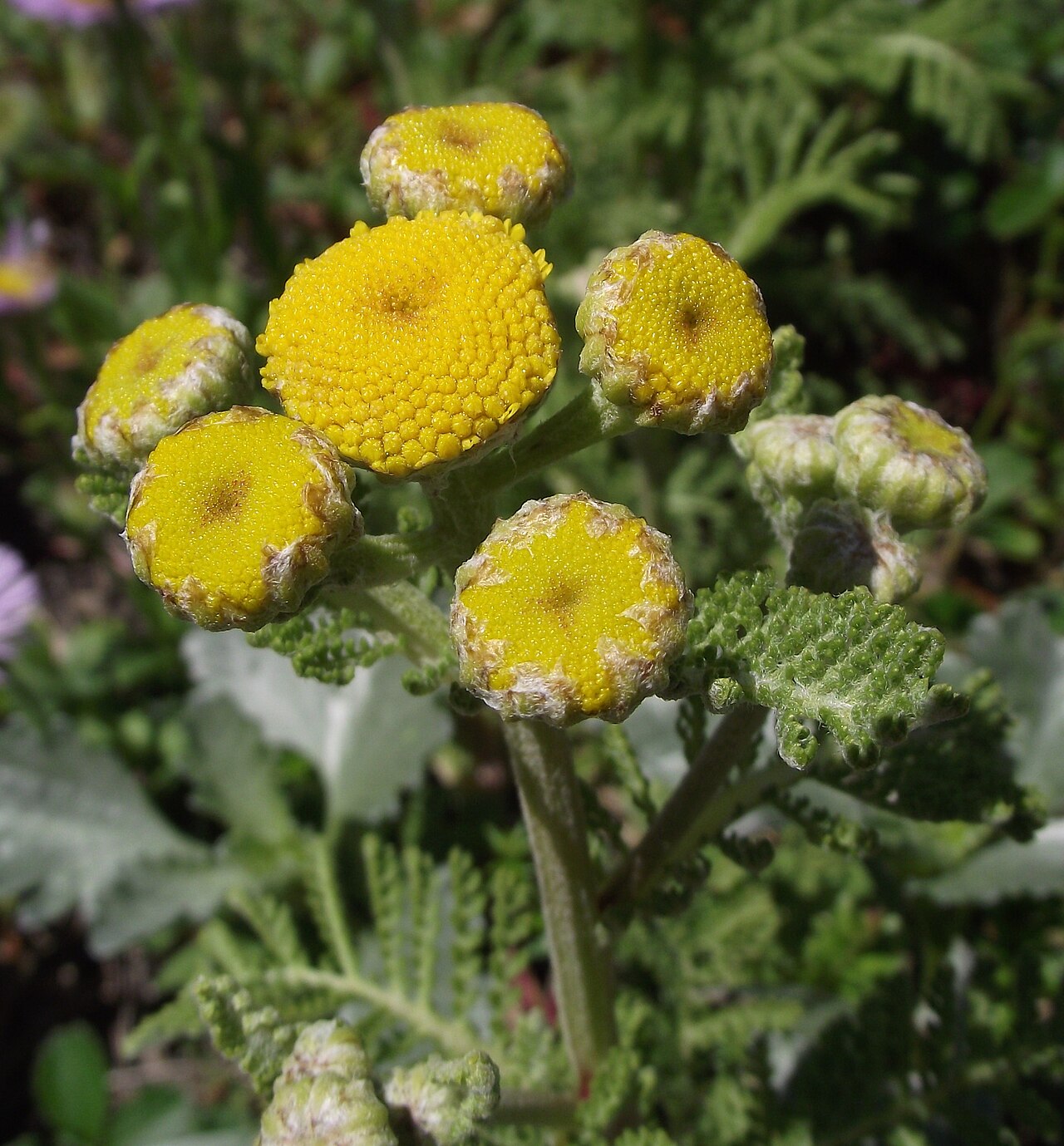
Tanacetum camphoratum (syn. T. douglasii) is a rhizomatous perennial in the daisy family (Asteraceae) native to coastal dune systems of the Pacific Northwest. Plants reach 12-24 inches (30-60 cm) tall and spread by creeping rhizomes to form loose colonies 18-36 inches (45-90 cm) wide. Stems are erect to ascending, woolly-white when young, becoming less hairy with age. Leaves are pinnately divided into 5-9 pairs of bluntly lobed segments, 2-5 inches (5-13 cm) long, fleshy-textured, grey-green to silvery from dense woolly pubescence, with a strong camphor-like scent when crushed. Flower heads are button-shaped, 0.3-0.5 inch (8-12 mm) across, bright yellow, lacking ray florets (disc florets only), borne in flat-topped corymbs of 5-20 heads per stem. The species is restricted to active and stabilised coastal dune habitats from British Columbia south to northern California, where it colonises open sand, dune swales, and the lee side of foredunes. It is treated as rare or of conservation concern in parts of its range due to coastal habitat loss, invasive species displacement (particularly European beachgrass, Ammophila arenaria), and recreational disturbance. The species tolerates salt spray, wind exposure, sand burial, and extreme drainage. Plants do not persist in garden soils with regular irrigation — root rot develops rapidly in consistently moist conditions.
Native Range
Tanacetum camphoratum is native to the Pacific coast of North America, from southern British Columbia south through Washington, Oregon, and into northern California. The species is restricted to coastal dune habitats including foredunes, deflation plains, and stabilised dune grasslands, typically within 0.5 mile (0.8 km) of the ocean.Suggested Uses
Used primarily in coastal dune restoration and native plant gardens on sandy coastal sites. The species works in dune stabilisation plantings alongside other native dune species such as Abronia latifolia, Leymus mollis, and Fragaria chiloensis. In garden settings, the species is restricted to sand-based raised beds or rock gardens with no supplemental irrigation. Not suited to standard garden borders or irrigated landscapes.How to Identify
Appearance
Size & Dimensions
Height1' - 2'
Width/Spread1'6" - 3'
Bloom Information
Yellow button-shaped flower heads open from July through September. Each corymb of 5-20 heads opens progressively over 3-4 weeks. Bloom period is approximately 6-8 weeks total. Flowers are pollinated by a variety of insects including bees, flies, and beetles. Achenes ripen in September-October and are dispersed by wind.
Detailed Descriptions
Foliage Description
Silver-grey, woollyGrowing Conditions
Sun Requirements
Requires 6-12 hours of direct sunlight daily
• Full Sun: 6+ hours of direct sunlight
• Partial Shade: 3-6 hours of direct sunlight
• Full Shade: Less than 3 hours of direct sunlight
Care & Maintenance
Care Guide
Plants grow in full sun in sharply drained, sandy soil with a pH of 5.5-7.0. In garden settings, replicating dune conditions matters: a planting mix of 80-90% coarse sand and 10-20% compost in a raised bed or mound supports the species. The species is not irrigated once established — summer-dry conditions are required and root rot follows consistently moist soil. No fertilising is needed; added nutrients promote weak growth. Plants are spaced 12-18 inches (30-45 cm) apart. In habitat restoration, plugs or direct-seeded sand plantings in autumn establish well. Protection from competition by aggressive grasses during establishment supports survival.Pruning
Dead stems are cut back to ground level in late winter before new growth emerges from the rhizomes. No other pruning is required. In garden settings, spent flower heads are removed in October when self-seeding is not desired.Pruning Schedule
Prune: February–March
early spring