Overview
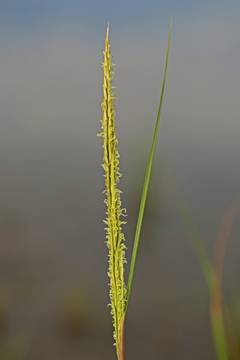
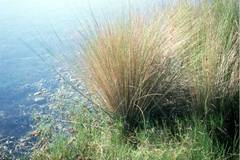
Spartina anglica is a robust rhizomatous perennial grass in the family Poaceae reaching 24-60 inches (60-150 cm) tall and 24-48 inches (60-120 cm) wide, forming dense monoculture stands in tidal salt marshes and upper mudflats. Culms are erect, stout, and stiff. Leaves are gray-green, stiff, flat to inrolled, and 0.2-0.5 inch (5-12 mm) wide. Inflorescence is a spike-like panicle 4-8 inches (10-20 cm) long carrying 2-9 appressed branches. The species is an allopolyploid (chromosome number 2n = 120-124) that originated in Southampton Water, England around 1890 through hybridization of the European native S. maritima (2n = 60) with the introduced S. alterniflora (2n = 62), followed by chromosome doubling. The sterile F1 hybrid S. × townsendii spontaneously doubled its chromosomes to produce the fertile S. anglica. The speciation sequence is among the thoroughly documented examples of allopolyploid speciation in recorded history. The species is listed as a Class A noxious weed in Washington State and colonizes higher tidal zones than S. alterniflora, converting open mudflats and salt marsh to dense grass stands.
Native Range
Spartina anglica originated in Southampton Water, England, circa 1890 through allopolyploid speciation. Spread deliberately for erosion control throughout the British Isles, then to China, Australia, and New Zealand. Introduced to the Pacific coast of North America. Listed as Class A (eradication priority) in Washington State. The species invades different tidal zones than S. alterniflora, and together the two species threaten the full intertidal range.Suggested Uses
Used as the textbook example of allopolyploid speciation in real time, one of only a handful of new species documented as originating in recorded human history. The speciation sequence (S. maritima × S. alterniflora → sterile S. × townsendii → fertile allopolyploid S. anglica) is taught in genetics, evolution, and plant systematics. Studied in estuarine invasion ecology alongside S. alterniflora. The Willapa Bay Spartina eradication is a case study in multi-species estuarine invasive management.How to Identify
Appearance
Size & Dimensions
Height2' - 5'
Width/Spread2' - 4'
Bloom Information
Spike-like panicles 4-8 inches (10-20 cm) long carrying 2-9 appressed branches, borne August through October over 2-3 weeks. Wind-pollinated. Seed production is variable; some populations produce viable seed while others rely primarily on rhizome expansion. In the Pacific Northwest, vegetative spread is the primary expansion mechanism.
Detailed Descriptions
Flower Description
Green to yellowish; spike-like panicles 4-8 inches (10-20 cm) carrying 2-9 appressed branches; August-OctoberFoliage Description
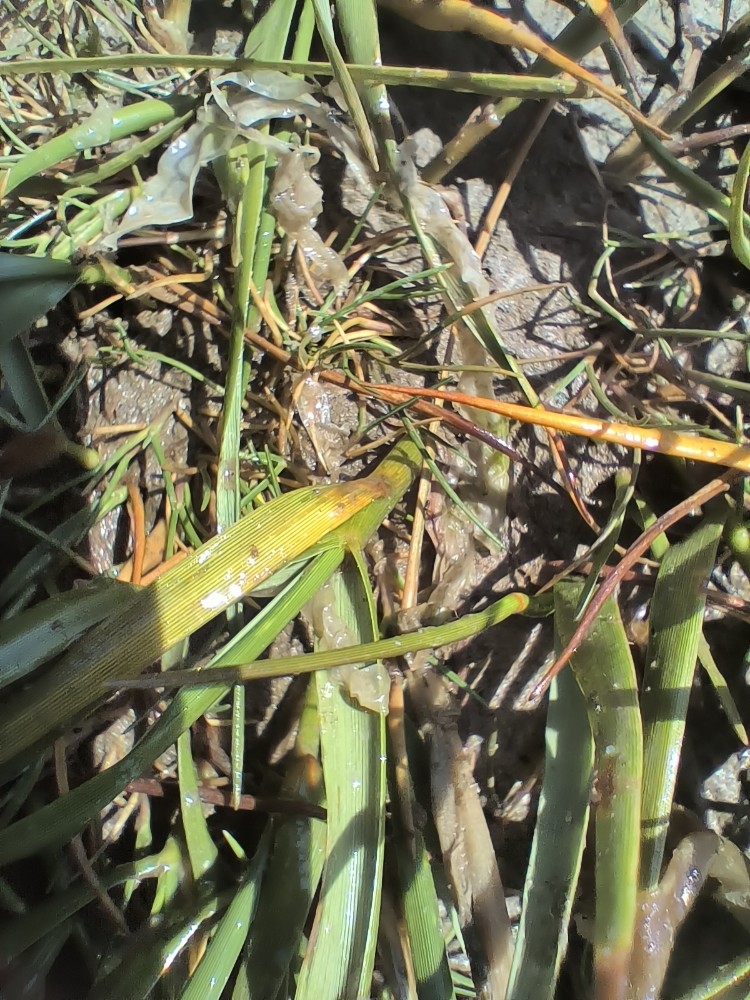
Gray-green; stiff, flat to inrolled; carrying a ligule of hairs; leaves more rigid than those of S. alterniflora; deciduousGrowing Conditions
Sun Requirements
Requires 6-12 hours of direct sunlight daily
• Full Sun: 6+ hours of direct sunlight
• Partial Shade: 3-6 hours of direct sunlight
• Full Shade: Less than 3 hours of direct sunlight