Schoenoplectus, Genus, acutus, Species,
- Genus & species
hardstem bulrush
Across North America including the Pacific Northwest; marshes, pond margins, lake edges, slow rivers, and wet ditches
Overview
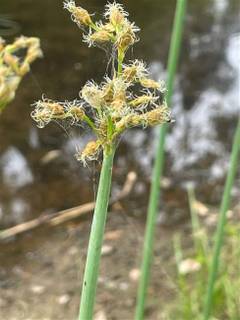
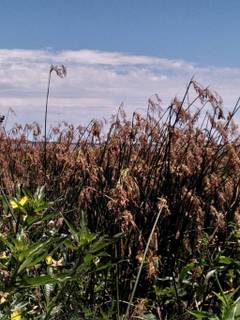
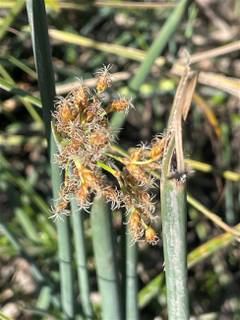
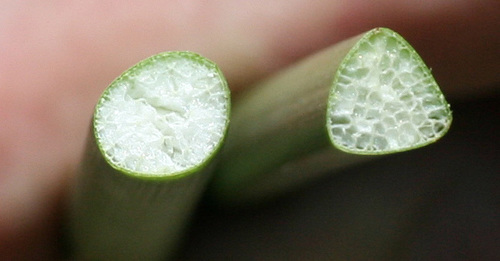
Schoenoplectus acutus is an emergent aquatic perennial in the family Cyperaceae native to marshes, pond margins, lake edges, slow rivers, and wet ditches across North America including the Pacific Northwest. The epithet acutus means sharp or pointed and refers to the sharply tapered tip of the involucral bract that subtends the inflorescence. The common name hardstem bulrush contrasts with softstem bulrush (Schoenoplectus tabernaemontani); stems of S. acutus are firm and resistant to compression while those of S. tabernaemontani compress readily between the fingers. Stem firmness is the field character that separates the two species. Plants grow 3-10 feet (0.9-3 m) tall from stout creeping rhizomes and form dense colonies in shallow water. Stems are round (terete) in cross-section, medium to dark green, and stiff. Leaves are reduced to basal bladeless sheaths and the stem itself carries out photosynthesis. From June through August the inflorescence forms a cluster of reddish-brown spikelets 0.3-0.5 inch (8-12 mm) long that appear to arise laterally near the stem tip; the apparent stem above the spikelets is actually a long erect involucral bract. Aggressive rhizome spread excludes other emergents within 2-3 seasons in suitable conditions. Non-toxic; rhizomes and seeds are eaten by waterfowl and marsh mammals.
Native Range
Schoenoplectus acutus is native across North America including the Pacific Northwest. It grows in marshes, pond margins, lake edges, slow rivers, and wet ditches in standing water 0-18 inches (0-45 cm) deep or in permanently saturated mud.Suggested Uses
Used as a tall emergent in large-scale Pacific Northwest wetland restoration, stormwater treatment marshes, and wildlife pond margins at 18-36 inch (45-90 cm) spacing. Dense colonies provide nesting, foraging, and cover habitat for marsh birds, waterfowl, and muskrats. Combined with Typha latifolia, Carex obnupta, and Sparganium emersum in mixed emergent plantings.How to Identify
Appearance
Size & Dimensions
Height3' - 10'
Width/Spread2' - 4'
Bloom Information
Reddish-brown spikelet clusters 0.3-0.5 inch (8-12 mm) emerge June through August, appearing lateral on the stem because of the long erect bract that continues the apparent axis above them. Wind-pollinated. Bloom duration averages 8 weeks. Seeds, stem fragments, and rhizomes are eaten by Canada geese, dabbling ducks, red-winged blackbirds, and muskrats from late summer through winter.
Detailed Descriptions
Flower Description
reddish-brown spikelet clusters 0.3-0.5 inch (8-12 mm); appear lateral on the stem because subtended by a long erect stem-like bract; June-August; wind-pollinatedFoliage Description
medium to dark green; round (terete) firm hard stems resistant to compression; leaves reduced to basal bladeless sheaths; stem is the photosynthetic organGrowing Conditions
Sun Requirements
Requires 6-12 hours of direct sunlight daily
• Full Sun: 6+ hours of direct sunlight
• Partial Shade: 3-6 hours of direct sunlight
• Full Shade: Less than 3 hours of direct sunlight
Care & Maintenance
Care Guide
Plant in full sun in wet to standing-water conditions with a pH of 6.0-8.0; tolerated soil types include clay, silt, and loam. Suited to permanently saturated mud or 0-18 inches (0-45 cm) of standing water. Plugs are set at 18-36 inch (45-90 cm) spacing in shallow water margins. Establishment takes 2-3 growing seasons and no fertilization is needed. Spreads aggressively by rhizome and forms monodominant stands within 2-3 seasons in shallow open water; this rules out small ornamental ponds and beds where plant diversity is the goal.Pruning
No routine pruning is needed. Old brown stems can be cut to ground level in early spring (March) before new growth emerges. Standing dead stems function as winter cover and nesting structure for marsh birds and are typically left in place through the cold season.Pruning Schedule
Prune: March
early spring