Santalum, Genus, paniculatum, Species,
- Genus & species
Hawaiian sandalwood
Overview
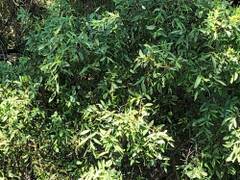
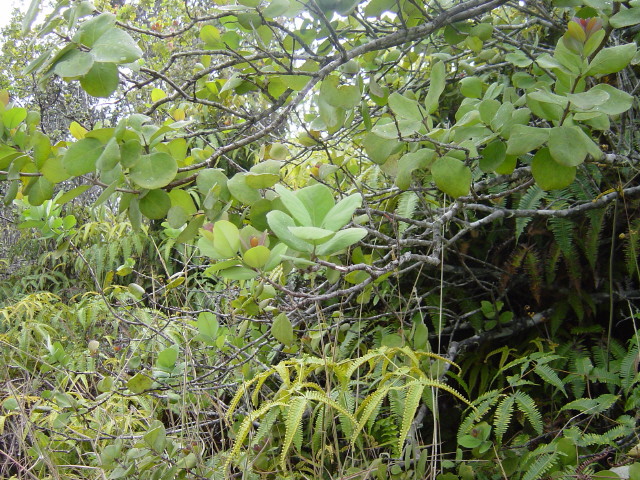
Santalum paniculatum is an evergreen hemiparasitic shrub to small tree 10-33 feet (3-10 m) tall and 8-20 feet (2.4-6 m) wide, endemic to Hawaii island. Its roots form haustoria that tap the roots of neighbouring plants for water and nutrients, so seedlings do not survive past the first year without a compatible host such as Acacia koa, Dodonaea viscosa, Myoporum sandwicense, or several grasses. Leaves are opposite, leathery, elliptic to ovate, 1.5-3 inches (4-7.5 cm) long, dull blue-green to olive, and often hang from the shoots rather than standing out from them. Flowers are 0.2 inch (5 mm) across in terminal panicles, opening cream and deepening through salmon to red-brown over several days, so one panicle carries several colours at once. Fruit is a purple-black drupe 0.4-0.6 inch (1-1.5 cm) across holding a single seed. Heartwood forms slowly and carries the aromatic oil behind the Hawaiian sandalwood trade of roughly 1790 to 1840, a period that removed most large trees from accessible forest. Growth runs 6-12 inches (15-30 cm) a year, and harvestable heartwood takes 20-30 years or more to accumulate.
Native Range
Santalum paniculatum is endemic to Hawaii island, where it grows in dry and mesic forest and on lava substrate between 1,000 and 8,000 feet (300-2,400 m). It occurs on the slopes of Mauna Loa, Mauna Kea, Hualalai, and Kohala, most often on free-draining pahoehoe and aa flows. Related species occupy the other Hawaiian islands, with S. freycinetianum on Oahu, Maui, and Molokai and S. ellipticum on coastal sites across the chain.Suggested Uses
Planted in Hawaiian dry-forest restoration and in agroforestry trials on Hawaii island at spacings of 12-20 feet (3.7-6 m), always alongside a host species. Heartwood is distilled for sandalwood oil and cut for carving and incense, with harvest on state land regulated under Hawaii forestry rules. Grown as a specimen tree in dryland native gardens where a companion host is already established.How to Identify
Appearance
Size & Dimensions
Height10' - 33'
Width/Spread8' - 20'
Bloom Information
Flowering runs February through August with the heaviest output between March and June, and scattered panicles open at other times of year. Individual flowers last 5-8 days, changing colour as they age, and a panicle stays in flower for 3-4 weeks. Drupes ripen 3-5 months after flowering, turning from green to purple-black. Trees begin flowering at 4-7 years old.
Detailed Descriptions
Flower Description
Cream ageing through salmon to red-brownFoliage Description
Dull blue-green to oliveGrowing Conditions
Sun Requirements
Requires 5-12 hours of direct sunlight daily
• Full Sun: 6+ hours of direct sunlight
• Partial Shade: 3-6 hours of direct sunlight
• Full Shade: Less than 3 hours of direct sunlight
Care & Maintenance
Care Guide
Santalum paniculatum requires full sun to light shade and sharply drained rocky, lava, or sandy loam at pH 6.0-7.5. A compatible host plant must be growing within reach of the root system from the seedling stage, and pot culture uses a nurse grass or Dodonaea seedling in the same container. Established plants tolerate 5-7 dry months and annual rainfall of 15-40 inches (380-1,000 mm), while waterlogged soil kills them within weeks. Hardiness runs to USDA zones 10-11, with damage below 32F (0C). Fertilizer is applied sparingly, since the plant draws much of its nutrition through haustoria and high fertility favours the host over the sandalwood. Cattle and feral ungulates browse seedlings heavily, and unfenced regeneration seldom survives.Pruning
Pruning is limited to taking out dead and broken wood in winter, since the slow growth rate makes replacement of removed branches a matter of years. Lower branches are retained where possible, as they shade the trunk and reduce sunscald on thin bark. Host plants around the base are trimmed rather than removed, because cutting the host severs the haustorial connection. Cuts over 2 inches (5 cm) in diameter close slowly and are kept to a minimum.Pruning Schedule
Prune: January–February
winter