Rhododendron, Genus, 'PJM', Cultivar,
- Genus
- Cultivar
PJM rhododendron
Hybrid of garden origin — bred at Weston Nurseries in Hopkinton, Massachusetts in the 1940s by the Mezitt family from the cross of {R. carolinianum} (Carolina rhododendron, native to the southern Appalachian Mountains of the southeastern United States) × {R. dauricum} (Dahurian rhododendron, native to Siberia and northeastern Asia)
Overview
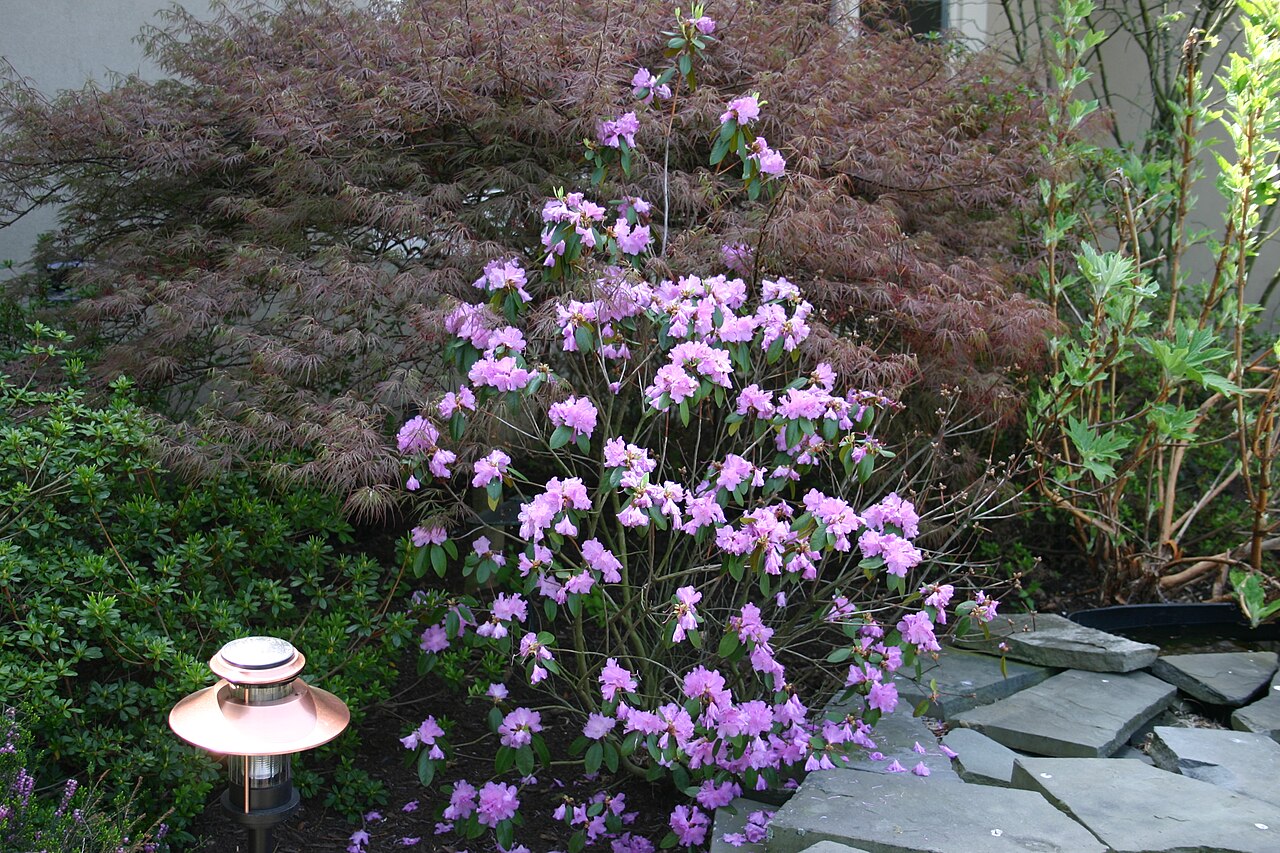
Rhododendron 'PJM' is an upright broadleaf evergreen rhododendron in the heath family Ericaceae growing 3-6 feet (0.9-1.8 m) tall and 3-6 feet (0.9-1.8 m) wide on a multi-stemmed base that produces a rounded compact form well-clothed to the ground. The cultivar epithet 'PJM' is the initials of Peter John Mezitt (1885-1972), the founder of Weston Nurseries in Hopkinton, Massachusetts, where the cultivar was bred in the 1940s by his son Edmund V. Mezitt from the cross of R. carolinianum (Carolina rhododendron, native to the southern Appalachian Mountains) with R. dauricum (Dahurian rhododendron, native to Siberia and northeastern Asia). The interspecific cross combined the R. carolinianum parent's heat tolerance, small lepidote leaves, and adaptable hardiness with the R. dauricum parent's extreme cold hardiness (the species native to Siberia is reliably hardy to USDA zone 3) and early bloom timing, producing a hybrid with reliable hardiness through USDA zone 4 — extending rhododendron cultivation into Mid-Atlantic, New England, Upper Midwestern, and Pacific Northwest cold-winter zones where the broad-leaved elepidote hybrids of the catawbiense lineage are unreliable. The 'PJM' designation is now applied to a broader Group of related Mezitt selections in the British and North American nursery trade including 'PJM Elite' (more compact form), 'PJM Compact' (smaller stature), and 'Olga Mezitt' (clear pink flowers) — all sharing the parental hardiness, small aromatic lepidote foliage, and mahogany-purple winter color expression. Vivid lavender-purple to bright pinkish-purple funnel-shaped flowers 1.5 inches (4 cm) across open in compact ball-shaped trusses of 5-9 flowers each in March through April across a 2-3 week bloom period — the very early bloom timing is among the earliest in cold-climate rhododendron cultivation and opens before most other broadleaf evergreens have begun spring growth. The foliage shifts to mahogany-purple to plum-bronze tones through fall and winter, supplying a secondary year-round identifying character that separates the 'PJM' group from green-overwintering rhododendron cultivars. Limitation: like all rhododendrons, 'PJM' requires strictly acidic soil with a pH of 4.5-6.0 and develops chlorosis at higher pH levels, calling for naturally acidic native soil or sustained acidification through pine-needle mulch and elemental-sulfur amendment to maintain the low pH at the root zone — alkaline-soil regions remain the primary cultural restriction despite the cultivar's broad climatic adaptability. The cultivar is more tolerant of full sun and of summer drought than the broad-leaved elepidote rhododendrons and accepts garden positions that exclude most other rhododendron cultivars. All parts of the plant — leaves, stems, flowers, and nectar — contain grayanotoxin and are severely toxic to humans, livestock, cats, dogs, and horses if ingested. Deer-resistant.
Native Range
Hybrid of garden origin — bred at Weston Nurseries in Hopkinton, Massachusetts in the 1940s by Edmund V. Mezitt from the cross of Rhododendron carolinianum (Carolina rhododendron, native to the southern Appalachian Mountains of the southeastern United States) with Rhododendron dauricum (Dahurian rhododendron, native to Siberia and northeastern Asia). The cultivar epithet 'PJM' honors Peter John Mezitt (1885-1972), the founder of Weston Nurseries and Edmund's father.Suggested Uses
Used in mixed acidic-soil shrub borders, foundation plantings, mass plantings for early-spring color display, hummingbird-feeding plantings, cold-climate woodland-edge transitions, and container specimens in containers of at least 5 gallons (19 L) with acidic potting mix at 36-72 inch (90-180 cm) spacing between plants in USDA zones 4 through 8. The vivid lavender-purple early-spring flower trusses, the mahogany-purple to plum-bronze fall and winter foliage color, the year-round small aromatic lepidote evergreen foliage, the broad sun and drought tolerance not shared by most other rhododendrons, and the reliable cold hardiness through USDA zone 4 combine to make 'PJM' the standard rhododendron selection for cold-climate gardens in the Mid-Atlantic, New England, Upper Midwestern, and Pacific Northwest regions of North America. Alkaline-soil positions without acidification, sites with heavy poorly drained clay where Phytophthora pressure is significant, and households with children, pets, livestock, or horses that may access the foliage or flowers should be considered carefully because of the cultural soil requirements and the severe grayanotoxin toxicity of all plant parts.How to Identify
Appearance
Size & Dimensions
Height3' - 6'
Width/Spread3' - 6'
Bloom Information
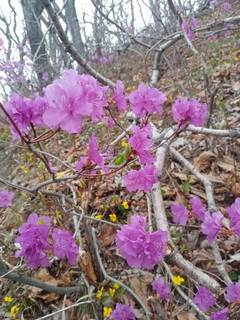
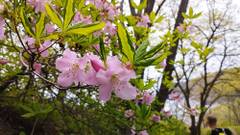
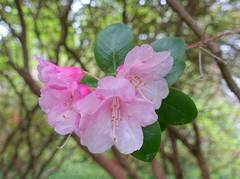
Early spring (March through April) across a 2-3 week bloom period. Vivid lavender-purple to bright pinkish-purple funnel-shaped flowers 1.5 inches (4 cm) across in compact ball-shaped trusses of 5-9 flowers each. The very early bloom timing supplies an early rhododendron flower display in cold-climate cultivation and opens before most other broadleaf evergreens have begun spring growth. Honeybees, bumblebees, hummingbirds, and several early-spring butterfly species work the flowers for nectar across the early-spring bloom window — the nectar contains grayanotoxin and is toxic in volume to humans (the mad-honey concern that applies broadly to flowers in the family Ericaceae).
Detailed Descriptions
Flower Description
vivid lavender-purple to bright pinkish-purple funnel-shaped flowers 1.5 inches (4 cm) across carried in compact ball-shaped trusses of 5-9 flowers each in early spring (March through April) across a 2-3 week bloom period; the very early bloom timing supplies one of the earliest rhododendron flower displays in cold-climate gardens, opening before most other broadleaf evergreens have begun spring growth; lightly fragrant with a faint sweet scent at close rangeFoliage Description
dark green and elliptic in summer, 1-3 inches (2.5-7 cm) long, lepidote (covered in tiny scales on the underside that catch light when the leaf is rotated), aromatic with a resinous spicy scent when crushed; the foliage shifts to mahogany-purple to plum-bronze tones through fall and winter — the purple winter foliage color is one of the cultivar's primary identifying secondary features and is a trait inherited from the Rhododendron dauricum parent of the cross; the small leaf size and the lepidote scaly underside separate the 'PJM' group from the broad-leaved elepidote rhododendrons of the catawbiense and hybrid lineage; evergreen year-roundGrowing Conditions
Sun Requirements
Requires 4-8 hours of direct sunlight daily
• Full Sun: 6+ hours of direct sunlight
• Partial Shade: 3-6 hours of direct sunlight
• Full Shade: Less than 3 hours of direct sunlight
Care & Maintenance
Care Guide
Site in part sun to full sun with 4-8 hours of direct sun per day in well-drained acidic loam or peat-amended soil with a strictly acidic pH of 4.5-6.0 — the cultivar develops chlorosis at higher pH levels and calls for naturally acidic native soil or sustained acidification through pine-needle mulch and elemental-sulfur amendment to maintain the low pH at the root zone. The cultivar is more tolerant of full sun and of summer drought than the broad-leaved elepidote rhododendrons, supporting garden positions that exclude most other rhododendron cultivars, and develops drought tolerance once the root system is established. Sharp drainage protects against Phytophthora root rot in heavy or poorly drained soils. The root ball is planted at the original nursery soil level — burying the crown below grade traps moisture against the bark and promotes collar rot. Spent flower trusses are deadheaded by snapping at the base immediately after bloom finishes (April or May). All parts contain grayanotoxin and are severely toxic to humans, livestock, cats, dogs, and horses if ingested. Deer-resistant. Hardy in USDA zones 4-8.Pruning
Spent flower trusses are deadheaded by snapping at the base immediately after bloom finishes (April or May), with care to preserve the small growth buds at the base of each truss because next year's flower bud and the new vegetative growth both initiate from these positions. The compact upright form develops naturally without intervention and requires minimal corrective pruning. The cultivar tolerates hard renovation pruning back into older wood when an overgrown plant has lost lower branching, with regrowth from latent buds typically following within 1-2 growing seasons.Pruning Schedule
Prune: April–May
late spring
Container Growing
Suitable for container growing
Minimum container size: 5 gallons