Paeonia, Genus, lactiflora, Species, 'Red Charm', Cultivar,
- Genus & species
- Cultivar
red charm peony
horticultural hybrid (parent species native to East Asia and southern Europe)
Overview
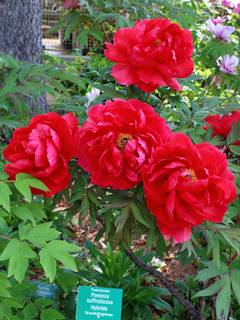
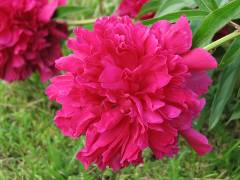
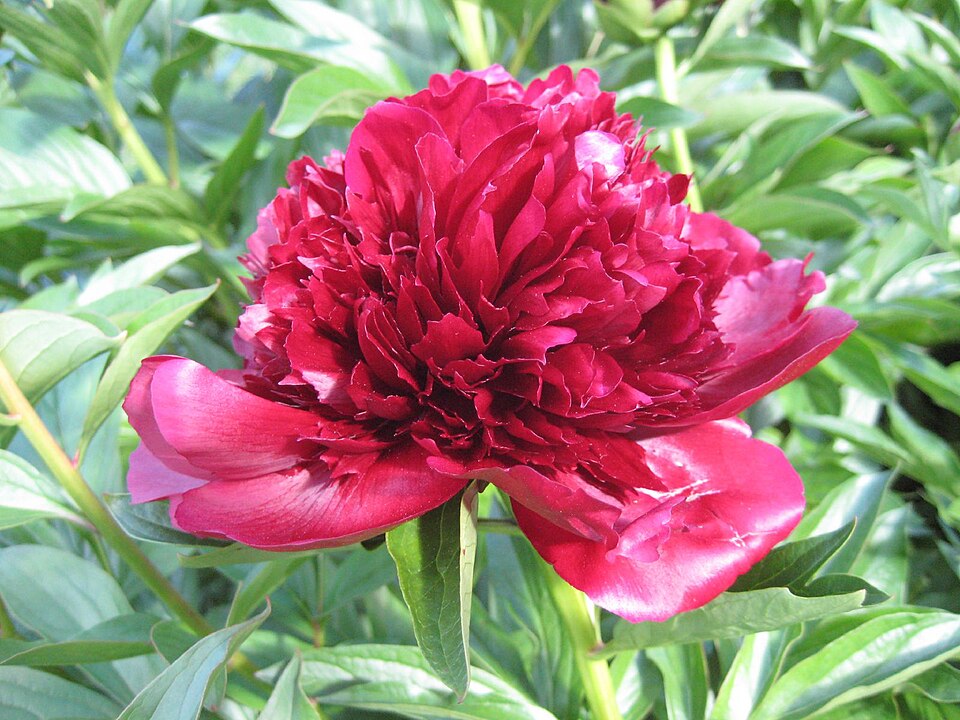
Paeonia lactiflora 'Red Charm' is a hybrid herbaceous peony, raised by Lyman Glasscock in 1944 from a cross of P. lactiflora and P. officinalis. Plants form upright clumps 30-36 inches (76-91 cm) tall and 30-36 inches (76-91 cm) wide, with strong stems that resist flopping more than most fully double cultivars. Foliage is glossy mid-green, divided into nine leaflets each 3-5 inches (8-13 cm) long, emerging bronze-tinted in early spring. Bomb-form flowers 6-7 inches (15-18 cm) across open in late spring with a flat ring of large guard petals surrounding a dense mounded center of narrower petals; bloom color is deep crimson red, fading toward magenta-red as flowers age. Fragrance is light and detectable mainly up close. Each plant produces 5-10 stems with one terminal bloom per stem; total bloom season lasts 7-10 days at peak temperatures, longer in cool springs. Foliage remains green through summer and turns yellow to russet in October before dying back to ground level. Plants are long-lived in cold-winter regions, often persisting 50+ years in the same location, but flower poorly in zones 8-9 where winter chill is insufficient. All parts contain paeoniflorin and methylpaeoniflorin and are toxic to dogs, cats, and horses.
Native Range
'Red Charm' is a horticultural hybrid without natural distribution. Parent species Paeonia lactiflora is native to central and eastern Asia, including northern China, eastern Mongolia, Korea, and the Russian Far East, growing on mountain woodland edges and grassy slopes at 1,500-7,000 feet (450-2,100 m). Paeonia officinalis is native to southern and central Europe in open subalpine meadows.Suggested Uses
Planted in mixed perennial borders, foundation plantings, and as a single-cultivar mass for cut flower production at 36-42 inch (90-105 cm) spacing. Used as a long-term low hedge in zones 3-6 due to 50+ year longevity. Container culture is impractical due to deep root systems and need for winter chill; pots of at least 15 gallons (57 L) are required and plants typically decline after 4-5 years in containers.How to Identify
Appearance
Size & Dimensions
Height2'6" - 3'
Width/Spread2'6" - 3'
Bloom Information
Late spring, typically late May through early June in zones 4-6 and mid-May to late May in zones 7-8. Individual blooms last 5-7 days; total bloom season for a clump is 10-14 days. Bloom timing advances by 7-10 days in early-warm springs. Plants flower poorly in zones 8-9 due to insufficient winter chill, requiring at least 400 hours below 40°F (4°C) for reliable flower bud formation.
Detailed Descriptions
Flower Description
deep crimson red, fading toward magenta-redFoliage Description
glossy mid-green; bronze-tinted on emergenceGrowing Conditions
Sun Requirements
Requires 6-8 hours of direct sunlight daily
• Full Sun: 6+ hours of direct sunlight
• Partial Shade: 3-6 hours of direct sunlight
• Full Shade: Less than 3 hours of direct sunlight
Care & Maintenance
Care Guide
Plant crown buds 1-2 inches (2.5-5 cm) below soil surface in fall; deeper planting reduces or eliminates flowering for several seasons. Apply low-nitrogen fertilizer in early spring before bud break and again after flowering. Water deeply during dry spells from bud formation through bloom; established plants tolerate periodic drought once foliage is mature. Botrytis blight develops in cool wet springs, causing stem collapse and bud blasting; affected stems are cut at the base and discarded to reduce overwintering spore load. Powdery mildew may appear on foliage in late summer in humid regions. Disturbance to established plants delays normal flowering 2-3 years after division or transplanting; division is rarely needed.Pruning
Cut stems to ground level in mid to late fall after foliage has yellowed and frost has occurred; this reduces overwintering Botrytis spores. Spent flowers can be removed throughout bloom to prevent seedhead formation, redirecting resources into next year's bud development. No summer pruning is required.Pruning Schedule
Prune: October–November
fall