Potentilla, Genus, anserina, Species,
- Genus & species
Pacific silverweed
Northern circumpolar (coastal and wet inland sites)
Overview
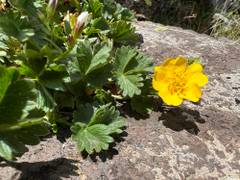
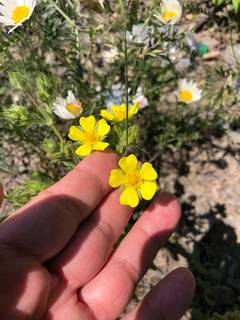
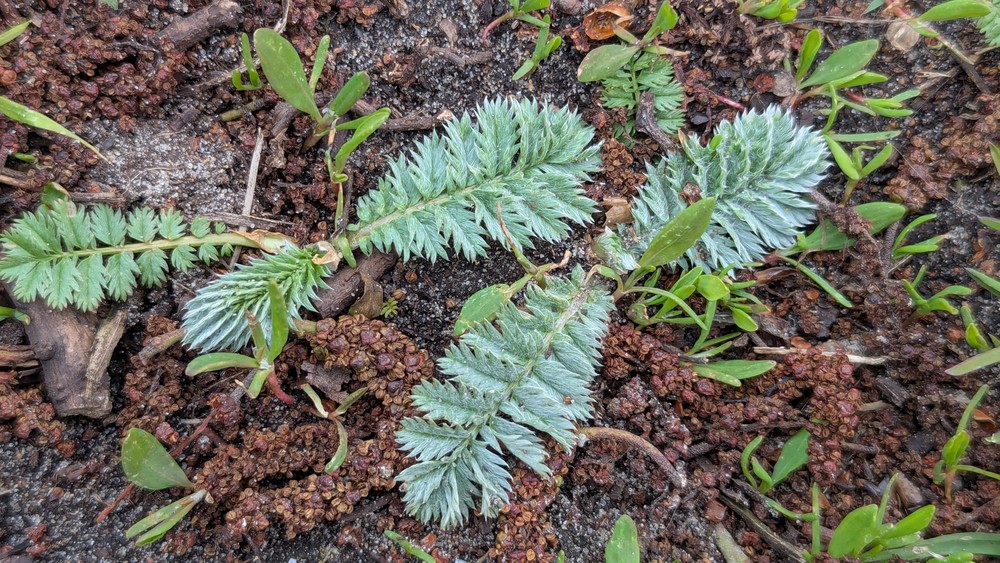
Potentilla anserina is a low spreading stoloniferous perennial reaching 4-12 inches (10-30 cm) tall with stolons that radiate up to 3 feet (90 cm) from the parent crown, rooting and forming new plants at each node. Leaves pinnately compound, 2-10 inches (5-25 cm) long, with 7-25 oblong leaflets 0.4-1.5 inches (10-38 mm) long that are sharply toothed; upper surface medium green and lower surface densely covered in silvery-white silky hairs. Flowers solitary on slender stalks 2-6 inches (5-15 cm) tall, bright yellow with 5 broad rounded petals 0.4-0.7 inch (10-18 mm) across, with a central ring of 20 or more stamens, blooming from May through August. Fleshy edible taproots 0.25-0.5 inch (6-13 mm) thick were a traditional starch source for Pacific Northwest indigenous peoples (the Pacific subspecies, sometimes treated as Argentina egedei, develops the largest roots). Spreads aggressively along stolons in moist sandy soils and may overrun smaller plantings within 2-3 years.
Native Range
Native to coastal salt marshes, brackish flats, sandy beaches, and inland wet meadows across northern circumpolar regions including coasts of Alaska, Canada, the northern United States (Pacific Northwest, Great Lakes, and Atlantic coasts), Iceland, northern Europe, and northern Asia, generally at elevations from sea level to 8,000 feet (2,400 m).Suggested Uses
Used in coastal restoration plantings, salt marsh edges, sand dune stabilization, and naturalistic moist meadow plantings at 12-18 inch (30-45 cm) spacing in zones 3-9. Its aggressive spread limits use in mixed perennial borders; planted instead as a groundcover where it can fill freely, such as wide rain garden margins or dune anchor plantings. Containers tolerate the species in pots of at least 5 gallons (19 L), but stolons fall over the rim and require trimming to keep contained.How to Identify
Appearance
Size & Dimensions
Height4" - 1'
Width/Spread1' - 3'
Bloom Information
May through August across the species range, with peak bloom from late May through July at most sites. In zones 8-9 along the coast, bloom may begin in late April. Individual flowers last 4-6 days; sequential opening from the rooting nodes sustains the colony in bloom for 10-14 weeks. Bloom continues sporadically into September on actively spreading stolons.
Detailed Descriptions
Foliage Description
Medium green above, silvery-white belowGrowing Conditions
Sun Requirements
Requires 4-12 hours of direct sunlight daily
• Full Sun: 6+ hours of direct sunlight
• Partial Shade: 3-6 hours of direct sunlight
• Full Shade: Less than 3 hours of direct sunlight
Care & Maintenance
Care Guide
Establishes within one growing season in moist sandy or sandy-loam soils with weekly water through the first summer; salt-tolerant forms accept brackish or saline conditions. Mature plants tolerate periodic drought but slow stolon production and flowering when soil dries to depth. Spreads aggressively in cultivated garden soil; volunteer plantlets may need to be removed annually to contain stands. Crown rot is uncommon. No serious pest or disease problems occur. Plants can be confined by edging buried 6-8 inches (15-20 cm) deep, but stolons may travel along the soil surface and root beyond the edge.Pruning
No formal pruning is required. Yellowing leaves are removed by hand any time during the growing season for tidiness. Stolons that have rooted beyond the desired bed are cut from the parent plant and lifted in early spring or autumn; cutting alone without removal does not stop spread because rooted plantlets persist as independent crowns.Pruning Schedule
Prune: March & October
early springfall
Container Growing
Suitable for container growing
Minimum container size: 5 gallons