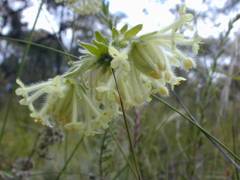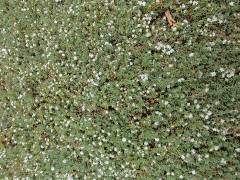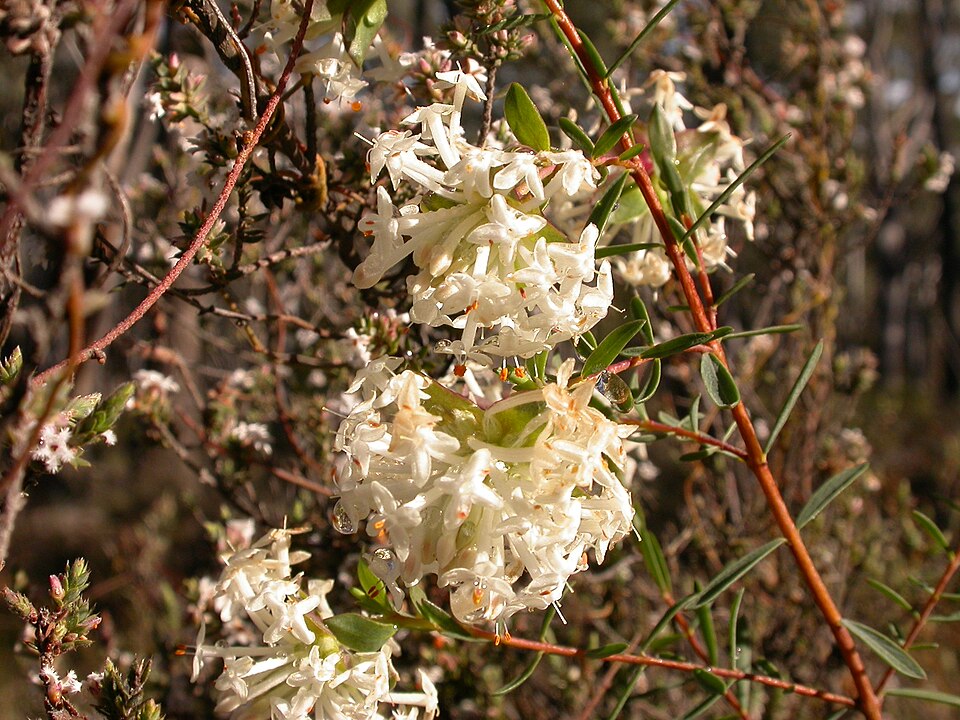
Image 1 of 7
1 / 7
© Donald Hobern from Copenhagen, Denmark, some rights reserved (CC-BY) · Wikimedia Commons
Pimelea, Genus, spp., Multiple species,
- Genus
- Multiple species
riceflowers
Australia, New Zealand, and nearby islands
Overview
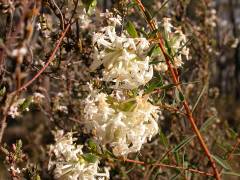
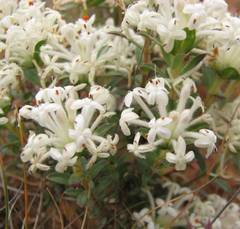
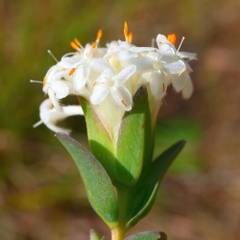
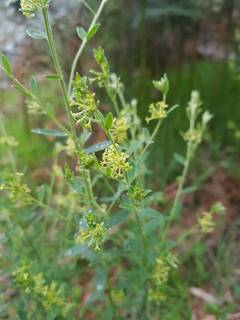
Pimelea is a genus of roughly 150 species of shrubs and subshrubs in the family Thymelaeaceae, distributed across Australia, New Zealand, and a few neighbouring islands. Plants range from prostrate mats a few centimetres high to erect shrubs reaching 6.5 ft (2 m), with most species growing 8-40 in (20-100 cm) tall. Stems are slender and wiry with a tough fibrous bark, and the simple entire leaves are arranged in opposite pairs or alternately, measuring 0.2-1.6 in (5-40 mm) long. The small tubular flowers have four spreading lobes and are massed into dense rounded terminal heads, often framed by a ring of coloured leafy bracts. Across the genus the flower colour spans white, cream, yellow, pink, and red, with individual heads measuring 0.4-1.6 in (10-40 mm) across. Flowering occurs mainly in spring and summer, though some species flower over an extended period in mild climates. Several species, including P. trichostachya and P. simplex, contain the diterpenoid simplexin and cause Pimelea poisoning in grazing cattle. The genus occupies heathland, grassland, woodland, and alpine sites, with many species adapted to nutrient-poor sandy soils. Frost tolerance varies between lowland and montane species, and most decline in prolonged waterlogging.
Native Range
The genus is centred in Australia, where most of the roughly 150 species occur, with a secondary concentration in New Zealand. A small number of species extend to Timor and Lord Howe Island.Suggested Uses
Smaller and prostrate Pimelea species are grown in rockeries, coastal gardens, and containers, while taller species are used in mixed native shrub borders. Spacing of 16-32 in (40-80 cm) suits most shrubby forms. The cut flower heads are used in fresh and dried arrangements.How to Identify
Appearance
Size & Dimensions
Height4" - 6'7"
Width/Spread1' - 4'
Bloom Information
Most Pimelea species flower from spring into summer, roughly September to February in their native southern-hemisphere range. In cultivation under mild conditions some species produce scattered heads across a wider window. The flowers are followed by small dry one-seeded fruits.
Detailed Descriptions
Flower Description
white, cream, yellow, pink, or redFoliage Description
green to grey-greenGrowing Conditions
Sun Requirements
Requires 6-8 hours of direct sunlight daily
• Full Sun: 6+ hours of direct sunlight
• Partial Shade: 3-6 hours of direct sunlight
• Full Shade: Less than 3 hours of direct sunlight
Water & Climate
Water Needs
Drought Tolerance
Drought tolerant when established
Care & Maintenance
Care Guide
Grow Pimelea in full sun to light shade in sharply drained sandy or gravelly soil with a slightly acidic to neutral pH of 5.5-7.0. The genus is adapted to low-nutrient soils, so feed sparingly with low-phosphorus formulations, as many Australian species are sensitive to phosphorus. Water young plants regularly through the first season, then reduce frequency once established, since mature plants tolerate short dry spells but decline in waterlogged ground. Most species grow well in a sheltered spot out of cold drying winds. Frost hardiness ranges from tender lowland species to montane species hardy to about 23 F (-5 C). Container culture suits the smaller species where drainage can be controlled.Pruning
Light tip pruning after flowering keeps plants compact and encourages branching. Old leafless wood regenerates slowly or not at all in many species, so hard renovation cuts often fail. Dead or frost-damaged stems can be removed in spring.Pruning Schedule
Prune: February–March
summer
Container Growing
Suitable for container growing
Minimum container size: 3 gallons