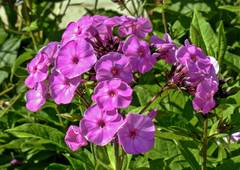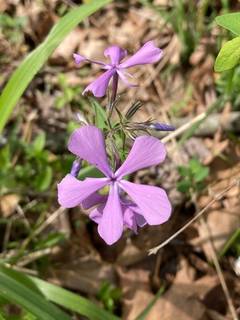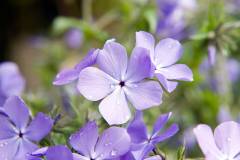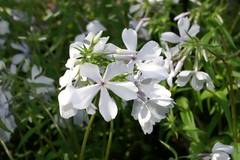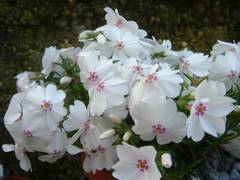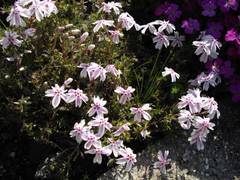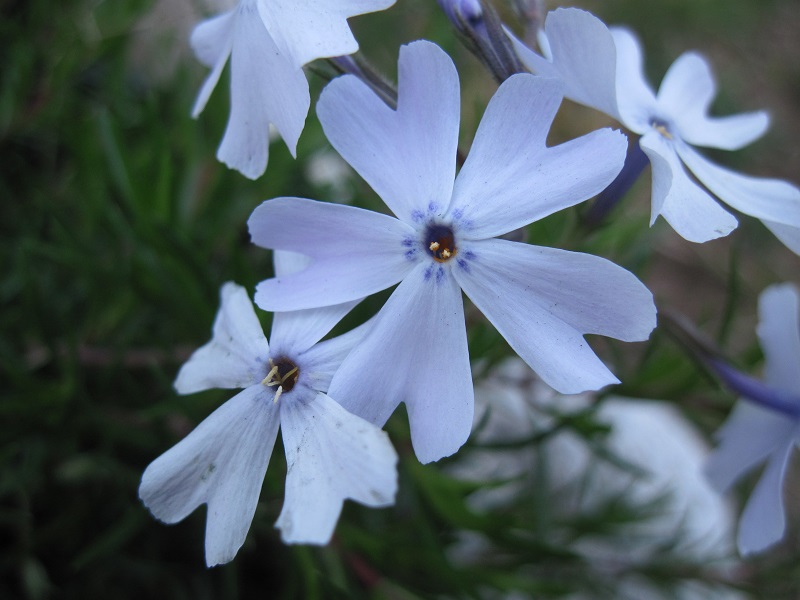
Phlox, Genus, subulata, Species, 'Emerald Blue', Cultivar,
- Genus & species
- Cultivar
emerald blue creeping phlox
Garden selection from the species Phlox subulata, which is native to eastern and central North America — rocky outcrops, dry slopes, and open sunny banks from Maine south to Tennessee and west to Michigan.
Overview
Phlox subulata Emerald Blue is a creeping phlox cultivar in the phlox family (Polemoniaceae) growing 4-6 inches (10-15 cm) tall and 18-24 inches (45-60 cm) wide as a low spreading evergreen mat. Lavender-blue to violet-blue five-petaled flowers 0.75 inch (2 cm) across cover the foliage mat in dense bloom in April and May across a 3-week active flowering window, producing the cascading blue spring waterfall effect over stone walls, retaining walls, and steep slopes that has made the species a standard spring ground cover across most of temperate North America. The cultivar name combines the foliage descriptor (emerald, for the dark green evergreen mat) with the flower descriptor (blue, for the lavender-blue spring bloom), and the two-word name captures the year-round contribution of the cultivar across both visual seasons. The lavender-blue flower color is the coolest tone in the standard creeping phlox cultivar palette, contrasting with the warm pinks (Drummond's Pink, Candy Stripe), the bright reds (Scarlet Flame), and the white (Snowflake) cultivars within the same species; the cultivar is the principal color choice when a cool-tone planting is wanted in the same species. The flower color is technically lavender-blue rather than true blue — true blue does not occur in the genus Phlox because the Phlox biochemical pathway produces anthocyanin pigments in the red-pink-purple-violet range rather than the delphinidin-derived blue pigments found in genuinely blue flowers like Delphinium and gentians. Dense dark green awl-shaped needle-like evergreen foliage on prostrate stems forms the structural mat that persists 12 months of the year, with the foliage holding its dark green color through winter even in zone 3 conditions and giving ground-cover function across the dormant season when the flowers are absent. The species' growth habit is substantially different from the upright herbaceous tall garden phlox (Phlox paniculata, 24-36 inches tall): the creeping mat-forming habit of P. subulata suits the species to ground-cover positions, slope plantings, retaining-wall cascades, and rock-garden plantings rather than the cottage-garden border position that P. paniculata fills. The cultivar is the leading blue creeping phlox in commercial distribution in North American garden centers because of vigorous mat-forming growth and reliable flowering across a broad climate range (zones 3-9). Light fragrance at flower level. Deer avoid the awl-shaped foliage from the bitter compounds the genus produces.
Native Range
Phlox subulata Emerald Blue is a garden cultivar selected from the species Phlox subulata, which is native to eastern and central North America. The species occurs on rocky outcrops, dry slopes, sandy banks, and open sunny meadow margins from Maine and southern Quebec south through New York, Pennsylvania, Virginia, and Tennessee and west to Michigan and Illinois, with the principal native habitat being well-drained rocky-substrate sunny positions on the eastern North American piedmont and the Appalachian foothills. The species' physiological adaptation to lean rocky soil and full-sun exposure carries through into the Emerald Blue cultivar, which retains the species' preference for well-drained substrate and 6+ hours of direct sun. The cultivar was selected for the lavender-blue flower color and the vigorous mat-forming growth habit that suits commercial nursery production and large-scale ground-cover planting.Suggested Uses
Used cascading over retaining walls, along stone path edges, in rock gardens, on sunny slopes, on south-facing banks, and as an evergreen ground cover in lean-soil planting positions. The cascading blue spring waterfall over stone walls is the cultivar's iconic landscape application and is the principal reason for the species' widespread garden-center distribution. The cultivar pairs with companion Phlox subulata cultivars in different colors for a multi-color spring carpet — Drummond's Pink for warm pink contrast, Snowflake for white highlight, Candy Stripe for bicolor pink-and-white, and Scarlet Flame for hot-color punch — and a mixed-cultivar planting reads as a multicolor mat from late April through May. Container culture in 1-gallon (3.8 liter) or larger pots works for the small root volume of the mat-forming habit.How to Identify
Appearance
Size & Dimensions
Height4" - 6"
Width/Spread1'6" - 2'
Colors
Bloom Information
Lavender-blue to violet-blue five-petaled flowers 0.75 inch (2 cm) across cover the foliage mat in dense bloom from April through May across a 3-week active flowering window, with the dense flower coverage producing the cascading-waterfall visual effect that has made the species a standard spring ground cover. Pollination is by butterflies and other long-tongued insect pollinators that work the salverform flat-faced flower architecture and the pale lavender-blue flower color, with the flat flower platform suiting butterfly visitation more than bee visitation. Light sweet fragrance at flower level adds a secondary sensory feature beyond the visual display.
Detailed Descriptions
Flower Description
Lavender-blue to violet-blue five-petaled flowers 0.75 inch (2 cm) across covering the foliage mat in dense bloom, with the lavender-blue color being the coolest tone in the standard creeping phlox cultivar palette and providing a counterpoint to the warm pinks and reds of other Phlox subulata cultivarsFoliage Description
Dark green; small needle-like awl-shaped leaves arranged densely along prostrate stems, with the foliage holding its dark green color through winter as an evergreen mat — the species name 'subulata' is Latin for awl-shaped and references the leaf form that distinguishes the species from broader-leaved Phlox congenersGrowing Conditions
Sun Requirements
Requires 6-10 hours of direct sunlight daily
• Full Sun: 6+ hours of direct sunlight
• Partial Shade: 3-6 hours of direct sunlight
• Full Shade: Less than 3 hours of direct sunlight
Care & Maintenance
Care Guide
Plant in full sun with at least 6 hours of direct light. Lean well-drained soil at pH 6.0-7.5 supports the cultivar; the species' rocky-outcrop native habitat means lean soil produces the strongest mat density, and high-fertility soil produces leggy growth and weak flowering. Fertilization is omitted because the species is adapted to lean rocky substrates and over-fertilization produces excessive vegetative growth at the expense of flowering. Watering is during establishment only because the species is drought-tolerant once the mat root system develops. Light shearing after bloom (cutting the spent flower-bearing stems back by one-third with grass shears or hedge shears) maintains mat density and prevents the center of the mat from thinning out across multiple seasons. The cultivar is not suited to shade or wet conditions: shaded positions produce sparse growth and reduced flowering, and wet-bottom positions cause crown rot and mat dieback. Containment is generally not needed because the spreading rate is moderate (the mat reaches its 18-24 inch full width over 2-3 seasons rather than colonizing aggressively).Pruning
Light shearing after bloom (cutting spent flower stems back by one-third) maintains mat density and prevents the mat center from thinning. No other seasonal pruning is needed because the evergreen foliage persists 12 months of the year and the mat maintains itself at ground level.Pruning Schedule
Prune: June
summer
Container Growing
Suitable for container growing
Minimum container size: 1 gallons