Petasites, Genus, frigidus, Species,
- Genus & species
coltsfoot
Circumboreal — Alaska south through BC, Washington, Oregon to California; also across boreal North America, Europe, and Asia; stream banks, wet forest edges, seeps, and moist openings
Overview
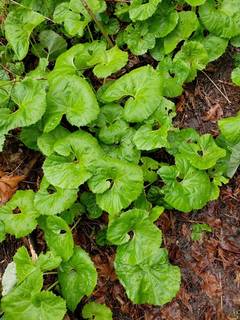
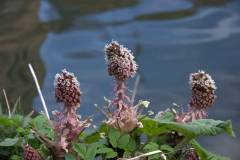
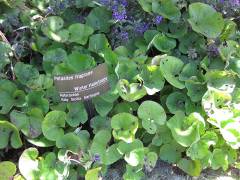
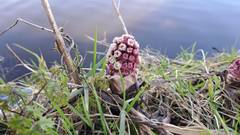
Petasites frigidus is a rhizomatous deciduous perennial in the Asteraceae family native to wet forest edges, seeps, and stream banks across the circumboreal zone. Flowering stems emerge in early spring before the leaves, reaching 4-16 inches (10-40 cm) tall and topped with rounded clusters of pinkish-white to pale lilac disk-and-ray flower heads. After bloom, large basal leaves expand to 4-12 inches (10-30 cm) wide on petioles up to 24 inches (60 cm) tall; the leaves are reniform to triangular with toothed margins, green above and white-woolly beneath. The plant spreads by thick rhizomes that form colonies several feet across in a few seasons. P. frigidus contains pyrrolizidine alkaloids in all parts and is toxic to humans if ingested; the rhizomatous spread also makes it difficult to contain in small garden settings, so it is restricted to large naturalized plantings, rain gardens, and stream-restoration sites where colony formation is acceptable. Hardy to USDA zone 2, it tolerates wet to saturated soils and partial to full shade. The North American material is sometimes treated as the distinct species P. palmatus or as the variety P. frigidus var. palmatus.
Native Range
Native to stream banks, wet forest edges, seeps, and moist openings from Alaska south through British Columbia, Washington, and Oregon to California, and broadly across the circumboreal zone of North America, Europe, and Asia.Suggested Uses
Used in rain gardens, stream restoration plantings, large naturalized woodland edges, and pond margin plantings where rhizomatous spread is acceptable. Spaced 24-36 inches (60-90 cm) apart, plants form a continuous groundcover within 2-3 seasons. Not suited to mixed perennial borders or small gardens because of the rapid spread.How to Identify
Appearance
Size & Dimensions
Height4" - 2'
Width/Spread2' - 4'
Bloom Information
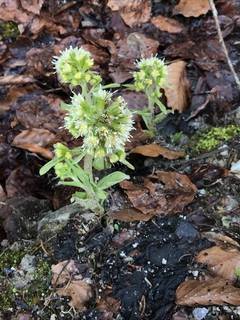
Blooms February to May depending on elevation and latitude, with flowers appearing on bare stalks before the leaves expand. Pinkish-white to pale lilac disk-and-ray flower heads are clustered in flat-topped corymbs 2-4 inches (5-10 cm) across at the top of stout stems. Flowering lasts 3-5 weeks per colony; the bare flowering stems are visually distinct from the later large basal leaves.
Detailed Descriptions
Flower Description
Pinkish-white to pale lilacFoliage Description
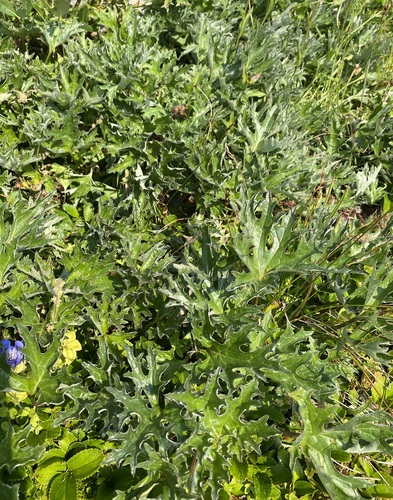
Green above; white-woolly tomentose beneathGrowing Conditions
Sun Requirements
Requires 2-5 hours of direct sunlight daily
• Full Sun: 6+ hours of direct sunlight
• Partial Shade: 3-6 hours of direct sunlight
• Full Shade: Less than 3 hours of direct sunlight
Care & Maintenance
Care Guide
Site P. frigidus in part shade to full shade with consistently moist to saturated soil; suitable for stream banks, rain gardens, pond margins, and bog gardens. Tolerates seasonal flooding and prefers organic-rich, acidic to neutral substrates. Plant rhizome divisions 6-12 inches (15-30 cm) deep in fall or early spring, spacing 24-36 inches (60-90 cm) apart for a colony to fill in within 2-3 seasons. Water deeply during establishment; once established the plant requires no supplemental irrigation in sites with reliable groundwater. The vigorous rhizomatous spread will overrun smaller perennials, and root barriers are commonly used in mixed plantings. All parts contain pyrrolizidine alkaloids and the plant should not be planted near vegetable beds where leaves might be confused with edible greens.Pruning
Cut spent flowering stems to the base after seed set in late spring if self-seeding is not wanted. Foliage dies back in fall and decomposes naturally; cut and remove blackened leaves in late autumn if the planting is in a visible location. To control colony spread, sever and remove rhizomes at the colony edge in fall or early spring with a sharp spade.Pruning Schedule
Prune: June & November
late springfall