Petasites, Genus, japonicus, Species,
- Genus & species
fuki,butterburr
Eastern Asia — Japan, Korea, northeastern China, and the Kuril and Sakhalin islands of the Russian Far East; moist stream banks, river margins, wet mountain meadows, and forest edges; naturalized widely outside the native range across temperate Europe, North America, and New Zealand through escape from garden cultivation and classified as an invasive species in several regions
Overview
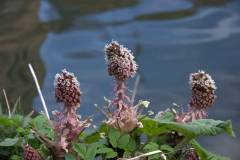
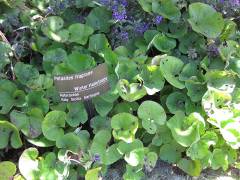
Petasites japonicus is a large spreading deciduous herbaceous perennial in the family Asteraceae native to the wet habitats of eastern Asia, growing 36-48 inches (90-120 cm) tall and 48-72 inches (120-180 cm) wide per plant with colonies extending indefinitely through rhizomatous spread. The species produces two separate visual displays across the year that give it a central role in bog and wet-garden plantings. First, in late winter from February through March, dense rounded clusters 4-6 inches (10-15 cm) across of small white to pale-yellow composite flower heads emerge on scaly pre-foliar stems 6-12 inches (15-30 cm) tall, rising directly from the underground rhizome before any leaves appear — this pre-foliar flowering habit is atypical among temperate perennials and produces one of the earliest bloom displays of any cold-hardy plant, drawing early-season bees and flies when few other nectar sources are available. The flower clusters (known as fuki-no-tou in Japanese cuisine) are harvested and cooked as a traditional early-spring vegetable in Japan, Korea, and parts of China. Second, after the flowering period ends, enormous mid-green kidney-shaped leaf blades 24-48 inches (60-120 cm) across expand from the underground rhizome on stout hollow bristly petioles and produce a dense tropical-looking ground-cover canopy through the main growing season — the leaves are among the largest of any temperate-climate herbaceous perennial and rival the size of small umbrellas (the genus name Petasites derives from the Greek 'petasos' for a broad-brimmed shade hat, a direct reference to leaf size). The leaf petioles (fuki) are harvested, peeled, and boiled as a traditional Japanese cooked vegetable with a mild vegetable flavor and a crunchy celery-like texture, and fuki is sold in Japanese and Korean grocery stores as a seasonal spring and early-summer vegetable. The central ecological and cultivation consideration for this species is aggressive rhizomatous spread: the thick underground rhizomes expand several feet per year under favorable moist conditions and regenerate from small fragments if dug up and disturbed, forming dense monocultures that displace surrounding vegetation and are extremely difficult to eradicate once established. The species is classified as an invasive species in several U.S. states, in the United Kingdom, and in parts of continental Europe where it has escaped garden cultivation and colonized stream banks and wet-forest habitats. Gardeners planting P. japonicus in North America and Europe are advised to verify regulatory status in their local jurisdiction and to plan for either a contained installation (with root barriers or concrete curbing) or a setting where the aggressive spread can be accommodated as part of the garden design. All parts of the plant contain pyrrolizidine alkaloids that are hepatotoxic when consumed in raw form or in large quantities over time, and traditional Japanese preparation methods involve blanching, peeling, and extended cooking to reduce the alkaloid content to safe levels — the raw plant is not safe for consumption and should not be treated as a casual wild edible, though the properly prepared traditional dishes have a long culinary history. Deer avoid the foliage. The species is not drought-tolerant and needs consistent soil moisture through the active growing season.
Native Range
Petasites japonicus is native to the wet habitats of eastern Asia, with a natural range spanning Japan (where it is an important traditional vegetable and is cultivated commercially as well as collected from wild populations), Korea, northeastern China, and the Kuril and Sakhalin islands of the Russian Far East. The species grows on moist stream banks, river margins, wet mountain meadows, and the shaded edges of moist deciduous and mixed forests at low to mid elevations where the consistent soil moisture and cool humid summer conditions of the native range match the cultivation requirements. The species has naturalized widely outside the native range across temperate Europe (including Britain, Ireland, Germany, France, Belgium, the Netherlands, and Switzerland) and across several regions of North America (including parts of Washington, Oregon, British Columbia, New York, Massachusetts, and the upper Midwest) through escape from garden cultivation, and is classified as an invasive species in several jurisdictions. Commercial cultivation for the edible stalks continues in Japan and Korea as a traditional vegetable production industry, and the plant carries significant cultural weight as one of the earliest spring foods of the year in Japanese cuisine where fuki is associated with early-spring seasonal cooking traditions.Suggested Uses
Planted at stream banks, pond margins, bog garden edges, rain garden low points, and large wet woodland plantings at 4-6 foot (1.2-1.8 m) spacing in zones 4-9 where the aggressive rhizomatous spread can be accommodated either through root-barrier containment or through the scale of the planting site, and where regulatory status permits the species. The enormous tropical-looking kidney-shaped leaves and the pre-foliar late-winter flower clusters together give the species a role in bold-foliage water-feature plantings where the scale and the two-season interest justify the space allocation and the management of the rhizomatous spread. Combined with other large-leaved moist-shade perennials including Gunnera (where climate permits), Darmera peltata, Rodgersia, Ligularia, Lysichiton americanus (western skunk cabbage), and ostrich fern Matteuccia struthiopteris in bog and water-garden plantings where the shared moisture requirements align and the bold foliage theme gives the planting a tropical appearance despite the temperate climate. Traditional Japanese vegetable garden plantings grow the species as a spring and early-summer food crop alongside other Japanese culinary perennials. Not suited to regions where the species is classified as a regulated invasive (parts of North America and Europe), small residential gardens where the rhizomatous spread cannot be contained and overwhelms neighboring plantings, dry sites without consistent moisture where the leaves wilt and the plant declines, formal plantings where the rough wild character of the foliage conflicts with controlled design, or households where the toxic pyrrolizidine alkaloids pose an ingestion risk to young children or curious pets.How to Identify
Appearance
Size & Dimensions
Height3' - 4'
Width/Spread4' - 6'
Bloom Information
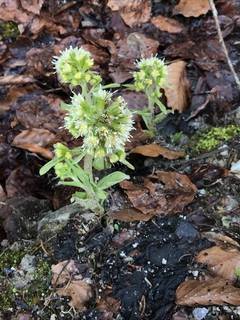
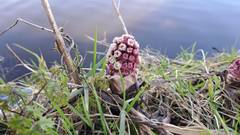
Small white to pale-yellow composite flower heads packed into dense rounded clusters 4-6 inches (10-15 cm) across open on scaly pre-foliar stems 6-12 inches (15-30 cm) tall during February and March in zones 4-9, lasting approximately 3 weeks. The flowering stems rise directly from the underground rhizome before any leaves appear, and the pre-foliar bloom display is one of the earliest flower events of any cold-hardy temperate perennial — drawing early-season bees, flies, and other pollinators at a time when few other nectar sources are available. The flower clusters are known as fuki-no-tou in Japanese cuisine and are harvested and cooked as a traditional early-spring vegetable alongside the similarly-harvested leaf petioles (fuki). After pollination the flower stems elongate to release wind-dispersed seeds, though seed production is a minor contribution to the species' spread compared to the dominant rhizomatous vegetative expansion. The enormous leaves expand after the flowering period ends and dominate the plant's visible presence through the remainder of the growing season.
Detailed Descriptions
Flower Description
white to pale yellow; small composite flower heads packed into dense rounded clusters 4-6 inches (10-15 cm) across on scaly pre-foliar stems 6-12 inches (15-30 cm) tall emerging directly from the underground rhizome in late winter before any leaves appearFoliage Description
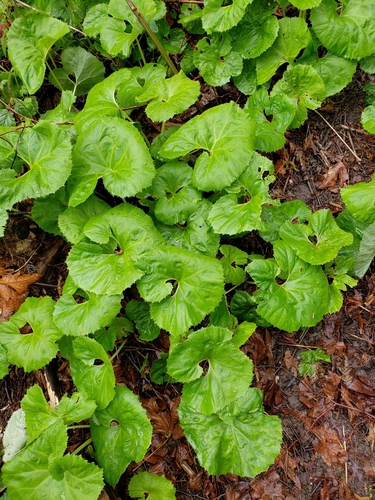
mid-green; enormous rounded kidney-shaped leaf blades 24-48 inches (60-120 cm) across carried on stout hollow bristly petioles rising from the underground rhizome; the leaves are among the largest of any temperate-climate herbaceous perennial and create a dense tropical-looking ground-cover canopy in mature plantingsGrowing Conditions
Sun Requirements
Requires 2-8 hours of direct sunlight daily
• Full Sun: 6+ hours of direct sunlight
• Partial Shade: 3-6 hours of direct sunlight
• Full Shade: Less than 3 hours of direct sunlight
Care & Maintenance
Care Guide
Plant in moist to wet humus-rich soil with a pH of 5.5-7.0 in part shade to full sun (2-8 hours of direct sun), with full sun tolerated only where the soil remains consistently moist or saturated through the summer season; tolerated soil types include loam, clay, and peat. The species is not drought-tolerant and dry conditions cause leaf wilting, browning, and premature dormancy, so the species is suited to stream banks, pond margins, rain garden floors, and purpose-built wet plantings where consistent moisture is guaranteed rather than to ordinary garden borders with only average summer rainfall. The central cultural consideration is aggressive rhizomatous spread: the thick underground rhizomes expand several feet per year under favorable moist conditions and form dense monocultures that displace surrounding vegetation, and the rhizomes regenerate from small fragments if dug and disturbed so eradication of an established colony requires repeated digging over several seasons. Installation of root barriers (heavy plastic sheeting buried 24-36 inches / 60-90 cm deep around the planting), concrete curbing, or containment in large planters sunk in the ground is the standard approach for containing the spread in mixed plantings, while plantings in open stream-bank settings or wild-garden areas can be allowed to expand without containment if the site can accommodate the scale. The species is classified as an invasive species in several U.S. states, in the United Kingdom, and in parts of continental Europe — gardeners in these regions are advised to verify regulatory status before planting and to not release the plant into natural areas where it can escape and colonize wild wetlands. Dead foliage is cut to the ground in fall (November) after the leaves collapse. All parts of the plant contain pyrrolizidine alkaloids that are hepatotoxic when consumed raw or in large quantities over time, and traditional Japanese preparation methods involve blanching, peeling, and extended cooking to reduce alkaloid content to safe levels — the raw plant is not safe for consumption and should not be treated as a casual wild edible despite the long culinary tradition of the properly prepared vegetable. Deer avoid the foliage.Pruning
Dead foliage is cut to the ground in fall (November) after the first frost collapses the leaves, clearing the planting for the pre-foliar flower emergence that follows in late winter. Unwanted rhizome growth along the edges of an established colony is dug out during the active growing season when the leaves make the shoots easy to locate, with the whole attached rhizome section removed rather than just the visible shoot because rhizome fragments left in the soil regenerate into new shoots within the same season. Containment by root barriers or concrete curbing is the standard long-term approach in plantings where the aggressive spread is unwanted, and the containment is inspected annually for rhizomes that have escaped over or under the barrier. Flower stalks can be cut at the base after bloom if seed production and visible flowering debris are unwanted, though the flower event is typically part of the garden value of the species in late winter plantings.Pruning Schedule
Prune: November
fall