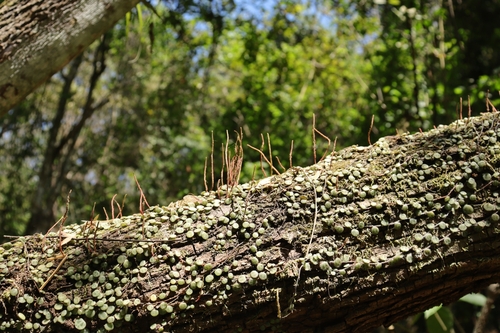
Peperomia, Genus, prostrata, Species,
- Genus & species
string of turtles
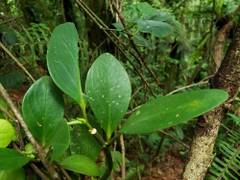
Atlantic Forest of southeastern Brazil
Overview
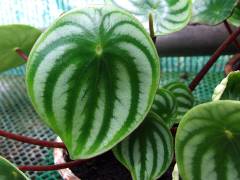
Peperomia prostrata is an evergreen trailing epiphyte in the Piperaceae family grown indoors for its small round patterned leaves on hanging stems. Mature plants produce stems 12–24 inches (30–60 cm) long, each bearing alternate to subopposite leaves spaced about 0.5 inch (12 mm) apart, giving the strands a beaded appearance. Leaves are succulent, near-circular, 0.4–0.7 inch (10–18 mm) across, with a domed upper surface bearing a network of pale gray-green to silvery vein patterns on a dark gray-green ground; this tortoise-shell pattern is the source of the common name 'String of Turtles.' New leaves emerge bright green and develop the silvery vein pattern as they mature over 4–6 weeks. Inflorescences are slender pale-green spikes (typical of the genus) that emerge above the foliage in summer, carrying many tiny non-showy flowers; the spikes are often removed by growers because they add little to the leaf display and divert energy from foliage growth. The plant is non-toxic to pets and humans. Roots form along the prostrate stems where leaves contact damp medium, allowing simple propagation by laying a stem segment on moist soil. Plants in dry indoor air or under low light push out smaller leaves and longer internodes; mature pendant strands take 18–24 months to reach 12 inches (30 cm).
Native Range
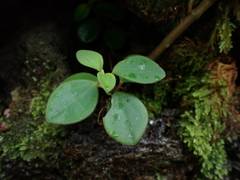
Peperomia prostrata is native to tropical southeastern Brazil (Atlantic Forest region of Espírito Santo, Rio de Janeiro, and São Paulo states), growing as an epiphyte on tree branches and rocks in shaded humid microhabitats at 200–800 m (660–2,600 ft) elevation. The species is restricted to the Mata Atlântica biome and is propagated commercially by stem cuttings rather than seed.Suggested Uses
Used as a hanging-basket or shelf-edge specimen indoors, in terrariums, and in shaded epiphyte mounts where humidity stays above 50%. Pairs well with other small-leaved trailing tropicals (Pilea glauca, Hoya curtisii, small Ficus pumila forms) at similar light requirements. Spaced one plant per 4–6 inch (10–15 cm) shallow pot, the trailing strands reach 12 inches (30 cm) within 18–24 months from a rooted cutting.How to Identify
Appearance
Size & Dimensions
Height2" - 4"
Width/Spread1' - 2'
Colors
Bloom Information
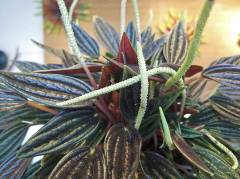
Inflorescences emerge in summer (June–August) on indoor plants in bright conditions, consisting of slender pale-green flower spikes 1.5–3 inches (4–8 cm) long held above the foliage. Each spike carries many tiny flowers densely packed along the rachis; the flowers are not showy and many growers remove the spikes within 1–2 weeks to redirect energy to leaf production. Bloom is uncommon under low light and absent in plants kept below 5,000 lux.
Detailed Descriptions
Foliage Description
dark gray-green with silvery vein patternsGrowing Conditions
Sun Requirements
Needs bright indirect light. Keep it out of direct sun, which can scorch the leaves.
• Bright indirect light: a bright spot near a window, with no direct sun on the leaves
Care & Maintenance
Care Guide
Bright indirect light of 8,000–15,000 lux suits this species; under 4,000 lux internodes lengthen and the silvery vein patterns become muted, while direct sun bleaches and crisps the small leaves. Temperatures of 60–80°F (16–27°C) are required, with leaf damage starting at 50°F (10°C). A well-drained mix (2 parts standard houseplant mix to 1 part perlite to 1 part orchid bark) drains within 30 seconds of watering. Watering occurs when the top half of the pot dries; constantly wet medium causes stem rot at the soil line and is the main cause of plant loss in this species. Humidity above 50% supports steady growth, and very dry indoor air below 30% causes leaf shrinkage. Balanced liquid fertilizer at quarter strength every 4–6 weeks during active growth (April–September) supports new leaf production; fertilizer is paused during winter.Pruning
Tip-pruning is done to maintain compact strands and encourage branching, typically in spring (March–May) using a clean blade. Damaged or scorched leaves can be removed by pinching at the petiole base. Long bare strands with leaf gaps can be cut back to a healthy section, and the cuttings can be propagated on damp medium to renew the planting.Pruning Schedule
Prune: March–May
early springlate spring
Container Growing
Suitable for container growing
Minimum container size: 1 gallons