Packera, Genus, obovata, Species,
- Genus & species
roundleaf ragwort
Overview
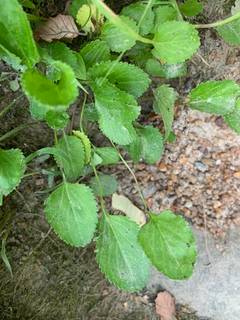
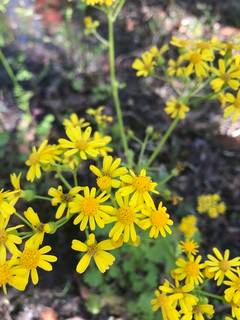
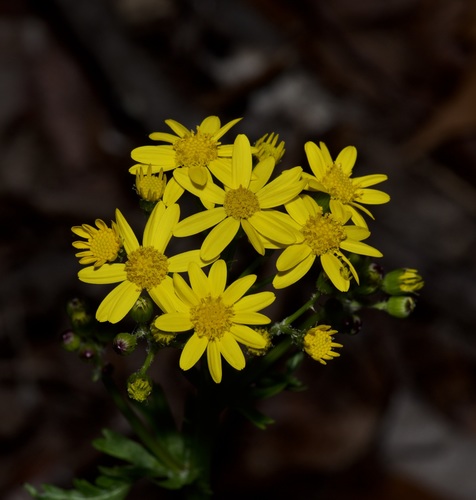
Packera obovata is a clumping, spreading perennial in the Asteraceae that forms a basal rosette of rounded, spoon-shaped leaves and spreads by short stolons into a low groundcover. The basal leaves are obovate to nearly round, 1-3 inches (2.5-8 cm) long, with toothed or scalloped margins, dark green above and often purple-tinged beneath, while the smaller stem leaves are deeply lobed. In spring, flowering stems 12-24 inches (30-60 cm) tall carry flat clusters of yellow daisy-like heads, each about 0.5-0.75 inch (12-19 mm) across with yellow rays around a yellow centre. After bloom the seed heads form a fluffy white pappus, and the plant carries on through the year as overwintering rosettes. It grows in moist to dry woodland, on slopes, limestone outcrops, and streambanks, tolerating both sun and shade. All parts contain pyrrolizidine alkaloids that are toxic to people and livestock if eaten. The spreading habit can crowd smaller plants in a border.
Native Range
Native to eastern and central North America, from the mid-Atlantic and southeastern states west to Texas and north into the Great Lakes region. It grows in moist to dry woodlands, on rocky and limestone slopes, bluffs, and along streams.Suggested Uses
Used as a spring-flowering groundcover in woodland gardens, shaded borders, native plantings, and on slopes for erosion control, spaced 12-18 inches (30-45 cm) apart. It suits naturalised areas where its stoloniferous spread fills space. The spreading habit and toxicity make it poorly suited to small formal beds or pet and livestock areas.How to Identify
Appearance
Size & Dimensions
Height1' - 2'
Width/Spread1' - 1'6"
Bloom Information
Flowering occurs in spring, mainly April and May, over a period of three to four weeks. Flat-topped clusters of yellow heads open above the foliage and are followed by wind-borne seed. Bloom is earlier in the south and later at northern sites and higher elevations.
Detailed Descriptions
Foliage Description
green, purple-tinged beneathGrowing Conditions
Sun Requirements
Requires 3-8 hours of direct sunlight daily
• Full Sun: 6+ hours of direct sunlight
• Partial Shade: 3-6 hours of direct sunlight
• Full Shade: Less than 3 hours of direct sunlight
Care & Maintenance
Care Guide
Grows in full sun to shade in average to moist, well-drained soil over a pH range of about 5.5-7.0, including clay and rocky or limestone-derived soils. Established plants tolerate short dry spells but flower and spread most freely with steady spring moisture. It travels by stolons to form colonies, so room to expand suits it. Propagation is easy from division of rooted offsets or from fresh seed. Hardy in USDA zones 4-8. All parts are toxic to livestock and people if eaten.Pruning
Needs little pruning. Spent flower stems are cut back after bloom to keep the planting tidy and limit self-seeding. Stolons and offsets that stray beyond the intended area are lifted or cut off. The basal rosette is left in place over winter.Pruning Schedule
Prune: June
summer
Container Growing
Suitable for container growing
Minimum container size: 1 gallons