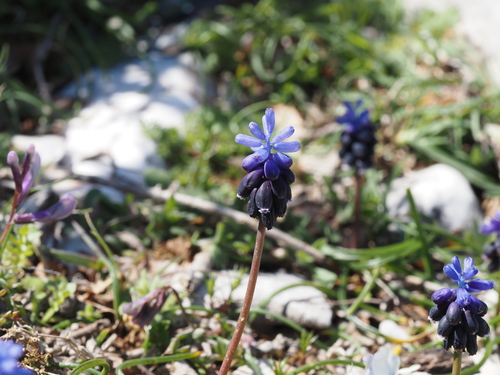
Muscari, Genus, neglectum, Species,
- Genus & species
musk hyacinth
Southern and central Europe, North Africa, and western Asia
Overview
Grape hyacinth is a small spring-flowering bulb in the asparagus family, growing 4-8 inches (10-20 cm) tall with a spread of 2-4 inches (5-10 cm) per bulb. Narrow, grass-like leaves emerge in autumn, persist through winter, and flop somewhat by bloom time. In early to mid-spring each bulb sends up one or more stiff stems topped by a dense, cone-shaped cluster of tight, urn-shaped flowers. The flowers are deep blue-violet with a small white rim at the puckered mouth, and the sterile flowers at the top of the spike are paler and smaller. A faint musky scent gives the species one of its common names. Muscari neglectum multiplies quickly by offset bulbs and self-sown seed, forming broad drifts over a few seasons; in lawns and beds this spread can become weedy and hard to remove once established. After flowering the foliage yellows and dies back, and the bulbs rest dormant through summer. The leaves that return in autumn can look untidy through winter, the main trade-off for the spring flowers.
Native Range
Native to southern and central Europe, North Africa, and western Asia around the Mediterranean and Black Sea. Muscari neglectum grows in grassland, scrub, vineyards, and rocky open ground, and has naturalized widely in temperate gardens and beyond.Suggested Uses
Planted in drifts at the front of borders, under deciduous shrubs and trees, in rock gardens, and naturalized in short grass. The early flowers fill the gap before later spring bulbs and perennials. It also suits containers and edging where its low blue spikes mass together.How to Identify
Appearance
Size & Dimensions
Height4" - 8"
Width/Spread2" - 4"
Bloom Information
Blooms in early to mid-spring, usually March to April, over about three to four weeks. The dense flower spikes open from the bottom upward, and a planting comes into color all at once. Flowering ends as the foliage begins to fade for summer dormancy.
Detailed Descriptions
Flower Description
deep blue-violet with white rimFoliage Description
greenGrowing Conditions
Sun Requirements
Requires 4-8 hours of direct sunlight daily
• Full Sun: 6+ hours of direct sunlight
• Partial Shade: 3-6 hours of direct sunlight
• Full Shade: Less than 3 hours of direct sunlight
Care & Maintenance
Care Guide
Grows in full sun to part shade in average, well-drained soil with a pH from 6.0 to 7.5. Bulbs are planted about 3 inches (8 cm) deep in autumn and need a cold winter to flower well. The plant tolerates poor, dry soils once dormant and rots in ground that stays wet in summer. It needs no feeding in average soil, though a light feed after bloom supports the bulbs. Clumps can be lifted and divided in early summer as the foliage dies back, to thin crowded colonies and move offsets. Because it spreads by seed and offsets, it can colonize lawns and borders more widely than intended.Pruning
Spent flower stems are removed after bloom to limit self-seeding. The leaves are left to yellow and die back on their own, which feeds the bulb for the next year. Foliage is cleared only once it has fully withered.Container Growing
Suitable for container growing
Minimum container size: 1 gallons


