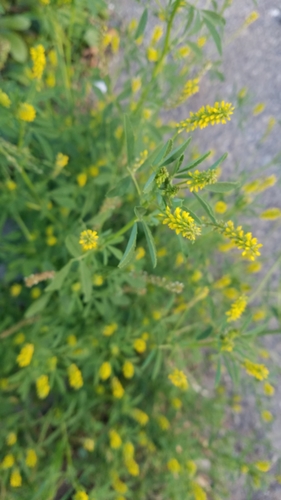
Melilotus, Genus, indicus, Species,
- Genus & species
small melilot
Mediterranean Basin and western Asia
SunFull Sun
Overview
Melilotus indicus is an annual or winter-annual legume reaching 4-24 in (10-60 cm) tall, with erect, branched, mostly hairless stems. The leaves are trifoliate; each leaflet measures 0.4-1 in (1-2.5 cm) long, narrowly oblong to wedge-shaped, with finely toothed margins. From spring into summer, slender racemes 0.4-2 in (1-5 cm) long carry numerous yellow pea-type flowers, each only 2-3 mm across, smaller than the 5-7 mm flowers of M. officinalis. Every flower is followed by a small, hairless pod about 2-3 mm long containing a single seed. The foliage and stems contain coumarin, which produces a sweet hay scent as the plant dries. M. indicus completes its life cycle in a single season and dies after setting seed, then relies on a persistent soil seed bank rather than perennial regrowth. It colonises disturbed, compacted, and saline soils, and is classed as a weed of roadsides, crops, and waste ground across much of its naturalised range. As a legume it fixes nitrogen through root nodules, and is sometimes grown as a short-term green manure or forage crop, though its coumarin content limits palatability.
Native Range
Native to the Mediterranean Basin, southern Europe, and western and southern Asia. It has naturalised widely in Australia, the Americas, and southern Africa, typically on disturbed and saline ground.Suggested Uses
Sometimes sown as a short-term green manure or cover crop to add nitrogen and organic matter to depleted soils. It also serves as rough forage on marginal land, though coumarin reduces its feed value.How to Identify
Appearance
Size & Dimensions
Height4" - 2'
Width/Spread6" - 1'6"
Bloom Information
Flowering runs mainly from spring through early summer, roughly September to December in its southern-hemisphere range and April to July in the northern hemisphere. The small yellow flowers open progressively up the lengthening raceme over several weeks. In mild climates scattered flowering can continue after rain.
Detailed Descriptions
Foliage Description
greenGrowing Conditions
Sun Requirements
Requires 6-12 hours of direct sunlight daily
• Full Sun: 6+ hours of direct sunlight
• Partial Shade: 3-6 hours of direct sunlight
• Full Shade: Less than 3 hours of direct sunlight
Water & Climate
Water Needs
Drought Tolerance
Drought tolerant when established
Care & Maintenance
Care Guide
Melilotus indicus grows in full sun on a wide range of soils, including poor, compacted, alkaline, and mildly saline ground. It tolerates drought once established and needs no supplemental feeding, since root nodules fix atmospheric nitrogen. Seed germinates after autumn or spring rain and seedlings develop a deep taproot. Plants set seed prolifically and self-sow, so unwanted stands spread readily on bare soil. Growth is fastest in cool, moist conditions and slows sharply under summer heat and water stress.Pruning
No pruning is required for this annual. Plants can be cut or mown before pods ripen to limit self-seeding, and the cut material breaks down quickly as a nitrogen-rich green manure.Toxicity Warning
Toxic to petsPlanting Guide
Planting Methods & Timing
Planting Method
direct sow
Direct Sow Timing
autumn or early spring
Days to Maturity
90–150 days
Plant Spacing
6 inches


