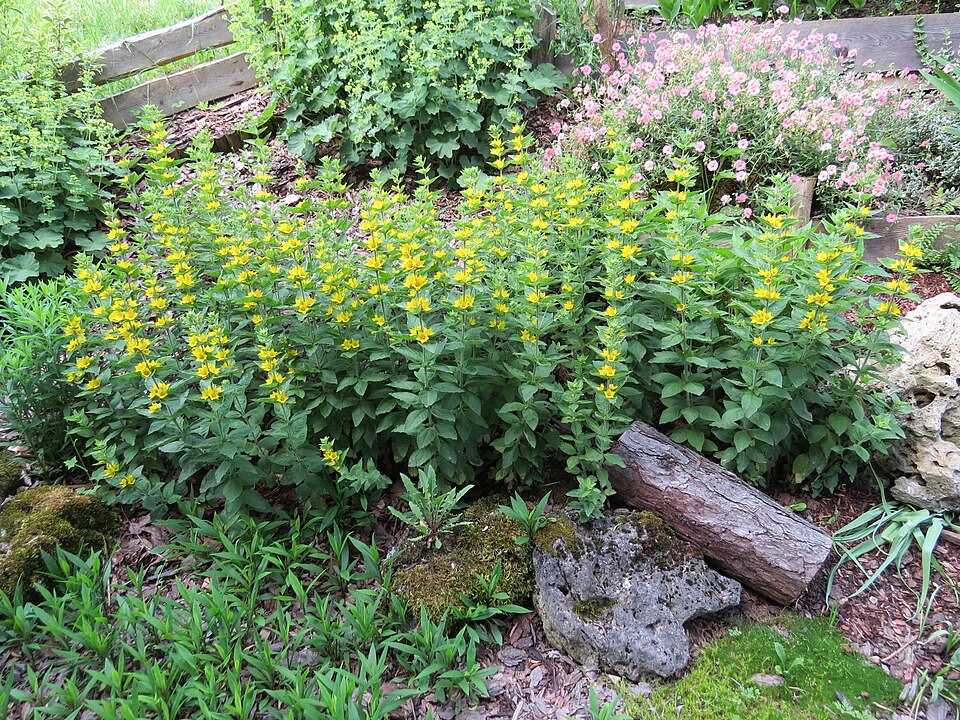
Lysimachia, Genus, punctata, Species,
- Genus & species
dotted loosestrife
Overview
Lysimachia punctata is an upright, clump-forming perennial 24-36 inches (60-90 cm) tall that spreads steadily by underground rhizomes to form broad colonies. Stiff, hairy stems carry whorls of pointed, oval leaves 2-4 inches (5-10 cm) long in tiers up the stem. Through summer the upper leaf axils fill with whorls of cup-shaped, bright yellow flowers about 1 inch (2.5 cm) across, often marked with dark dots and rusty-orange centres, so the top half of each stem becomes a column of yellow. It grows in damp to moist soil in sun or part shade and runs freely once settled, forming dense stands that can crowd out smaller neighbours. The roots spread well beyond the original clump, and the plant is widely naturalised along ditches and damp ground outside its native range. Foliage dies back to the ground in winter and returns from the rhizomes in spring. It tolerates poor conditions but flowers most freely in moist, fertile soil and open sun.
Native Range
Lysimachia punctata is native to south-eastern Europe and Turkey, in damp meadows, stream sides, and open woodland. It has naturalised widely across Europe and North America, often escaping from gardens onto damp roadsides and ditches.Suggested Uses
Grown in damp borders, bog and pond margins, wild gardens, and large naturalistic plantings where its spread is welcome. Massed in moist ground, it makes a strong block of summer yellow and fills difficult wet corners.How to Identify
Appearance
Size & Dimensions
Height2' - 3'
Width/Spread1'6" - 3'
Bloom Information
Whorls of yellow flowers open from June to August, rising up the stem as the season goes on. The long display lasts six to eight weeks at the height of summer. Bees and hoverflies visit the open flowers.
Detailed Descriptions
Foliage Description
greenGrowing Conditions
Sun Requirements
Requires 4-12 hours of direct sunlight daily
• Full Sun: 6+ hours of direct sunlight
• Partial Shade: 3-6 hours of direct sunlight
• Full Shade: Less than 3 hours of direct sunlight
Care & Maintenance
Care Guide
Grow in moist to damp soil in full sun or part shade, where it spreads quickly to fill space. It tolerates heavy, wet ground and poorer soils but flowers most freely in moisture-retentive, fertile sites. Because it runs strongly by rhizome, it suits wild or contained plantings rather than small mixed borders, where it can overrun neighbours. Lifting and dividing every few years, or planting within a barrier, keeps the spread in check. Cutting it back after flowering tidies the clump and limits self-seeding. It needs little feeding and no staking.Pruning
Cut the stems back after flowering to tidy the clump and prevent seeding, or leave them to stand into autumn. Old top growth is removed in late winter before new shoots rise. Dividing the clump in spring or autumn controls its spread.Container Growing
Suitable for container growing
Minimum container size: 3 gallons


