Overview
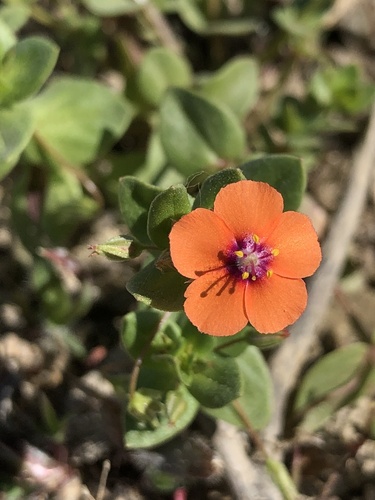
Lysimachia arvensis, the scarlet pimpernel, is a low-growing annual (occasionally a short-lived perennial) in the primrose family, with weak, sprawling, four-angled stems 4-12 inches (10-30 cm) long that spread along the ground. The opposite, stalkless leaves are oval, 0.4-1 inch (10-25 mm) long, smooth-edged, and dotted with dark glands on the underside. From late spring through autumn it produces solitary five-petalled flowers about 0.4-0.6 inch (10-15 mm) across on slender stalks from the leaf axils, usually salmon to brick-orange, sometimes blue, with a small reddish eye. The flowers open in bright sun and close in cloudy weather and by mid-afternoon, a habit that gives the plant its old name of poor man's weatherglass. Round capsules split around the middle to release many tiny seeds. The plant grows quickly on disturbed and cultivated ground, completing its cycle in a single season and self-sowing freely. It is naturalized across much of North America as a weed of fields and gardens. All parts contain saponins and can be toxic to grazing animals and irritating to skin.
Native Range
Native to Europe, North Africa, and western Asia, where it grows on cultivated and disturbed ground. It has spread as a weed across temperate and subtropical regions worldwide. In North America it is naturalized in fields, gardens, and roadsides throughout much of the continent.Suggested Uses
Mostly encountered as a weed rather than a cultivated plant, though it sometimes appears in wildflower seed mixes. Its low sprawling habit suits open, sunny, disturbed ground. It is not used in formal plantings because of its weedy spread and toxicity to livestock.How to Identify
Appearance
Size & Dimensions
Height4" - 1'
Width/Spread6" - 1'
Bloom Information
Flowers from late spring through autumn, roughly May to October, with each flower lasting a single day. Blooms open in direct sun and close by early afternoon or in overcast conditions. Small bees and flies visit the flowers, which can also self-pollinate.
Detailed Descriptions
Foliage Description
greenGrowing Conditions
Sun Requirements
Requires 6-12 hours of direct sunlight daily
• Full Sun: 6+ hours of direct sunlight
• Partial Shade: 3-6 hours of direct sunlight
• Full Shade: Less than 3 hours of direct sunlight
Water & Climate
Water Needs
Drought Tolerance
Drought tolerant when established
Care & Maintenance
Care Guide
Grows in full sun in average to dry, well-drained soil and tolerates poor and sandy ground. It needs no care once seedlings appear and germinates readily on bare, disturbed soil. Because it self-sows heavily, removing plants before seed set limits its spread. It withstands drought and short dry spells but fades in deep shade. It has few pests of note. As an annual it relies on a fresh crop of seedlings each year rather than persisting from a root.Pruning
No pruning is needed. Plants can be pulled or hoed once they finish flowering, as they will not regrow. Removing them before seed ripens reduces self-seeding.Toxicity Warning
Toxic to pets and humansPlanting Guide
Planting Methods & Timing
Planting Method
direct sow
Direct Sow Timing
Spring
Plant Spacing
8 inches


