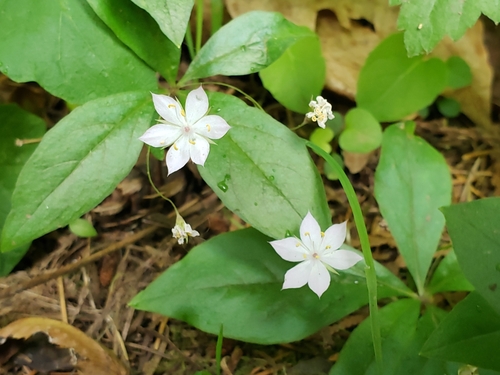
Lysimachia, Genus, latifolia, Species,
- Genus & species
western starflower
Overview
A small herbaceous woodland perennial reaching 4-8 inches (10-20 cm) tall from a slender, creeping rhizome. Stem unbranched, with a single whorl of 4-8 oval to lance-shaped leaves at the top, each 1-3 inches (2.5-7.5 cm) long, dark green, with pointed tips. Flowers held above the leaf whorl on slender pedicels 1-2 inches (2.5-5 cm) long, opening flat as 5-9 (typically 7) pointed white petals occasionally tinted pink, 0.5-0.75 inch (12-19 mm) across, resembling stars. One to four flowers per stem. Capsules small, 0.1 inch (2.5 mm), ripening in summer and releasing small black seeds. Plants spread slowly by short rhizomes, eventually forming loose colonies 1-2 feet (30-60 cm) wide after 5-8 years. Foliage yellows and disappears by late summer; the plant is summer-deciduous and absent above ground from August through March in most of its range. Once established, plants persist 10 or more years in stable woodland sites.
Native Range
Native to moist coniferous and mixed forests of western North America from southern Alaska south through British Columbia, Washington, Oregon, and into northern California. Found in shaded forest understory, often in moss-covered soils and rotting logs at 100 to 5,000 feet (30-1,520 m) elevation.Suggested Uses
Commonly planted in shaded native plant gardens, woodland understory plantings, and moist rock gardens at 6-10 inch (15-25 cm) spacing. Suitable for shaded containers of at least 1 gallon (3.8 L) with consistent moisture and high organic matter, but lifespan in containers is reduced compared to garden settings. Pairs in cultivation with other moist-shade natives such as Tiarella trifoliata and Vancouveria hexandra.How to Identify
Appearance
Size & Dimensions
Height4" - 8"
Width/Spread1' - 2'
Bloom Information
April through June depending on elevation; coastal forests bloom in April-May, mid-elevation woodlands in May-June. Individual flowers last 5-10 days; the full bloom period in a stand extends 3-4 weeks.
Detailed Descriptions
Flower Description
white, occasionally tinted pinkFoliage Description
dark greenGrowing Conditions
Sun Requirements
Tolerates up to 4 hours of direct sunlight daily
• Full Sun: 6+ hours of direct sunlight
• Partial Shade: 3-6 hours of direct sunlight
• Full Shade: Less than 3 hours of direct sunlight
Care & Maintenance
Care Guide
Plant rhizome divisions in autumn or set out container plants in early spring into shaded soil with high organic matter. Maintain even moisture during the spring growing season; once foliage yellows in mid-summer, no further irrigation is needed. Slugs feed on emerging shoots in mild wet springs but cause limited damage. Plants are slow to establish; expect 2-3 years before flowering reaches full extent. Mulch with 1-2 inches (2.5-5 cm) of leaf mold annually in autumn to maintain soil moisture and replicate native forest floor conditions.Pruning
No active pruning is needed. Yellowing leaves can be left in place to compost in situ as the plant enters summer dormancy. The dormant rhizome rests below ground from late summer through early spring.Container Growing
Suitable for container growing
Minimum container size: 1 gallons


