Lewisia, Genus, rediviva, Species,
- Genus & species
bitterroot
Western North America (Rocky Mountains, Great Basin, Pacific Northwest)
Overview
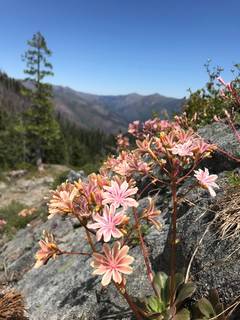
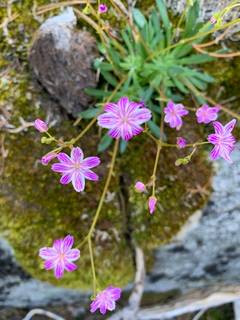
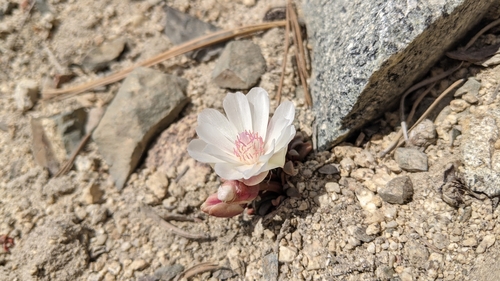
A small herbaceous perennial forming a basal rosette of succulent, cylindrical to linear leaves 0.5-2 inches (1.5-5 cm) long, blue-green to gray-green, emerging in late winter or early spring. Foliage withers and disappears entirely by the time flowers open in late spring; the plant is summer-deciduous. Flowers solitary on short stems 0.5-2 inches (1.5-5 cm) tall, opening flat to 1-3 inches (2.5-7.5 cm) across. Tepals 12-18, pink to rose, occasionally white, surrounding 30-50 yellow stamens. Each flower lasts 1-3 days; flowers open only in full sun and close at night and in cloudy weather. Capsules ripen 4-6 weeks after flowering, releasing 6-25 black seeds with white elaiosomes that attract ants for dispersal. The fleshy taproot extends 6-12 inches (15-30 cm) and can resume growth after years of dormancy if soil moisture returns; the species epithet rediviva translates as 'brought back to life.' Plants are absent above ground from midsummer through early winter.
Native Range
Native to western North America from southern British Columbia south through Washington, Oregon, California, and east to Montana, Wyoming, Colorado, and Arizona. Found on dry rocky slopes, gravelly grasslands, and sagebrush steppe at 1,000 to 9,000 feet (300-2,750 m) elevation. Designated as the state flower of Montana.Suggested Uses
Commonly used in dry rock gardens, sand beds, and crevice gardens at 4-6 inch (10-15 cm) spacing. Suitable for containers of at least 1 gallon (3.8 L) with at least 60% mineral grit and no summer irrigation. The dormant crown is invisible above ground from July to February; gardeners commonly mark its location with a stone or label. Cultural and historical significance to many Indigenous peoples of the Columbia Plateau, where roots were a traditional food source after preparation to remove bitterness.How to Identify
Appearance
Size & Dimensions
Height1" - 3"
Width/Spread3" - 5"
Colors
Bloom Information
April through July depending on elevation and latitude; lowland populations flower in April-May, mid-elevation in May-June, alpine sites into July. Individual flowers last 1-3 days but new flowers emerge over a 3-4 week period. Cool, moist springs extend the bloom period; in hot dry years flowering may compress into 10-14 days.
Detailed Descriptions
Flower Description
pink to rose, occasionally whiteFoliage Description
blue-green to gray-greenGrowing Conditions
Sun Requirements
Requires 6-12 hours of direct sunlight daily
• Full Sun: 6+ hours of direct sunlight
• Partial Shade: 3-6 hours of direct sunlight
• Full Shade: Less than 3 hours of direct sunlight
Care & Maintenance
Care Guide
Plant the dormant taproot in autumn or set out container plants in early spring. Provide sharply draining gritty soil with at least 60% mineral grit; heavy soils cause taproot rot within one season. Water deeply at planting; once leaves yellow in early summer, no further irrigation is needed. Summer irrigation in warm climates rots the dormant root. Slugs damage emerging foliage in mild climates with wet springs. Plants are long-lived in dry rocky sites, persisting 20 or more years; lifespan in irrigated garden beds rarely exceeds 2 years.Pruning
No active pruning is needed. Spent flowers and yellowing leaves can be removed when foliage withers in early summer; this has no effect on plant performance. Mulch can be cleared away in late winter to expose the crown to sun and warmth.Pruning Schedule
Prune: June–July
summer
Container Growing
Suitable for container growing
Minimum container size: 1 gallons