Overview
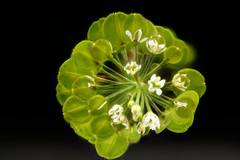
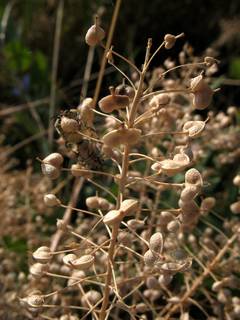
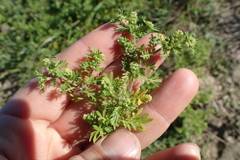
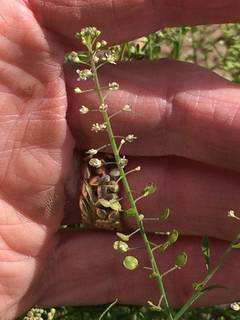
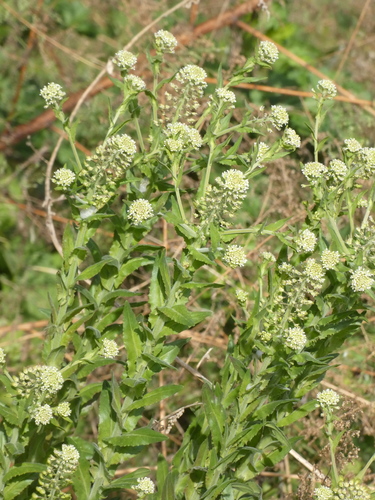
Lepidium campestre is an annual to biennial herb growing 8-24 inches (20-60 cm) tall on a single erect, gray-hairy stem that branches in the upper half. Basal leaves form a rosette and are spoon-shaped, 1-3 inches (2.5-8 cm) long; stem leaves are arrow-shaped and clasp the stem with pointed lobes. Four-petaled white flowers, about 0.1 inch (2.5 mm) across, crowd dense elongating racemes from late spring into summer. Each flower gives way to a flattened oval seedpod 0.2 inch (5-6 mm) long, winged and notched at the tip and held outward on short stalks, so the fruiting stalk takes on a bottlebrush form. Foliage and crushed pods carry a peppery, mustard-like scent. The whole plant dries to straw-brown by midsummer and persists as a rigid skeleton that scatters seed. It completes its life cycle in one to two years and is widely naturalized outside its native range, behaving as a weed of fields, roadsides, and waste ground.
Native Range
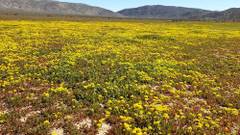
Native to Europe and western Asia. Widely naturalized across temperate North America, where it grows in cultivated fields, pastures, roadsides, railway lines, and disturbed waste ground in full sun.Suggested Uses
Grown occasionally in forage and oilseed trials and studied as a cover crop for its seed oil. Young leaves and pods are eaten as a peppery salad green or potherb. Its self-seeding habit and weed status make it unsuited to ornamental beds and cultivated fields where volunteers are unwanted.How to Identify
Appearance
Size & Dimensions
Height8" - 2'
Width/Spread4" - 10"
Colors
Flower Colors
Foliage Colors
Bloom Information
Detailed Descriptions
Foliage Description
gray-greenGrowing Conditions
Sun Requirements
Requires 6-12 hours of direct sunlight daily
• Full Sun: 6+ hours of direct sunlight
• Partial Shade: 3-6 hours of direct sunlight
• Full Shade: Less than 3 hours of direct sunlight
Water & Climate
Water Needs
Drought Tolerance
Drought tolerant when established
Care & Maintenance
Care Guide
A plant of open, disturbed ground, it grows in full sun on a wide range of soils, including poor, compacted, and calcareous types, and tolerates drought once established. It is grown from seed sown in fall or early spring, the seedlings overwintering as a rosette. Dense or shaded sites reduce flowering and seed set. The species self-sows heavily and builds a persistent seed bank, and is treated as an agricultural weed in many regions. Few pests trouble it, though it can host white rust and flea beetles shared with cultivated brassicas. Plants die after setting seed.Pruning
No pruning is required. Removing the flowering stalks before pods ripen limits self-seeding. Spent plants can be pulled or cut once they dry in midsummer.Toxicity
Non-toxicPlanting Guide
Planting Methods & Timing
Planting Method
direct sow