Lepidium, Genus, latifolium, Species,
- Genus & species
perennial pepperweed
Southern Europe and western Asia (Mediterranean basin through Turkey, Iran, Central Asia); naturalized across the western United States in saline wetlands, irrigation systems, and coastal estuaries
Overview
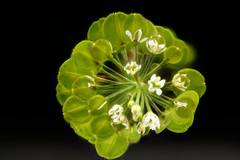
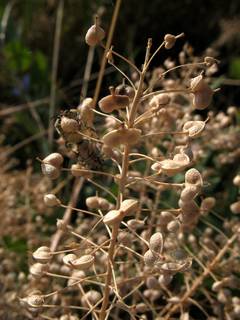
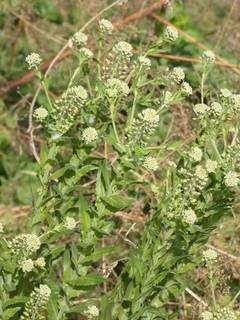
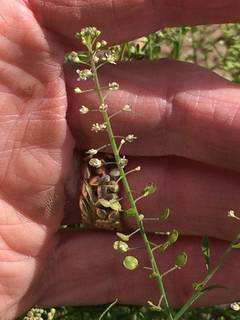
Lepidium latifolium is a deep-rooted rhizomatous perennial weed in the mustard family (Brassicaceae) reaching 24–60 inches (60–150 cm) tall and 24–48 inches (60–120 cm) wide, forming dense expanding colonies via adventitious root budding. Stems are erect, stiff, much-branched in the upper half, smooth, and somewhat woody at the base. Basal leaves are large 4–12 inches (10–30 cm) long, broadly lanceolate to oblong, with serrate margins and long petioles. Upper stem leaves run progressively smaller, sessile, with entire to finely serrate margins. Flowers are small white four-petaled 0.08–0.1 inch (2–3 mm) across, borne in dense rounded terminal and axillary panicles that give the plant a baby's-breath-like appearance when in full bloom. Fruit is a small round silicle 0.06–0.08 inch (1.5–2 mm) in diameter, slightly notched at the apex. A single plant produces 6,000–16,000 seeds over a growing season. The root system is the principal management challenge: a deep taproot to 6–10 feet (1.8–3 m) below grade with lateral roots producing adventitious buds at 6–12 inch (15–30 cm) intervals, enabling rapid colony expansion across 3–10 feet (0.9–3 m) per year under favorable moisture. Root fragments as small as 1 inch (2.5 cm) with an intact bud regenerate into new plants. The species tolerates saline, alkaline, and seasonally flooded soils that exclude most competing vegetation. Listed as a Class B noxious weed in Washington State. Infests wetlands, estuaries, irrigation ditches, and roadsides, displacing native marsh and riparian vegetation. Not known to be toxic to pets or humans (though crushed leaves and roots carry a peppery taste).
Native Range
Lepidium latifolium is native to southern Europe and western Asia, from the Mediterranean basin through Turkey and Iran to Central Asia, occurring in saline flats, riverbanks, and coastal marshes. The species was introduced to North America likely as a contaminant of sugar beet seed imported to the western United States in the early 20th century. The species is widely naturalized across the western United States from California through the Pacific Northwest to the intermountain West, primarily in saline wetlands, irrigation systems, and coastal estuaries where the salt tolerance gives it a competitive edge over native freshwater marsh vegetation.Suggested Uses
Used in noxious weed identification training for wetland managers, irrigation district staff, and rangeland ecologists across the western United States. Studied as a case study in saline-tolerant invasive species ecology, estuarine habitat conversion, and deep-rooted perennial weed management. The salt tolerance and deep root system make the species a standard teaching example of difficult-to-manage perennial weeds in Pacific Northwest and Great Basin weed science curricula. Included in Brassicaceae morphology exercises for silicle fruit type — the small round silicle separates this species from the more common elongated silique seen in Brassica, Sinapis, and most garden mustards.How to Identify
Appearance
Size & Dimensions
Height2' - 5'
Width/Spread2' - 4'
Bloom Information
Dense rounded terminal and axillary panicles of small white four-petaled flowers 0.08–0.1 inch (2–3 mm) across appear from June through August over a 3–4 week bloom window per flowering stem. The species is insect-pollinated by bees, syrphid flies, and other short-tongued pollinators. Seeds mature by August through September. In the Pacific Northwest, peak bloom runs July. Dried inflorescences remain upright on stalks through winter and into the following spring, providing a year-round identification cue even when plants are not in active growth.
Detailed Descriptions
Flower Description
White; small four-petaled 0.08-0.1 inch across in dense rounded terminal and axillary panicles giving a baby's-breath-like appearance in full bloomFoliage Description
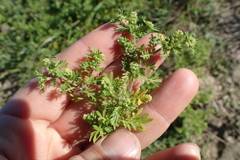
Gray-green to dark green; basal leaves large broadly lanceolate to oblong 4-12 inches long with serrate margins and long petioles; upper stem leaves smaller sessile entire to finely serrateGrowing Conditions
Sun Requirements
Requires 6-12 hours of direct sunlight daily
• Full Sun: 6+ hours of direct sunlight
• Partial Shade: 3-6 hours of direct sunlight
• Full Shade: Less than 3 hours of direct sunlight