Trees
Lagerstroemia, Genus, speciosa, Species,
- Genus & species
Queen's crape myrtle
Tropical Asia: India, Sri Lanka, Southeast Asia, southern China, and the Philippines
Overview
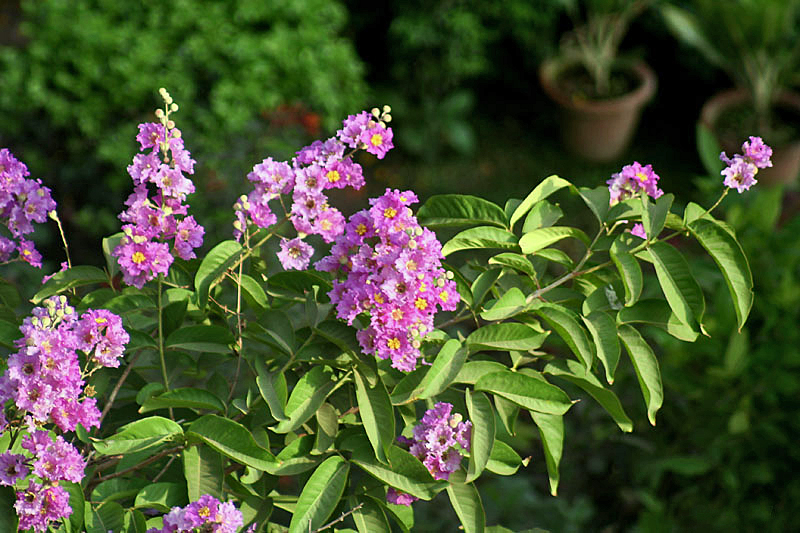
Lagerstroemia speciosa is a medium to large tropical tree in the loosestrife family (Lythraceae), growing 30–80 feet (9–24 m) tall with a rounded crown 20–40 feet (6–12 m) wide. The trunk is often short and the bark is smooth, pale grey to light brown, and flakes in patches to reveal paler inner bark. Leaves are opposite to subopposite, elliptic to oblong, 5–12 inches (12–30 cm) long, leathery, and glossy green; they turn orange to red before the tree sheds them in the dry season. Flowers are held in upright terminal panicles 8–16 inches (20–40 cm) long, each flower 2–3 inches (5–7.5 cm) across with six crinkled petals in pink, lilac, or purple that fade toward white. Fruits are rounded, woody capsules about 1 inch (2.5 cm) in diameter that split into 5–6 valves and release winged seeds. Growth is moderately fast at 2–3 feet (0.6–0.9 m) per year in warm, humid conditions. The species is frost-tender, suffers leaf and shoot damage below 40°F (4°C), and dies back or is killed at temperatures near freezing. Branches are brittle and can break in strong wind. The tree is cultivated in Southeast Asia and its leaves are used in traditional herbal preparations.
Native Range
Lagerstroemia speciosa is native to tropical Asia, including India, Sri Lanka, Myanmar, Thailand, Vietnam, southern China, Malaysia, Indonesia, and the Philippines. It grows in lowland and hill forests, along streams, and on forest margins at elevations up to about 2,600 feet (800 m).Suggested Uses
Planted as a shade and street tree in tropical cities, spaced 25–40 feet (7.5–12 m) apart. Also grown in large gardens and parks as a flowering specimen. The timber is used locally in construction and furniture.How to Identify
Appearance
Size & Dimensions
Height30' - 80'
Width/Spread20' - 40'
Bloom Information
Flowers open from late spring through summer, roughly May–August in the northern tropics, for 8–10 weeks. Each flower lasts 1–2 days, and a panicle opens flowers in sequence from the base. Flowers shift from deep pink to lilac and white as they age.
Detailed Descriptions
Flower Description
Pink, lilac, or purpleFoliage Description
Glossy green, orange-red before leaf dropGrowing Conditions
Sun Requirements
Requires 8-10 hours of direct sunlight daily
• Full Sun: 6+ hours of direct sunlight
• Partial Shade: 3-6 hours of direct sunlight
• Full Shade: Less than 3 hours of direct sunlight
Care & Maintenance
Care Guide
Grows in full sun, 8–10 hours daily, on deep, moist, well-drained loam with a pH of 5.5–7.5. Water needs are medium to high, about 1–2 inches (2.5–5 cm) weekly, with deep soakings during dry periods. Hardiness is USDA zones 10–12, and leaves drop in cool or dry seasons. Container plants need pots of 15 gallons (57 L) or larger and protection from temperatures below 40°F (4°C). Fertilizer is applied twice annually at the start and end of the rainy season. Scale insects and powdery mildew can affect foliage in humid conditions with poor airflow.Pruning
Pruning is done after the leaf-fall period, when the structure is visible, and removes crossing, dead, and weak branches. Cuts are made outside the branch collar, and branches larger than 3 inches (7.5 cm) are removed in stages. Trees are trained with a single trunk for the first 5–6 feet (1.5–1.8 m).Pruning Schedule
Prune: November–January
winter
Toxicity: Not assessed
UnknownRelated Lagerstroemia species
 Zuni crape myrtleLagerstroemia indica 'Zuni'
 Tuscarora crape myrtleLagerstroemia indica 'Tuscarora'
 Catawba crape myrtleLagerstroemia indica 'Catawba'
 Bellini grape crape myrtleLagerstroemia indica 'Bellini Grape'
 Natchez crape myrtleLagerstroemia indica 'Natchez'
 Pocomoke crape myrtleLagerstroemia indica 'Pocomoke'