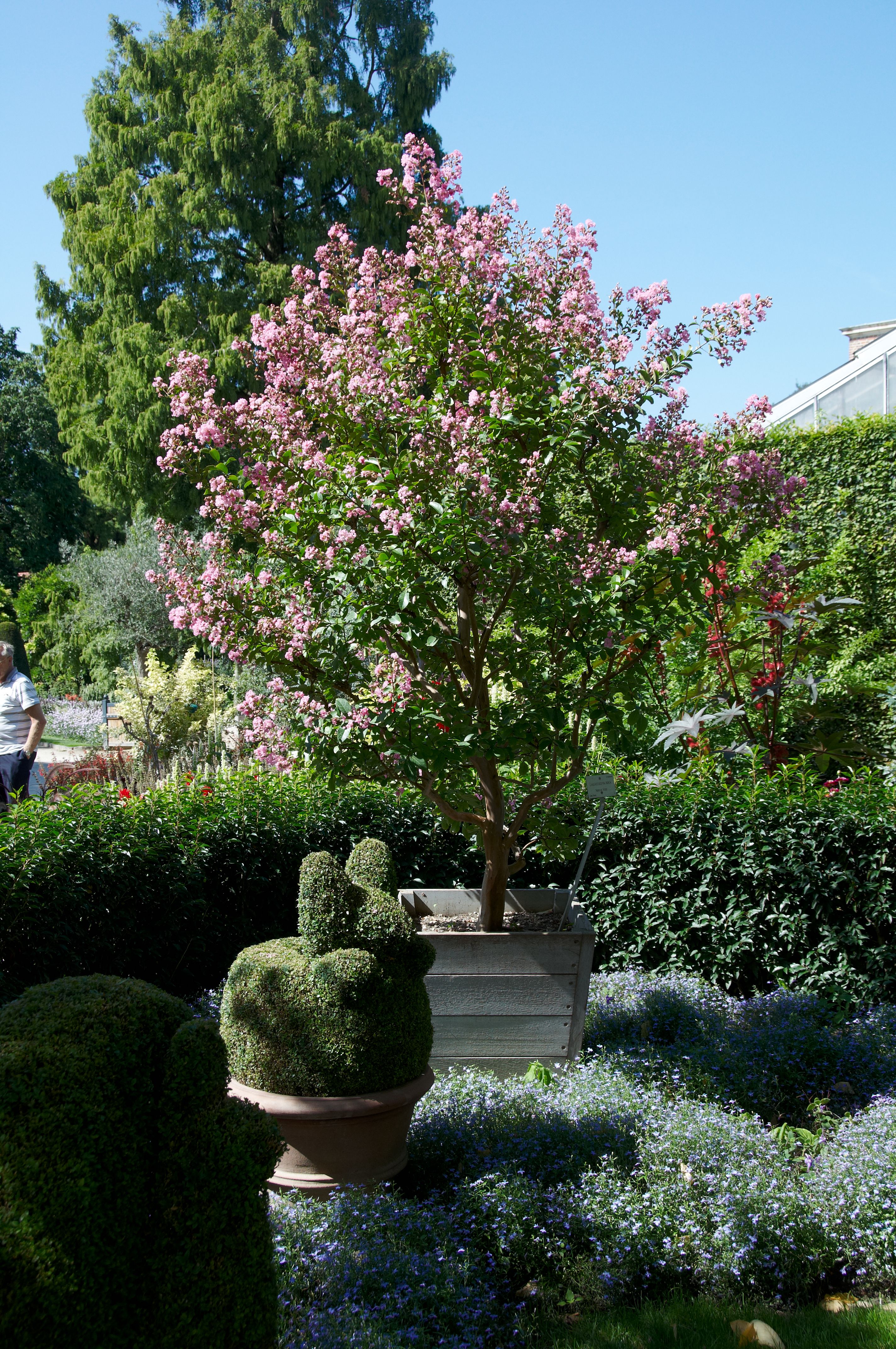
Lagerstroemia, Genus, indica, Species,
- Genus & species
Crape myrtle
Central and southern China and the Korean peninsula
Overview
Lagerstroemia indica is a deciduous multi-stemmed tree or large shrub reaching 15-25 feet (4.5-7.5 m) tall and 6-15 feet (1.8-4.5 m) wide. Trunks shed thin plates of outer bark each summer to leave a mottled surface in cinnamon, grey, and cream that stays exposed through winter. Leaves are 1-3 inches (2.5-7.5 cm) long, elliptic to obovate, glossy dark green, set in opposite to subopposite pairs, and turn yellow, orange, and red before dropping. Terminal panicles 6-8 inches (15-20 cm) long open from early July to September, each flower carrying six clawed petals with a crinkled margin in white, pink, red, lavender, or purple. Flowering occurs on shoots of the current season, so stems cut in late winter still flower the same summer. Leaf emergence is late, often mid-May in USDA zone 7, leaving the plant bare for four to six weeks after neighbouring species have leafed out. Crape myrtle bark scale, aphids and the sooty mould that follows them, and powdery mildew are widespread across the southeastern United States. Severe topping removes the branching structure and produces clusters of weak watersprouts. Hardy in USDA zones 7-9.
Native Range
Lagerstroemia indica is native to central and southern China and to the Korean peninsula; the epithet indica traces the introduction route through India rather than the native range. It occupies open hillsides and disturbed woodland margins below 4,000 feet (1,200 m). Seedlings from garden plantings establish along roadsides and fence lines across the southeastern United States.Suggested Uses
Planted as a street and courtyard tree in zones 7-9, as a specimen with the trunk cleared to 5-6 feet (1.5-1.8 m), and in rows at 12-15 foot (3.6-4.5 m) spacing along drives. Dwarf selections under 4 feet (1.2 m) are grown in 20 gallon (76 L) containers and in mixed borders. Fallen petals and seed capsules gather on paving below the canopy from August onward.How to Identify
Appearance
Size & Dimensions
Height15' - 25'
Width/Spread6' - 15'
Bloom Information
Panicles open from early July in USDA zone 7 and from mid-June in zone 9, running 90-120 days to late September. Each panicle carries flowers for two to three weeks, with successive panicles opening down the shoot. Cutting spent panicles at the first pair of leaves below the head brings a second flush six to eight weeks later. Plants in fewer than six hours of direct sun carry sparse panicles or none.
Detailed Descriptions
Flower Description
white, pink, red, lavender, or purpleFoliage Description
glossy dark green, turning yellow, orange, and red before leaf dropGrowing Conditions
Sun Requirements
Requires 6-10 hours of direct sunlight daily
• Full Sun: 6+ hours of direct sunlight
• Partial Shade: 3-6 hours of direct sunlight
• Full Shade: Less than 3 hours of direct sunlight
Care & Maintenance
Care Guide
Six or more hours of direct sun daily carries full flowering; shaded plants set few panicles and hold mildew on the leaves. Soil is well-drained loam, sand, or clay at pH 5.0-7.0, and the species tolerates compacted urban ground and reflected heat from paving. Water use is about 1 inch (2.5 cm) per week during the first two seasons, after which established plants hold through six to eight weeks without rain. A single spring application of balanced fertiliser at 1 pound per 100 square feet (0.5 kg per 9 sq m) covers the season; heavier nitrogen delays flowering and produces soft growth. Crape myrtle bark scale coats stems in white felted masses and is followed by black sooty mould on bark and leaves. Winter temperatures below 0 F (-18 C) kill stems back to ground level, though roots in zone 6 usually resprout.Pruning
Cutting is done from February to March before bud break, since panicles form on current-season shoots. Work is limited to crossing branches, basal suckers, and stems under 0.5 inch (13 mm) in diameter, which holds the mottled trunk structure in view. Cutting main trunks back to stubs produces 10-20 watersprouts per cut, each carrying heavier panicles on weaker wood, and the branching form is lost for several seasons. Seed capsules left over winter drop with the spring cut.Pruning Schedule
Prune: February–March
winterearly spring
Container Growing
Suitable for container growing
Minimum container size: 20 gallons
Toxicity
Non-toxicRelated Lagerstroemia species
 Zuni crape myrtleLagerstroemia indica 'Zuni'
 Tuscarora crape myrtleLagerstroemia indica 'Tuscarora'
 Catawba crape myrtleLagerstroemia indica 'Catawba'
 Bellini grape crape myrtleLagerstroemia indica 'Bellini Grape'
 Natchez crape myrtleLagerstroemia indica 'Natchez'
 Pocomoke crape myrtleLagerstroemia indica 'Pocomoke'