Krameria, Genus, bicolor, Species,
- Genus & species
white rhatany
Southwestern United States and northern Mexico
Overview
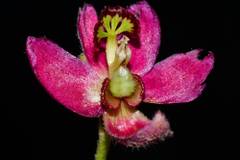
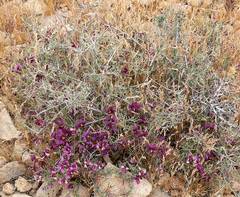
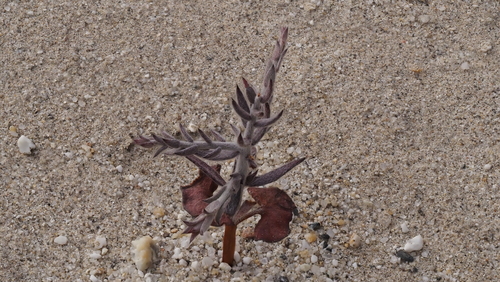
Krameria bicolor is a low, intricately branched desert shrub in the family Krameriaceae, growing 1-3 feet (30-90 cm) tall and spreading 2-4 feet (60-120 cm) wide. The rigid grey stems branch repeatedly and end in short thorn-tipped twigs, forming a dense rounded mound. Leaves are small, simple, narrow, and covered in silvery hairs, often dropping during drought. Flowers are about 0.5 inch (1.3 cm) wide, with five spreading reddish-purple sepals that look like petals and smaller specialized petals that secrete oil rather than nectar. This oil is gathered by specialist Centris bees, which pollinate the flowers. K. bicolor is a root hemiparasite, tapping the roots of neighboring desert shrubs such as creosote bush for water and minerals while still producing its own chlorophyll. This parasitic habit makes it slow and difficult to transplant or raise from seed in cultivation. The fruit is a small spiny bur that clings to fur and clothing. The species grows in the Sonoran, Mojave, and Chihuahuan deserts, where it withstands extreme heat and prolonged drought. Flowering peaks in spring and may repeat after summer rains. Hardy in USDA zones 8 to 11.
Native Range
Native to the Sonoran, Mojave, and Chihuahuan deserts of the southwestern United States, including Arizona, southern California, Nevada, New Mexico, and Texas, and into northern Mexico, on dry rocky slopes, gravelly flats, and desert washes.Suggested Uses
Used in desert and native-plant landscapes, rock gardens, and revegetation of arid sites, where its drought tolerance and wildlife value suit low-water designs. Spaced 3-4 feet (90-120 cm) apart, it serves as a low informal groundcover among larger desert shrubs. Rarely grown in containers because of its parasitic roots.How to Identify
Appearance
Size & Dimensions
Height1' - 3'
Width/Spread2' - 4'
Colors
Foliage Colors
Bloom Information
Flowers mainly in spring, from March to May, with scattered bloom following summer rains in wetter years. Individual flowers are small but borne along the branch tips over several weeks. The reddish-purple color and the barbed seed burs that follow mark the flowering and fruiting periods.
Detailed Descriptions
Foliage Description
silvery grey-greenGrowing Conditions
Sun Requirements
Requires 8-12 hours of direct sunlight daily
• Full Sun: 6+ hours of direct sunlight
• Partial Shade: 3-6 hours of direct sunlight
• Full Shade: Less than 3 hours of direct sunlight
Care & Maintenance
Care Guide
Grow in full sun in fast-draining sandy, gravelly, or rocky soil; it fails in heavy or wet ground. Water is rarely needed once established, as the species is adapted to desert drought and draws extra moisture parasitically from host shrub roots. Because it depends on host plants, container culture and transplanting are difficult and seedlings establish slowly. It tolerates intense heat and reflected sun. Young plants are injured by hard frost in the coldest part of its range. No significant pests or diseases are reported.Pruning
Little pruning is needed, as the plant holds a naturally dense, mounded form. Dead or frost-damaged twigs can be removed in spring. Heavy pruning is poorly tolerated and slow to regrow.Pruning Schedule
Prune: March
early spring