Kerria, Genus, japonica, Species, 'Picta', Cultivar,
- Genus & species
- Cultivar
variegated Japanese kerria
China and Japan (mountain forests and woodland margins)
Overview
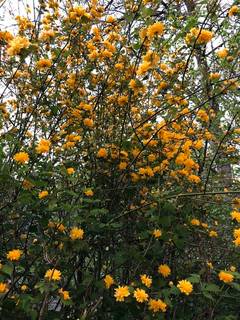
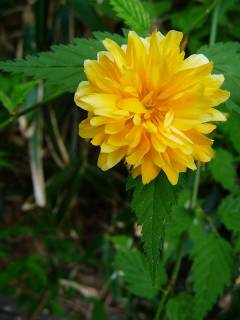
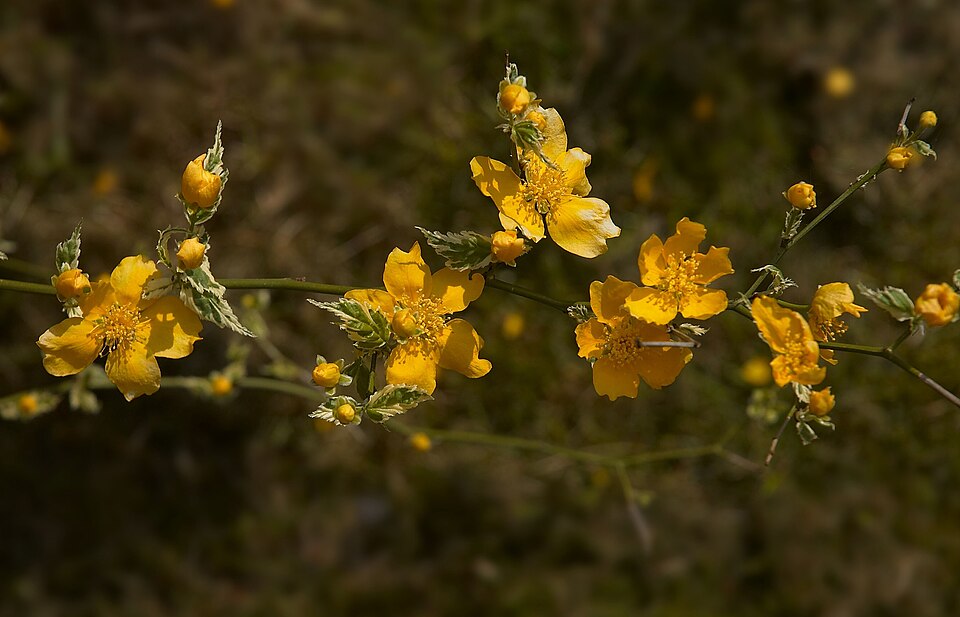
Kerria japonica 'Picta' is a compact, deciduous, suckering shrub reaching 3-4 feet (0.9-1.2 m) tall with a spread of 3-5 feet (0.9-1.5 m) — smaller than the 5-7 foot (1.5-2.1 m) species type. The cultivar carries variegated foliage: sharply double-toothed ovate leaves 1.5-3 inches (4-8 cm) long with gray-green centers and creamy-white to ivory margins 2-3 mm wide. Single, five-petaled, golden-yellow flowers 1-1.5 inches (2.5-4 cm) across appear in April-May on arching green stems; flowers are smaller and less numerous than on green-leaved cultivars such as 'Golden Guinea' (2-2.5 inch / 5-6 cm blooms). The slender, bright green stems remain green through winter and provide cold-season color after the variegated leaves drop. Growth rate is slow to moderate, slower than green-leaved cultivars. Suckers spread the clump outward 4-6 inches (10-15 cm) per year, less aggressively than the species type. All-green shoot reversions can appear and, if left in place, outcompete the variegated growth. Hardy to USDA zone 4. Non-toxic.
Native Range
The species Kerria japonica is native to China and Japan, growing in mountain forests and along woodland margins. 'Picta' is a variegated selection of the species and is propagated vegetatively to maintain the cream leaf margins.Suggested Uses
Used in shade borders, woodland gardens, mixed plantings, and 5-gallon (19 L) or larger containers at 3-4 foot (0.9-1.2 m) spacing. The cream-margined foliage carries visual contrast in shade from leaf-out through autumn. Flowers are a secondary feature, smaller and fewer than on green-leaved cultivars. Reverted green shoots require active management. Not suited to full sun in hot climates, to deep shade, or to sites where reverted shoots cannot be cut out promptly.How to Identify
Appearance
Size & Dimensions
Height3' - 4'
Width/Spread3' - 5'
Bloom Information
Single, five-petaled, golden-yellow flowers 1-1.5 inches (2.5-4 cm) across, from April through May. Flowers are smaller and less numerous than on green-leaved cultivars such as 'Golden Guinea'. The variegated foliage is the main season-long visual feature. Bloom duration is 3-4 weeks.
Detailed Descriptions
Flower Description
Golden-yellow, single, 5-petaled, 1-1.5 inches (2.5-4 cm) acrossFoliage Description
Gray-green center with creamy-white to ivory margins 2-3 mm wide; sharply double-toothed ovate, 1.5-3 inches (4-8 cm) long; variegatedGrowing Conditions
Sun Requirements
Requires 3-5 hours of direct sunlight daily
• Full Sun: 6+ hours of direct sunlight
• Partial Shade: 3-6 hours of direct sunlight
• Full Shade: Less than 3 hours of direct sunlight
Care & Maintenance
Care Guide
Grows in partial shade in average, well-drained soil at pH 5.5-7.5. Hardy to USDA zone 4. Variegation develops most strongly in partial shade; full sun can scorch the pale leaf margins in hot summers, and deep shade reduces contrast between center and margin. Growth is slower than green-leaved cultivars. All-green shoot reversions are more vigorous than variegated growth and will dominate the plant if not cut out at their point of origin.Pruning
Cut flowering stems back to new shoots immediately after spring bloom. Cut out any all-green reverted shoots at the base as soon as they appear. Thin the oldest stems to the ground each year to keep the clump open. Suckering spread at the edges can be confined by removing outer runners each spring.Pruning Schedule
Prune: May–June
late spring
Container Growing
Suitable for container growing
Minimum container size: 5 gallons