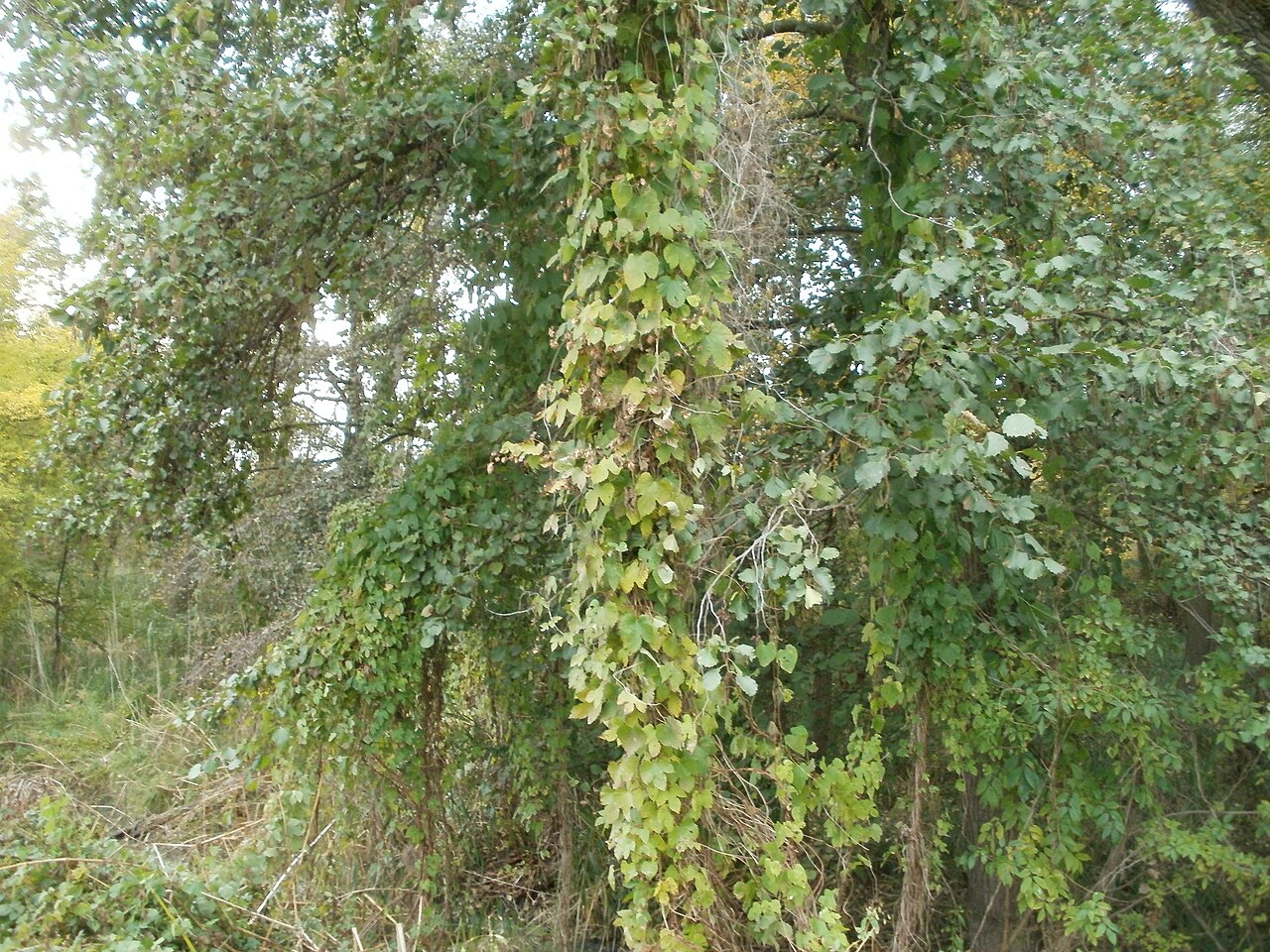
Humulus, Genus, lupulus, Species,
- Genus & species
Common hop
Temperate Europe, western Asia, and North America
Overview
Humulus lupulus is a herbaceous perennial climber that dies back to a woody crown each winter and regrows 15-25 feet (4.5-7.5 m) in a single season. The annual stems, called bines, twine clockwise around supports using stiff downward-pointing hooked hairs rather than tendrils, extending 6-12 inches (15-30 cm) per day at peak growth in early summer. Leaves are opposite, 3-6 inches (7.5-15 cm) long, sandpapery above, and palmately three- to five-lobed with coarsely toothed margins, though upper leaves are often unlobed. The species is dioecious: male plants carry loose panicles of small greenish flowers, while female plants carry cone-like strobiles 0.8-2 inches (2-5 cm) long built from overlapping papery bracts. Yellow lupulin glands at the base of each bract hold the resins and essential oils used in brewing. Crowns are hardy to -30 F (-34 C) and persist 20 years or more, but the annual growth places real load on structures, since a mature bine with wet foliage can weigh 20 pounds (9 kg). Downy mildew, powdery mildew, and two-spotted spider mite build up in humid summers, and the hooked stem hairs abrade bare skin during training and harvest.
Native Range
Humulus lupulus occurs naturally across temperate Europe, western Asia, and North America, with separate varieties recognised in each region. European H. lupulus var. lupulus ranges from Britain and Scandinavia east to the Caucasus, while var. lupuloides, var. neomexicanus, and var. pubescens occur in Canada, the Rocky Mountains, and the central and eastern United States. Wild populations grow in damp hedgerows, riverbanks, and woodland margins on deep alluvial soils.Suggested Uses
Grown over pergolas, arbours, and wire trellises where a seasonal screen 15-25 feet (4.5-7.5 m) tall is wanted, with crowns set 3-5 feet (0.9-1.5 m) apart. Golden-leaved selections are trained along fences and porch posts in ornamental plantings. Cones are harvested for brewing and dried to 8-10 percent moisture before storage.How to Identify
Appearance
Size & Dimensions
Height15' - 25'
Width/Spread3' - 6'
Bloom Information
Flowering runs from July to August in the northern hemisphere, initiated by shortening days after the summer solstice. Male panicles are 2-5 inches (5-13 cm) long and release wind-borne pollen, while female cones form on short lateral side-arms and enlarge over 4-6 weeks. Cones reach harvest condition from late August into September, when the bracts turn papery and lupulin deepens to amber-yellow. Flowering and cone development together span roughly 8-10 weeks.
Detailed Descriptions
Foliage Description
Mid to dark greenGrowing Conditions
Sun Requirements
Requires 6-10 hours of direct sunlight daily
• Full Sun: 6+ hours of direct sunlight
• Partial Shade: 3-6 hours of direct sunlight
• Full Shade: Less than 3 hours of direct sunlight
Care & Maintenance
Care Guide
Grows in full sun with 6-8 hours of direct light and needs a support system 12-20 feet (3.5-6 m) tall, most often coir twine strung from an overhead wire. Soil should be deep, free-draining loam at pH 6.0-7.5, as waterlogging around the crown causes rot within a single wet season. Water demand is steady through the growing season and peaks near 1.5 inches (4 cm) per week during cone formation. A nitrogen-led feed split between spring emergence and early flowering sustains bine extension, with potassium raised during cone fill. Rhizomes travel 3-6 feet (0.9-1.8 m) from the crown and throw up shoots at a distance, so a root barrier or annual crown trimming keeps the planting within bounds. Bines are cut to ground level after autumn frost, and crowns in zones 3-4 are mulched 3-4 inches (7.5-10 cm) deep.Pruning
Bines are cut to within 2 inches (5 cm) of ground level after the first hard autumn frost, with the debris removed to reduce overwintering mildew inoculum. In spring the crown pushes 20-30 shoots, of which 3-6 vigorous ones are trained onto each string and the rest rubbed out at the base. Leaves and side-arms below 3-4 feet (0.9-1.2 m) are stripped in early summer to increase air movement and limit soil-splash infection.Pruning Schedule
Prune: March & November
fallearly spring


