Overview
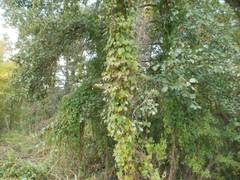
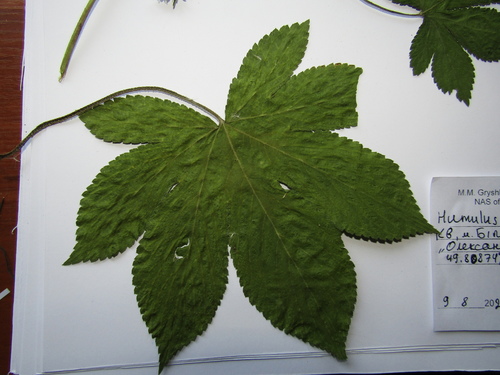
Humulus scandens is a fast-growing annual vine in the hemp family, climbing 6-35 ft (2-10 m) in one season by twining around supports. The square, green stems are covered in stiff, downward-hooked prickles that catch on clothing and can scratch or irritate skin on contact. Opposite leaves are rough-textured and palmately cut into 5-7 toothed lobes, 2-6 in (5-15 cm) across, on long bristly stalks. The species is dioecious: male plants carry loose, branched panicles of small greenish flowers, while female plants bear short, cone-like spikes of papery bracts. Flowering occurs from July to September, and the wind-borne pollen is a known hay-fever allergen. Each plant dies with frost, but a single vine sets abundant seed that germinates the next spring. Introduced from East Asia, it has naturalized along streambanks, floodplains, and disturbed ground in eastern North America, where it forms dense mats that smother low vegetation. It is regulated as a noxious or invasive weed in several U.S. states. Unlike the perennial common hop Humulus lupulus, it is annual and its female cones are not used in brewing.
Native Range
Humulus scandens is native to temperate East Asia, including China, Japan, Korea, and the Russian Far East. In North America it is an introduced species, naturalized across the eastern and midwestern United States and parts of Canada along rivers, floodplains, and disturbed sites.Suggested Uses
Humulus scandens is not planted ornamentally in North America, where it is managed as an invasive weed rather than grown. In its native East Asian range it has a history of traditional medicinal use. Removal and containment are the typical aims wherever it appears in the region.How to Identify
Appearance
Size & Dimensions
Height6' - 35'
Width/Spread3' - 6'
Bloom Information
Flowering runs from July to September, with male and female flowers on separate plants. Wind carries the pollen, which is a common late-summer allergen. Female spikes mature to dry, seed-bearing bracts by early autumn before the plant dies with frost.
Detailed Descriptions
Foliage Description
greenGrowing Conditions
Sun Requirements
Requires 4-10 hours of direct sunlight daily
• Full Sun: 6+ hours of direct sunlight
• Partial Shade: 3-6 hours of direct sunlight
• Full Shade: Less than 3 hours of direct sunlight
Water & Climate
Water Needs