Heterotheca, Genus, villosa, Species,
- Genus & species
hairy gold aster
Overview
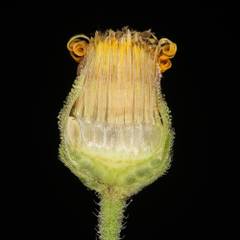
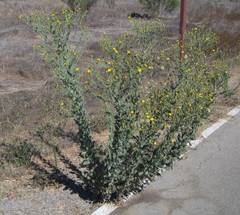
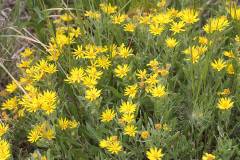
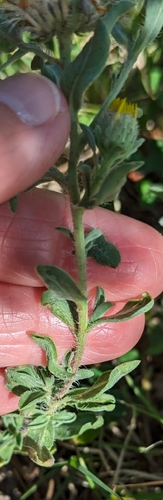
A clump-forming herbaceous perennial reaching 8-24 inches (20-60 cm) tall and 12-18 inches (30-45 cm) wide, growing from a fibrous-rooted basal crown that may produce short rhizomes in loose substrate. Stems erect to ascending, densely covered in white-woolly hairs (the source of the specific epithet villosa), branched above to carry numerous flower heads. Leaves alternate, lanceolate to oblong, 0.4-1.5 inches (1-4 cm) long, gray-green and densely hairy. Yellow daisy-like flower heads 0.6-1 inch (1.5-2.5 cm) across with 10-25 ray florets surround a yellow disc. Plants flower June through October across the species' range, with peak flowering August. Stems collapse with first hard frost; basal rosette persists through winter in zones 5-9. Plants self-seed readily on disturbed bare-soil sites, producing 20-50 volunteer seedlings per parent annually. Stands persist 4-7 years on well-drained sites and are commonly replenished by self-sown seedlings.
Native Range
Native across western and central North America from southern British Columbia and Saskatchewan south through the western United States to northern Mexico, east to Minnesota and Texas. Found on dry rocky slopes, sagebrush steppe, prairies, gravel road cuts, and disturbed soils from 1,000 to 12,000 feet (300-3,650 m).Suggested Uses
Planted in dryland meadow plantings, prairie restorations, and slope plantings within zones 4-9 at 12-18 inch (30-45 cm) spacing. Pairs with bunchgrasses, Eriogonum, and Sphaeralcea in xeric perennial groupings. Grows in containers of at least 2 gallons (8 L) with coarse drainage and full sun.How to Identify
Appearance
Size & Dimensions
Height8" - 2'
Width/Spread1' - 1'6"
Colors
Bloom Information
June through October across the species' wide range, with peak flowering in August. Lower-elevation populations bloom from late May; alpine populations may bloom into early September. Each head lasts 7-10 days; total bloom per stand 12-16 weeks. Deadheading the first flush extends bloom by 3-5 weeks but reduces self-seeding.
Detailed Descriptions
Foliage Description
Gray-green woollyGrowing Conditions
Sun Requirements
Requires 6-12 hours of direct sunlight daily
• Full Sun: 6+ hours of direct sunlight
• Partial Shade: 3-6 hours of direct sunlight
• Full Shade: Less than 3 hours of direct sunlight
Care & Maintenance
Care Guide
Plants establish quickly from autumn-sown seed, requiring no stratification; spring-sown seed germinates within 2-3 weeks at 60-70°F (15-21°C). Seedlings benefit from supplemental water during their first summer; established plants tolerate 8-10 weeks of drought once rooted to 18 inches (45 cm). Crown rot develops on irrigated heavy clay. Powdery mildew is rare on dry-grown plants but may appear in humid summers. Plants are deer-grazed in spring before flowering. Stands persist 4-7 years on well-drained sites; replacement is by self-sown seedlings or fresh seed.Pruning
Spent flower stems are cut at the base after seed dispersal in October to prevent volunteer seedlings; left unsheared, the persistent dry stems stand through winter and are used by cavity-nesting native bees as overwintering sites. Tattered winter foliage is removed in March. Hard cutback into the woody crown delays flowering by 4-6 weeks.Pruning Schedule
Prune: March & October
fallearly spring
Container Growing
Suitable for container growing
Minimum container size: 2 gallons